Category Archives: Humor and Observations

Thermal Physics Humor

REPLYING TO AN INVITATION TO A SCIENTIST’S BALL

  • Pierre and Marie Curie were radiating enthusiasm.
  • Einstein thought it would be relatively easy to attend.
  • Volta was electrified and Archimedes, buoyant at the thought.
  • Ampere was worried he wasn’t up to current research.
  • Ohm resisted the idea at first.
  • Boyle said he was under too much pressure.
  • Edison thought it would be an illuminating experience.
  • Watt reckoned it would be a good way to let off steam.
  • Stephenson thought the whole idea was loco.
  • Wilbur Wright accepted, provided he and Orville could get a flight.
  • Dr Jekyll declined — he hadn’t been feeling himself lately.
  • Morse’s reply: “I’ll be there on the dot. Can’t stop now must dash.”
  • Heisenberg was uncertain if he could make it.
  • Hertz said in the future he planned to attend with greater frequency.
  • Henry begged off due to a low capacity for alcohol.
  • Audobon said he’d have to wing it.
  • Hawking said he’d try to string enough time together to make a space in his schedule.
  • Darwin said he’d have to see what evolved.
  • Schrodinger had to take his cat to the vet, or did he?
  • Mendel said he’d put some things together and see what came out.
  • Descartes said he’d think about it.
  • Newton was moved to attend.
  • Pavlov was drooling at the thought.
  • Gauss was asked to attend because of his magnetic personality.
  • JP Clark & Siegfried the Deerslayer Wanna-Be

School of Physics, University of Sydney

Leave a comment

Filed under Humor and Observations

Pictures of Hipsters Taking Pictures of Food, etc.

This is a post about the humor in hipsters, the modern day beatniks of retro-poetry coffee shop havens and their habits for taking pictures of their food.  There are some other random hipster items thrown in.  Enjoy!  (if you are a real hipster yourself, I am sure you know funnier jokes that I have not heard of or understand, so please bear with me.)

Leave a comment

Filed under Animals, Humor and Observations, Uncategorized

Where Did the Mile, the Acre and other Measurements Come From?

Why Are There 5,280 Feet in a Mile? Making Sense of Measurements

IMAGE CREDIT:
HOUSTONFREEWAYS.COM

Why are there 5,280 feet in a mile, and why are nautical miles different from the statute miles we use on land? Why do we buy milk and gasoline by the gallon? Where does the abbreviation “lb” come from? Let’s take a look at the origins of a few units of measure we use every day.

THE MILE

The basic concept of the mile originated in Roman times. The Romans used a unit of distance called the mille passum, which literally translated into “a thousand paces.” Since each pace was considered to be five Roman feet—which were a bit shorter than our modern feet—the mile ended up being 5,000 Roman feet, or roughly 4,850 of our modern feet.

If the mile originated with 5,000 Roman feet, how did we end up with a mile that is 5,280 feet? Blame the furlong. The furlong wasn’t always just an arcane unit of measure that horseracing fans gabbed about; it once had significance as the length of the furrow a team of oxen could plow in a day. In 1592, Parliament set about determining the length of the mile and decided that each one should be made up of eight furlongs. Since a furlong was 660 feet, we ended up with a 5,280-foot mile.

THE NAUTICAL MILE

So if the statute mile is the result of Roman influences and plowing oxen, where did the nautical mile get its start? Strap on your high school geometry helmet for this one.

Each nautical mile originally referred to one minute of arc along a meridian around the Earth. Think of a meridian around the Earth as being made up of 360 degrees, and each of those degrees consists of 60 minutes of arc. Each of these minutes of arc is then 1/21,600th of the distance around the earth. Thus, a nautical mile is 6,076 feet.

THE ACRE

Like the mile, the acre owes its existence to the concept of the furlong. Remember that a furlong was considered to be the length of a furrow a team of oxen could plow in one day without resting. An acre—which gets its name from an Old English word meaning “open field”—was originally the amount of land that a single farmer with a single ox could plow in one day. Over time, the old Saxon inhabitants of England established that this area was equivalent to a long, thin strip of land one furlong in length and one chain—an old unit of length equivalent to 66 feet—wide. That’s how we ended up with an acre that’s equivalent to 43,560 square feet.

THE FOOT

As the name implies, scholars think that the foot was actually based on the length of the human foot. The Romans had a unit of measure called a pes that was made up of twelve smaller units called unciae. The Roman pes was a smidge shorter than our foot—it came in at around 11.6 inches—and similar Old English units based on the length of people’s feet were also a bit shorter than our 12-inch foot. The 12-inch foot didn’t become a common unit of measurement until the reign of Henry I of England during the early 12th century, which has led some scholars to believe it was standardized to correspond to the 12-inch foot of the king.

THE GALLON

The gallon we use for our liquids comes from the Roman word galeta, which meant “a pailful.” There have been a number of very different gallon units over the years, but the gallon we use in the United States is probably based on what was once known as the “wine gallon” or Queen Anne’s gallon, which was named for the reigning monarch when it was standardized in 1707. The wine gallon corresponded to a vessel that was designed to hold exactly eight troy pounds of wine.

THE POUND

Like several other units, the pound has Roman roots. It’s descended from a roman unit called the libra. That explains the “lb” abbreviation for the pound, and the word “pound” itself comes from the Latin pondo, for “weight.” The avoirdupois pounds we use today have been around since the early 14th century, when English merchants invented the measurement in order to sell goods by weight rather than volume. They based their new unit of measure as being equivalent to 7000 grains, an existing unit, and then divided each 7000-grain avoirdupois pound into 16 ounces.

THE HORSEPOWER

Early 18th-century steam engine entrepreneurs needed a way to express how powerful their machines were, and the industrious James Watt hit on a funny idea for comparing engines to horses. Watt studied horses and found that the average harnessed equine worker could lift 550 pounds at a clip of roughly one foot per second, which equated to 33,000 foot-pounds of work per minute.

Not all scholars believe that Watt arrived at his measurement so scientifically, though. One common story claims that Watt actually did his early tests with ponies, not horses. He found that ponies could do 22,000 foot-pounds of work per minute and figured that horses were half again stronger than ponies, so he got the ballpark figure of 33,000 foot-pounds of work per minute.

– See more at: http://www.mentalfloss.com/article/25108/why-are-there-5280-feet-mile-making-sense-measurements#sthash.4V0XOGVj.dpuf

Read the full text here: http://mentalfloss.com/article/25108/why-are-there-5280-feet-mile-making-sense-measurements#ixzz2MGA5biGV
–brought to you by mental_floss!

Leave a comment

Filed under Humor and Observations

Inventors killed by their own inventions

Inventors killed by their own inventions

Reposted from Wikipedia

Direct casualties

Automotive

Aviation

Industrial

Maritime

Hunley Submarine

  • Horace Lawson Hunley (died 1863, age 40), Confederate marine engineer and inventor of the first combat submarineCSS Hunley, died during a trial of his vessel. During a routine exercise of the submarine, which had already sunk twice previously, Hunley took command. After failing to resurface, Hunley and the seven other crew members drowned.[11]
  • Thomas Andrews (shipbuilder) (7 February 1873 – 15 April 1912) was an Irish businessman and shipbuilder; managing director and head of the drafting department for the shipbuilding company Harland and Wolff in Belfast, Ireland. Andrews was the naval architect in charge of the plans for the ocean liner RMS Titanic. He was travelling on board the Titanic during its maiden voyage when it hit an iceberg on 14 April 1912 and was one of the 1,507 people who perished in the disaster. [12]

Medical

  • Thomas Midgley, Jr. (1889–1944) was an American engineer and chemist who contracted polio at age 51, leaving him severely disabled. He devised an elaborate system of strings and pulleys to help others lift him from bed. This system was the eventual cause of his death when he was accidentally entangled in the ropes of this device and died of strangulation at the age of 55. However, he is more famous—and infamous—for developing not only the tetraethyl lead (TEL) additive to gasoline, but also chlorofluorocarbons (CFCs).[13][14][15]
  • Alexander Bogdanov (22 August 1873 – 7 April 1928) was a Russian physician, philosopher, science fiction writer and revolutionary of Belarusian ethnicity who started blood transfusion experiments, apparently hoping to achieve eternal youth or at least partial rejuvenation. He died after he took the blood of a student suffering from malaria and tuberculosis, possibly due to blood type incompatibility. [16] [17]

Physics

Publicity and Entertainment

Karel Soucek in his barrel

  • Karel Soucek (19 April 1947 – 20 January 1985) was a Canadian professional stuntman who developed a shock-absorbent barrel nine feet long and five feet in diameter. He died when his barrel, with him inside, was prematurely dropped down a waterfall from the top of the Houston Astrodome.[21]

Punishment

Railways

Rocketry

  • Max Valier (1895–1930) invented liquid-fuelled rocket engines as a member of the 1920s German rocketeering society Verein für Raumschiffahrt. On 17 May 1930, an alcohol-fuelled engine exploded on his test bench in Berlin, killing him instantly.[27]

Popular myths and related stories

Perillos being pushed into his brazen bull

  • Jim Fixx (1932–1984) was the author of the 1977 best-selling book, The Complete Book of Running. He is credited with helping start America’s fitness revolution, popularizing the sport of running and demonstrating the health benefits of regular jogging. On 20 July 1984, Fixx died at the age of 52 of a fulminant heart attack, after his daily run, on Vermont Route 15 in Hardwick.[28][29]
  • Joseph-Ignace Guillotin (1738–1814) While he did not invent the guillotine, his name became an eponym for it.[30] Rumors circulated that he died by the machine, but historical references show that he died of natural causes.[31]
  • Perillos of Athens (circa 550 BCE), according to legend, was the first to be roasted in the brazen bull he made for Phalaris of Sicily for executing criminals.[32][33]
  • James Heselden (1948–2010), having recently purchased the Segway production company, died in a single-vehicle Segway accident. (Dean Kamen invented the Segway.)[34]
  • Wan Hu, a sixteenth-century Chinese official, is said to have attempted to launch himself into outer space in a chair to which 47 rockets were attached. The rockets exploded, and it is said that neither he nor the chair were ever seen again.

1 Comment

Filed under Humor and Observations

Zombie Apocalypse

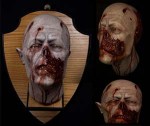
More Zombie Apocalypse themed pictures for your enjoyment.  WARNING:  Some are GRAPHIC.

Leave a comment

Filed under Humor and Observations

New Punctuation Marks We Need

8 New Punctuation Marks We Desperately Need

by Mike Trapp on February 20, 2013

  • Reposted from CollegeHumor
8 New Punctuation Marks - Image 10


8 New Punctuation Marks We Desperately Need - Image 10


8 New Punctuation Marks - Image 10


8 New and Necessary Punctuation Marks - Image 1


8 New and Necessary Punctuation Marks - Image 1


8 New and Necessary Punctuation Marks - Image 1


8 New and Necessary Punctuation Marks - Image 1


8 New and Necessary Punctuation Marks - Image 1

2 Comments

Filed under Humor and Observations, Writing

British Crown Jewel Will Not Be Returned

Koh-i-Noor Diamond, British Crown Jewel, Will Not Be Returned, Cameron Tells India (PHOTOS)

Reuters  |  Posted: 02/20/2013 11:30 pm EST  |  Updated: 02/21/2013 10:40 am EST

 
Kohinoor Diamond
AMRITSAR, India, Feb 21 (Reuters) – British Prime Minister David Cameron says a giant diamond his country forced India to hand over in the colonial era that was set in a royal crown will not be returned.

Speaking on the third and final day of a visit to India aimed at drumming up trade and investment, Cameron ruled out handing back the 105-carat Koh-i-Noor diamond, now on display in the Tower of London. The diamond had been set in the crown of the current Queen Elizabeth’s late mother.

One of the world’s largest diamonds, some Indians – including independence leader Mahatma Gandhi’s grandson – have demanded its return to atone for Britain’s colonial past.

“I don’t think that’s the right approach,” Cameron told reporters on Wednesday after becoming the first serving British prime minister to voice regret about one of the bloodiest episodes in colonial India, a massacre of unarmed civilians in the city of Amritsar in 1919.

Executive Director of Jewels de Paragon (JDP) Pavana Kishore shows the 'Koh-I-Noor' diamond on display with other famous diamonds at an exhibition intitled '100 World Famous Diamonds' in Bangalore 19 May 2002. The Koh-I-Noor diamond, which once belonged to Mughal Emperor Shah Jehan, weighs 105.60 Carats and is part of the British crown jewels, stored in the tower of London. (STR/AFP/Getty Images)

Executive Director of Jewels de Paragon (JDP) Pavana Kishore shows the ‘Koh-I-Noor’ diamond on display with other famous diamonds at an exhibition intitled ‘100 World Famous Diamonds’ in Bangalore 19 May 2002. The Koh-I-Noor diamond, which once belonged to Mughal Emperor Shah Jehan, weighs 105.60 Carats and is part of the British crown jewels, stored in the tower of London. (STR/AFP/Getty Images

“It is the same question with the Elgin Marbles,” he said, referring to the classical Greek marble sculptures that Athens has long demanded be given back.

“The right answer is for the British Museum and other cultural institutions to do exactly what they do, which is to link up with other institutions around the world to make sure that the things which we have and look after so well are properly shared with people around the world.

“I certainly don’t believe in ‘returnism’, as it were. I don’t think that’s sensible.”

Britain’s then colonial governor-general of India arranged for the huge diamond to be presented to Queen Victoria in 1850.

If Kate Middleton, the wife of Prince William, who is second in line to the throne, eventually becomes queen consort she will don the crown holding the diamond on official occasions.

When Elizabeth II made a state visit to India to mark the 50th anniversary of India’s independence from Britain in 1997, many Indians demanded the return of the diamond.

Cameron is keen to tap into India’s economic rise, but says he is anxious to focus on the present and future rather than “reach back” into the past. (Reporting By Andrew Osborn; Editing by Michael Roddy)

Leave a comment

Filed under Humor and Observations, Uncategorized

Things You Would Like to Have – But Don’t Need

Just an odd assortment here for your enjoyment:

3 Comments

Filed under Humor and Observations

Zombie Update – Brain cells can outlive the body

Brain cells can outlive the body

By Tia Ghose

Published February 26, 2013

LiveScience

  • neurons

    Mouse neurons implanted into a rat brain can live twice as long as the mice from which they were taken, new research suggests. (iDesign, Shutterstock)

Brain cells can live at least twice as long as the organisms in which they reside, according to new research.

The study, published Monday, Feb. 25, in the journal Proceedings of the National Academy of Sciences, found that mouse neurons, or brain cells, implanted into rats can survive with the rats into old age, twice as long as the life span of the original mice. The findings are good news for life extension enthusiasts.

‘We are slowly but continuously prolonging the life of humans.’

– Dr. Lorenzo Magrassi, a neurosurgeon at the University of Pavia in Italy 

“We are slowly but continuously prolonging the life of humans,” said study co-author Dr. Lorenzo Magrassi, a neurosurgeon at the University of Pavia in Italy.

So if the human life span could be stretched to 160 years, “then you are not going to lose your neurons, because your neurons do not have a fixed lifetime.”

Long-lived cells
While most of the cells in the human body are being constantly replaced, humans are born with almost all the neurons they will ever have. [10 Odd Facts About the Brain]

Magrassi and his colleagues wanted to know whether neurons could outlive the organisms in which they live (barring degenerative diseases like Alzheimer’s).

To do so, the researchers took neurons from mice and implanted them into the brains of about 60 rat fetuses.

The team then let the rats live their entire lives, euthanizing them when they were moribund and unlikely to survive for more than two days, and then inspected their brains. The life span of the mice was only about 18 months, while the rats typically lived twice as long.

The rats were found to be completely normal (though not any smarter), without any signs of neurological problems at the end of their lives.

And the neurons that had been transplanted from mice were still alive when the rats died. That means it’s possible the cells could have survived even longer if they were transplanted into a longer-lived species.

Life extension
The findings suggest that our brain cells won’t fail before our bodies do.

“Think what a terrible thing it could be if you survive your own brain,” Magrassi told LiveScience.

While the findings were done in rats, not humans, they could also have implications for neuronal transplants that could be used for degenerative diseases like Alzheimer’s disease or Parkinson’s disease, Magrassi said.

But just because brain cells may be able to live indefinitely doesn’t mean humans could live forever.

Aging is dependent on more than the life span of all the individual parts in the body, and scientists still don’t understand exactly what causes people to age, Magrassi said.

Read more: http://www.foxnews.com/science/2013/02/26/brain-cells-can-outlive-body/?intcmp=features#ixzz2M9COJANr

1 Comment

Filed under Humor and Observations

More Vehicles You Would Like to Own

If you could only choose one of the following vehicles, which one would it be?

For earlier posts type “vehicles” into the search on my home page.  Enjoy!

1 Comment

Filed under Humor and Observations