2,000-year-old electronics tech still can’t be matched

2,000-year-old electronics tech still can’t be matched

Published July 28, 2013

news.com.au
  • metalplatingcover.jpg

    How artisans centuries ago achieved sophisticated gilding, such as on the St. Ambrogio golden altar from 825 AD, is now coming to light. (American Chemical Society)

Over 2,000 years ago, gold and silversmiths developed a variety of techniques, including using mercury like a glue, to apply thin films of metals to statues and other objects.

They developed thin-film coating technology that is unrivalled by today’s process for producing DVDs, solar cells, electronic devices and other products and used it on jewels, statues, amulets and more common objects.

Workmen managed to make precious metal coatings as thin and adherent as possible, which not only saved expensive metals but improved resistance to wear caused from continued use and circulation.

Scientists today say understanding these sophisticated metal-plating techniques could help preserve priceless artistic and other treasures from the past.

British scientists say Elizabethan craftsmen developed advanced manufacturing technology that could match that of the 21st century. 

In Italy, Gabriel Maria Ingo, senior scientist at the Institute for the Study of Nanostructured Materials of the National Research Council, says that while scientists have made good progress in understanding the chemistry, big gaps in knowledge remain about how gilders in the Dark Ages and other periods applied such lustrous, impressively uniform films of gold or silver to intricate objects.

Ingo’s team set out to apply the newest analytical techniques to uncover the ancients’ artistic secrets. Using surface analytical methods, such as selected area X-ray photoelectron spectroscopy and scanning electron microscopy combined with energy-dispersive spectroscopy on Dark Ages objects such as St. Ambrogios altar from 825 AD, they say that their findings confirm “the high level of competence reached by the artists and craftsmen of these ancient periods who produced objects of an artistic quality that could not be bettered in ancient times and has not yet been reached in modern ones.”

In Britain, scientists studying a 400-year-old hoard of jewelry have found that Elizabethan craftsmen developed advanced manufacturing technology that could match that of the 21st century.

The team from Birmingham City University have analyzed the craftwork behind the famous Cheapside Hoard, the world’s largest collection of Elizabethan and Jacobean jewelry, discovered in a London cellar in 1912.

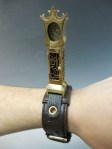
Among the historic find, which is being showcased by the Museum of London, is a Ferlite watch that dates back to the 1600s and is so technologically advanced it has been described as the “iPod of its day.”

Ann-Marie Carey, a research fellow at Birmingham City University, and her colleagues have used modern technology to discover how these beautiful items were created — and have been stunned at the advanced technologies used.

“Our forensic analysis has revealed the amazing technologies which craftsman of this period were using, and we fear some of these 400-year-old processes may now be lost to us,” she said.

“It is has been a fascinating investigation. We think of our own time as one of impressive technological advances, but we must look at the Elizabethan and Jacobean age as being just as advanced in some ways.”

Selected items of the Hoard are set to be revealed to the world at a major exhibition at the Museum of London from this October to next April.

The university experts combined their own background in craft with CAD-technology to investigate the Hoard in an attempt to discover what kind of manufacturing methods could have been used to create the jewelry, which includes brooches, pendants and delicate gemstone rings.

“When we received photographs of the Hoard we were fascinated with the level of detail in the jewelry,” Carey said.

“We wanted to know how such pieces were made and to understand the story behind them. Until now there had been little research into the craftsmanship involved so we feel we are making a unique contribution to the forthcoming exhibition.”

Carey, with the help of senior technologist Keith Adcock, have used 21st century digital technologies to recreate pieces from the Hoard, including a ‘Pearl Dropper’ an egg-shaped item that originally featured ribbons of pearls and was possible worn on as a hairpiece.

The university team has created a bronze version of this item which will be used as part of the exhibition, as well as ‘augmented reality’ displays of the jewelry items.

“This will create tangible items which will be ideal for visually-impaired visitors who will be handle items directly,” Carey added.


Read more: http://www.foxnews.com/tech/2013/07/28/2000-year-old-metal-coating-technology-cant-be-matched-even-today-for-use-in/?intcmp=obinsite#ixzz2ahE9Bh2g

1 Comment

Filed under Humor and Observations

Random Humor

More random humor to get you through Hump Day.  Enjoy!

1 Comment

Filed under Humor and Observations

Laser experiments may lead to faster computer chips

So long silicon: Laser experiments may lead to faster computer chips

Smarter America

Published July 29, 2013

FoxNews.com
  • faster electron transfer.jpg

    An optical laser pulse (the red streak) shatters the ordered electronic structure (blue) in an insulating sample of magnetite, switching the material to electrically conducting (red) in one trillionth of a second. (Greg Stewart/SLAC)

So long silicon! A small change in the design of a computer chip could soon lead to the creation of smaller, faster and far more powerful computers.

Researchers at the U.S. Department of Energy’s SLAC National Accelerator Laboratory reported that magnetite, a naturally magnetic mineral — the most magnetic of all the minerals on Earth — was found to have the fastest-possible electrical switching time. Electrical switching, or moving a “switch” from a non-conductive state to a conductive one, is the process that makes our current electrical circuits.

The team of scientists used SLAC’s Linac Coherent Light Source (LCLS) X-ray laser and found that that it takes only 1 trillionth of a second – thousands of time faster than current transistors – to flip the on-off electrical switch in samples of magnetite.

The findings were published July 28 in Nature Materials, a scientific journal.

According to Roopali Kukreja, the lead author of the study and a materials science researcher at Stanford University, this project unveiled the so-called “speed limit” for electrical switching in this material.

Researchers say that when the laser pulse struck the sample, the electronic structure was rearranged into non-conducting “islands” surrounded by electrically conducting regions, hundreds of quadrillionths of a second later.

First, scientists hit the samples with a visible-light laser, fragmenting the material’s electronic structure at an atomic scale, which rearranged it and formed the islands. Following closely by an ultrabright, ultrashort X-ray pulse in adjusted intervals, they measured how long it took for the material to switch from a non-conducting to an electrically conducting state.

The magnetite samples were then cooled to -190 degrees Celsius, locking the molecular changes in place, according to Kukreja. Follow-up studies were conducted on a hybrid material that exhibits ultrafast switching properties at room temperature, making it more commercially viable than magnetite. Future experiments will attempt to identify other compounds and techniques to induce electrical switching, possibly creating superior transistors.

With a global search underway for new materials that go beyond modern semiconductor transistors, the LCLS x-ray could help hone in on processes that occur at the atomic size, according to Hermann Dürr, the principal investigator of the LCLS experiment and senior staff scientist for the Stanford Institute for Materials and Energy Sciences.

This experiment shows that although magnetite’s magnetic properties have been known for thousands of years, there is a lot that can still be learned, notes Dürr.

Read more: http://www.foxnews.com/tech/2013/07/29/experiment-with-laser-shows-possible-replacement-for-silicon-chips/?intcmp=trending#ixzz2abUfnPnx

2 Comments

Filed under Humor and Observations

What People Thought Vehicles Would Like Today

These are all pictures and illustrations of what people predicted future vehicles would be like today.  To me, beyond the coolness of the pictures, is the analysis of where they went wrong. You see, predicting the future does not usually work, because we are too fixed on how things are right now.  For instance, the clothing in the pictures is the most wrong.  Men don’t dress nice in suits all the time like they used to.  It is a way for futurists such as myself to look at the mistakes in predicting made before and try to avoid them.  Society, dress and appearance is likely to change just as much as technology.  The pictures also do not reflect a change in urban buildings or lifestyle as technology changes.  With that added thought, enjoy!

6 Comments

Filed under Humor and Observations

World of Warcraft loses 2 million players since start of year

Game over? ‘World of Warcraft’ loses 600,000 subscribers

Published July 29, 2013

SkyNews
  • world of warcraft.jpg

    The game is still the market leader but its crown appears to be slipping. (SkyNews)

World of Warcraft, the massively popular online video game, has seen 600,000 subscribers leave in three months.

It means a total of nearly two million players have turned off since the start of the year.

Announcing its second quarter results, Activision Blizzard, which makes the dungeons and dragons-style game, said it now had 7.7 million subscribers. At the start of 2013, shortly after expansion pack Mists of Pandria was launched, it boasted 9.6 million. At its peak in October 2010, 12 million people were signed up.

Subscribers pay a fee or buy a prepaid card to enter the Internet-connected game world and take on quests alongside other players.

Despite the steady decline, World of Warcraft is still easily the world’s most popular MMOG (massively multiplayer online game). A new in-game store, announced earlier this month and allowing players to buy extra items, may also help shore up subscriber numbers.

Some paid-for online titles have struggled over the last year and dropped their subscription fees, casting doubt over the future of the business model.

Star Wars: The Old Republic was the most notable casualty. Reported to have cost several hundred million dollars to produce, it became free to play in November 2012.

World of Warcraft‘s subscriber figures come as Activison Blizzard revealed it is to go independent and buy $8 billion shares from its owner, French media giant Vivendi.

Activision CEO Bobby Kotick and its co-chairman, Brian Kelly, have personally stumped up $100 million for the deal.

Read more: http://www.foxnews.com/tech/2013/07/29/game-over-world-warcraft-loses-600000-subscribers/?intcmp=obnetwork#ixzz2aTFHwjbl

Leave a comment

Filed under Humor and Observations

12 drinks on Starbucks’ ‘secret menu’

12 drinks on Starbucks’ ‘secret menu’

Published February 07, 2012

The Daily Meal
  • A Starbucks drink is seen on a table in New York's Times Square

    A Starbucks drink is seen on a table in New York’s Times Square April 21, 2010. REUTERS/Shannon Stapleton (UNITED STATES – Tags: FOOD BUSINESS) (Reuters)

Last August I had a revelatory experience. A good friend, and Starbucks non-enthusiast, had accompanied me to the local ‘bucks to pick up a quick drink. I ordered my usual, reciting the string of descriptors with the greatest of ease. And she… well, she ordered something I had never heard of — an Iced Grande Dirty Chai.

I was floored. How had she gotten this intel? And how had it evaded me for so long? And man was this drink good.

Naturally, I began to wonder about the other off-the-menu items I had been missing out on, and how many there were. As it turned out, quite a lot. Green Eyes and Double-Dirty Chais, Zebra Mochas and Crunch Berry Frappuccinos — an entire “secret menu,” revealed.

When I shared what I’d learned shortly thereafter, it sparked a flood of comments from fans and haters, former employees and current Starbucks baristas alike. Most were in fervent agreement about one particular point: These drinks and their oh-so-clever names are not universal, so if you’re planning on ordering one, you better know how to tell your barista to prepare it. (That, and to be prepared to pay a little extra for these special drinks.)

It’s a fair point. After all, as many eagerly noted, these drinks are largely the invention of customers and employees, and are not part of a widely recognized “secret menu” à la In-N-Out. And, as is common with this sort of word-of-mouth game, things tend to get lost in translation.

One man’s zebra mocha is another’s black and white mocha, is another’s penguin mocha.
Still, an impressive number of commenters chimed in with their own creations, making for an intriguing list of additions.

Cinnamon Roll Frappuccino

According commenter and Starbucks barista, Jonathan, this combination of Vanilla Bean Crème Frappuccino and cinnamon dolce syrup tastes just like the popular breakfast pastry.

Cookies & Cream Frappuccino

Per a commenter, this is a White Chocolate Mocha Frappuccino blended with java chips and a dash of peppermint syrup.

Marble Mocha Macchiato

Says an anonymous barista commenter, “The Marble Mocha Macchiato is a twist on the signature Caramel Macchiato. White mocha on the bottom with no whip, shot on the top and mocha drizzle.”

The Dirty Hippy

Prefer your Dirty Chai Tea Latte with soy milk instead of regular milk? According to one barista commenter, thats called a Dirty Hippy.

The Grasshopper Frappuccino

Recommended by another The Daily Meal commenter who identified themselves as a barista, the Grasshopper Frappuccino consists of a Mocha Frappuccino blended with java chips and peppermint syrup. “It tastes like mint chip ice cream and is a personal favorite.”

Apple Juice Orange Blossom

This combination of Tazo Orange Blossom Tea steeped in steamed apple juice (with no water), is what one anonymous The Daily Meal commenter calls “a perfect tasty tea alternative for us non-coffee drinkers.”

Click here for more secret Starbucks’ drinks

Read more: http://www.foxnews.com/leisure/2012/02/07/12-more-drinks-on-starbucks-secret-menu/?intcmp=trending#ixzz2aSz1kumi

Leave a comment

Filed under Humor and Observations

Cute Dogs For Your Monday Blues – Dog Shaming

This is an occasional variant on cute dogs for Monday.  Today, dog shaming photos.  I have posted these about eight times and these are the last of them I have right now.  So, if you have some dog shaming photos, please feel free to send them to my email.  Enjoy!

11 Comments

Filed under Animals, Humor and Observations

The Old Company Store – Now Called Student Loans

Tennessee Ernie Ford sang the tune, “You load sixteen tons and what do you get?  Another day older and deeper in debt.  St. Peter don’t you call me cause I can’t go…I owe my soul to the company store.”  You see companies would work you and pay you in scrip.  The scrip was good at the company store where you could buy food and other items.  The gimmick is that the more you work the more you got into debt.  You were basically a slave.

company store

Here is the new song for our generation – “You take fifteen credits and what do you get?  More indoctrination and deeper in debt.  St. Peter don’t you call me cause I can’t go…I owe my soul to the federal government.”

So how did this happen?  There are three ways colleges get money – tuition, grants, and taxes.  Public colleges want to grow just as much as private colleges.  To grow means more faculty, nicer campuses, better artwork, libraries and laboratories.  At some point, tax support competes against other things.  Parents and kids can only spend so much because they only have so much.  Enter the student loan era.  Have the parents and children go into debt so they can pay money they don’t have.  It increased college growth and tuition costs by 400 times the rate of growth of the economy.

Then the federal government looked out and realized that banks were making a profit.  The federal government likes to get taxes and not have to compete with the private sector.  So in 2010 – in Obamacare – yes the healthcare law, Congress and the President took away the ability of banks to issue student loans and had the federal government do so instead.  They said it would be more affordable for the students.  In reality, the Consumer Financial Protection Bureau estimates that there 38 million student loan borrowers in the United States and the total debt load has passed $1.1 trillion. The Project on Student Debt has estimated that 66 percent of graduating college seniors in 2011 had some student loan debt, with an average balance of $26,600.

Bottom line – the federal government took over a program that was making $51 billion in profits each year.  That money now goes into the federal coffers.  But of course that brought down costs for students right?  Of course not, the government bureaucracy always wants more.  $51 billion that the greedy banks got is not enough, we need to raise interest rates on loans from 3.4% the greedy banks charged to 8.75% through the federal government.  That would have raised “profit” to the federal government to over $131 billion per year so they could spend it on more programs.  It would have also helped out colleges who get a piece of that back.

tuition

Students protested, so the benevolent Congress brought the rate down to 4% for a few years, with a guarantee it won’t rise over 8.5%.  Wow.  Now you are supposed to thank them for saving you.  There was once a huge differential between earnings of a college graduate and a non-graduate.  Now those differentials only exist in key fields.  Many technical schools are churning out high paid workers with little or no debt.  So the government understands that right?

Of course not.  The federal government is using its control over students to force them into fields and areas of its choice.  Want to pay off your medical student loans?  Ok, be a general practice physician in one of the underserved areas.  Or join Americorps or whatever new program we devise.  It’s the old company store.  Get your education from government, owe your life to government, do what government tells you.  Don’t want to play?  Then the IRS suddenly gets interested in your delinquent debt and all the tax consequences.

Any time the government tells you they are taking over a chunk of the private sector to protect you from greedy businessman, know what is going to happen next.

2 Comments

Filed under Humor and Observations, Uncategorized

Could the Government Get a Search Warrant for Your Thoughts?

Why remain silent if they can just read your mind?

JUL 26 2013
From StumbleUpon From The Atlantic
C06086.jpgU.S. National Library of Medicine

We don’t have a mind reading machine. But what if we one day did? The technique of functional MRI (fMRI), which measures changes in localized brain activity over time, can now be used to infer information regarding who we are thinking aboutwhat we have seen, and the memories we are recalling. As the technology for inferring thought from brain activity continues to improve, the legal questions regarding its potential application in criminal and civil trials are gaining greater attention.

Last year, a Maryland man on trial for murdering his roommate tried to introduce results from an fMRI-based lie detection test to bolster his claim that the death was a suicide. The court ruled (PDF) the test results inadmissible, noting that the “fMRI lie detection method of testing is not yet accepted in the scientific community.” In a decision last year to exclude fMRI lie detection test results submitted by a defendant in a different case, the Sixth Circuit was even more skeptical, writing (PDF) that “there are concerns with not only whether fMRI lie detection of ‘real lies’ has been tested but whether it can be tested.”

So far, concerns regarding reliability have kept thought-inferring brain measurements out of U.S. (but not foreign) courtrooms. But is technology theonly barrier? Or, if more mature, reliable brain scanning methods for detecting truthfulness and reading thoughts are developed in the future, could they be employed not only by defendants hoping to demonstrate innocence but also by prosecutors attempting to establish guilt? Could prosecutors armed with a search warrant compel an unwilling suspect to submit to brain scans aimed at exploring his or her innermost thoughts?

The answer surely ought to be no. But getting to that answer isn’t as straightforward as it might seem. The central constitutional question relates to the Fifth Amendment, which states that “no person … shall be compelled in any criminal case to be a witness against himself.” In interpreting the Fifth Amendment, courts have distinguished between testimonial evidence, which is protected from compelled self-incriminating disclosure, and physical evidence, which is not. A suspected bank robber cannot refuse to participate in a lineup or provide fingerprints. But he or she can decline to answer a detective who asks, “Did you rob the bank last week?”

So is the information in a brain scan physical or testimonial? In some respects, it’s a mix of both. As Dov Fox wrote in a 2009 law review article, “Brain imaging is difficult to classify because it promises distinctly testimonial-like information about the content of a person’s mind that is packaged in demonstrably physical-like form, either as blood flows in the case of fMRI, or as brainwaves in the case of EEG.” Fox goes on to conclude that the compelled use of brain imaging techniques would “deprive individuals of control over their thoughts” and be a violation of the Fifth Amendment.

But there is an alternative view as well, under which the Fifth Amendment protects only testimonial communication, leaving the unexpressed thoughts in a suspect’s head potentially open to government discovery, technology permitting. In a recent law review article titled “A Modest Defense of Mind Reading,” Kiel Brennan-Marquez writes that “at least some mind-reading devices almost certainly would not” elicit “communicative acts” by the suspect, “making their use permissible under the Fifth Amendment.” Brennan-Marquez acknowledges that compelled mind-reading would raise privacy concerns, but argues that those should be addressed by the Fourth Amendment, which prohibits unreasonable searches and seizures.

That doesn’t seem right. It would make little sense to provide constitutional protection to a suspected bank robber’s refusal to answer a detective’s question if the thoughts preceding the refusal–e.g., “since I’m guilty, I’d better not answer this question”–are left unprotected. Stated another way, the right to remain silent would be meaningless if not accompanied by protection for the thinking required to exercise it.

And if that weren’t enough, concluding that compelled brain scans don’t violate the Fifth Amendment would raise another problem as well: In a future that might include mature mind-reading technology, it would leave the Fourth Amendment as the last barrier protecting our thoughts from unwanted discovery. That, in turn, would raise the possibility that the government could get a search warrant for our thoughts. It’s a chilling prospect, and one that we should hope never comes to pass.

2 Comments

Filed under Humor and Observations

China’s new doughnut-shaped hotel

A look at China’s new doughnut-shaped hotel

Published July 23, 2013

FoxNews.com
  • donuthotel.jpg
    Starwood Hotels & Resorts

It’s the newest concept building to mark China’s skyline.

Following the opening of the world’s largest building where the sun shines 24/7, and the construction of a five-star ‘groundscaping’ hotel built into a former mine, this hotel has a unique shape all its own: a glowing doughnut.

Officially known as Sheraton Huzhou Hot Spring Resort, this 27-story building is located in the city of Huzhou, near Shanghai.  Designed by Beijing-born architect Ma Yansong, the hotel appears to give off the appearance of a horseshoe, though the bottom ends are connected by two underground floors.

According to Sheraton’s website, the resort offers 321 spacious guest rooms, including 44 suites and 39 villas, all with private balconies.  The opulent lobby has 20,000 Swarovski and European natural crystal lamps on its ceiling which are arranged in a wave-like formation, and the  floor is paved with Afghanistan White Jade and Tiger’s Eye Stone from Brazil.

The hotel also features the company’s “Shine Spa for Sheraton,” with facilities including a steam room, saunas, and a hydrotherapy pool in each locker room.  For dining options, guests can choose from three restaurants and two lounges for an array of domestic and international food.

Currently in a soft-open phase, the hotel will officially open to the public in October 2013, and rooms are expected to cost about $400 per night.

Read more: http://www.foxnews.com/travel/2013/07/23/donut-shaped-hotel/?intcmp=features#ixzz2aJnx2Q7m

Leave a comment

Filed under Humor and Observations