Tag Archives: futurism

Binge-Watching. A New Trend to Watch Whole Seasons in One Sitting

Do you binge watch?  I have, a lot.  My wife and I rarely find anything on TV worth watching and there are only so many movies worth seeing.  So my son hooked us up with Roku.  It’s a device that hooks up to your system and you get access to Netflix, Hulu, and like a dozen other services.  You still have to pay any fees of course, but you can pretty much access the world.  Add to this option, our cable provider which allows you to watch episodes you miss on TV, AND the digital recorder that lets you record as you go.  I even have access to these on my smart phone, my wife’s Kindle, our computers, and my laptop.

roku

Roku – Your conduit for everything

It starts out with looking for something to watch.  “Hey, I heard Breaking Bad was good, but we never really watched it.  Look, it’s on Netflix.”

So we curl up with the hounds and check out the first episode.  “Wow, that was pretty good.  Would you like to see another one honey?”  “Sure sweetie, why not?”

Twelve hours later in the wee hours of the morning our bodies are insisting that we stop and get some sleep.  Watching episodes one after the other is like a form of visual and auditory crack.  Not all shows do this of course.  Some we watch for fifteen minutes and never watch again.  Others though were popular for many years and have tons of episodes.  Did you know that Deep Space Nine had over 170 episodes?  The best and worst for me is the access to some great BBC programs.  Foyle’s War was awesome!  Catching up on all the Dr. Who episodes that my wife had never seen – awesome!  Watching a few episodes of Alfred Hitchcock Presents, or reliving a few original Mission Impossible shows… where does it stop?

breaking bad

Is this an addiction you also suffer from?  I get 1,000 channels on my TV but rarely watch anything live.  I usually record things and then zap the commercials.  I can watch a 3 hour University of Oklahoma game in about 30 minutes now.  (My alma mater – Go Sooners!)  If you binge watch is that good or horrible?

Other than the obvious health concerns of sitting prolonged periods and the hygiene issues, some have noted other, artistic issues.  Here are some points made by Jim Pagels at Slate:

1. Episodes have their own integrity, which is blurred by watching several in a row.

TV series must constantly sustain two narrative arcs at once: that of the individual episode—which has its own beginning, middle, and end—and that of the season as a whole. (Some shows, like Breaking Bad and The Wire, operate on a third: that of the entire series.) To fully appreciate a show, you must pay attention to each of these arcs. This is one of the defining features of television as a medium and one of the things that makes it great. A TV show is not “an imagistic tone poem,” and it shouldn’t be viewed as one.

2. Cliffhangers and suspense need time to breathe.

Taking the time to ponder which Oceanic flight 815 member the Dharma Initiative brought back to the island or why Peggy decided to tell Pete she had his baby are an essential part of the experience of a series. Take the first season of Homeland: Much of the pleasure it provided came from wracking one’s brain each week—and changing one’s mind multiple times—trying to decide whether or not Brody was a double agent. That pleasure evaporates when you simply click “play” on the next episode.

3. Episode recaps and online communities provide key analysis and insight.

Contra David Simon, TV recaps really do enhance one’s experience of a TV show. Even if you’re catching up on DVD or Netflix, you can still take the time to read recaps of nearly any episode on the A.V. Club, Hitfix, and here on Slate. They all provide great perspectives that you likely wouldn’t have picked up on your own.

4. TV characters should be a regular part of our lives, not someone we hang out with 24/7 for a few days and then never see again.

Our best friends are the ones we see every so often for years, and TV characters should be the same way. I feel like I grew up with Michael Scott, because I spent 22 minutes a week with him every Thursday night for seven years. A friend of mine who recently cranked through all eight seasons of The Office in two weeks (really) probably thinks of Carrell’s character like someone he hung out with at an intensive two-week corporate seminar and never saw again. Binge-watching reduces the potential for such deep, Draper-like relationships. While the Grantland piece argues that binges are the only way to forge “deep emotional connections,” in fact, the opposite is true.

5. Taking breaks maintains the timeline of the TV universe.

There are many exceptions to this rule, but TV series tend to place a few diegetic days between episodes and a few months between seasons. Thus, its rhythms match our own—when we watch them on their schedule. Watch an episode of Party Down a few days after finishing the last one, for instance, and notice how all the caterers have also had a few days off since their last gig. Or return to a new season of 30 Rock after a summer away, and see how the TGS writers are also returning from their vacation.

If you need to catch up with a show, here are the guidelines: Wait a minimum of 24 hours between episodes and at least a couple weeks between seasons. If one TV show doesn’t provide a full night’s entertainment for you, pick out a few programs you’ve been meaning to catch up with and watch one episode of each.

For the whole article you can read his commentary here:  http://www.slate.com/blogs/browbeat/2012/07/09/binge_watching_tv_why_you_need_to_stop_.html

I am not sure I agree with him on those points.  It sounds more like the controversy when Ted Turner colorized movies that no one was watching.  People started to watch them.  Without Netflix, I would never have watched Breaking Bad.  There had been too many seasons gone by for me to figure it out.  I am SO glad I did see it.  The same with Walking Dead and many other shows I only saw because I could “catch up.”

walking dead

As a futurist, one has to consider what this trend will develop into when it is fully implemented.  Just think, one day you will be able to watch anything, listen to any music, watch flash videos, plays, whatever you want, whenever you want, where ever you wish.  As an author, that certainly gives legs to my books that did not exist when traditional publishers left you on the shelf for a few months then replaced you with a newer book.  Something to think about, in between watching whole seasons…

tv

Leave a comment

Filed under Humor and Observations, Writing

Anthology Submissions Needed!

Twisted Futures!

Visions of the Future Anthology

Submissions Needed, 5,000 words or less, only futuristic themes.  Short stories, flash fiction and poetry are all welcome.  Paint your picture of a dsytopic, utopic or otherwise unique vision of the future.  WORD format preferred, only electronic submissions accepted.  Submission is FREE and you can submit multiple entries if you wish.

Publishing by Michael Bradley, President, Eiverness Consulting Group, Ltd., An Arizona Corporation in Good Standing.  Earlier anthologies were Twisted History and Twisted Nightmares.

Submissions required by December 15, 2013.  Expected publication prior to May 2014 both in print and published in Kindle format.

the future

the future 2

Please send inquiries and submissions to:

eiverness@cox.net

For the subject put:  Anthology Submission

Selected authors will receive two free printed copies of the final anthology and will be able to purchase unlimited print versions at cost.  All other sales will be retained by Eiverness Consulting Group, Ltd.

8 Comments

Filed under Humor and Observations, Writing

Researchers control each others’ body movements using only their brains

Researchers control each others’ body movements using only their brains

Published August 28, 2013

FoxNews.com
  • TMS1.JPG

    Andrea Stocoo, or subject 2 (the “Receiver”) with his right hand resting slightly above the “fire” key on the keyboard. The screen behind the subject shows the Sender’s game screen which is not seen by the Receiver. (University of Washington)

There’s still no cure for the common cold, but soon we may be able to control each others’ body movements.

Researchers at the University of Washington have successfully completed an experiment where one researcher was able to send a brain signal over the Internet to control the hand movements of his colleague.
“The Internet was a way to connect computers, and now it can be a way to connect brains,” experiment participant and researcher Andrea Stocco told ScienceNewsDaily. “We want to take the knowledge of a brain and transmit it directly from brain to brain.”

Stocco and fellow researcher Rajesh Rao donned swim caps with electrodes hooked up to an electroencephalography machine that reads electrical activity in the brain. The two men sat in separate labs and a Skype connection was set up so they could communicate during the experiment, although Rao and Stocco could not see each other.

Rao sat before a computer screen and played a video game using only his mind. When he wanted to fire a cannon, he imagined moving his hand to hit the “fire” button without actually moving any part of his body.

Almost simultaneously, Stocco involuntarily moved his hand to push the space bar on his keyboard as though to hit the “fire” button.

“It was both exciting and eerie to watch an imagined action from my brain get translated into actual action by another brain,” Rao said. “This was basically a one-way flow of information from my brain to his. The next step is having a more equitable two-way conversation directly between the two brains.”

Stocco likened the feeling of having Rao move his finger through thought to that of a twitch.

“I think some people will be unnerved by this because they will overestimate the technology,” assistant professor in psychology at the UW’s Institute for Learning & Brain Sciences and Stocco’s wife Chantel Prat said. “There’s no possible way the technology that we have could be used on a person unknowingly or without their willing participation.”

The University of Washington experiment sounds like something out of a science fiction movie. Stocco jokingly likened the results to the “Vulcan mind meld.”

Stocco explains that should they continue to be successful in their research, it could eventually result in helping a flight attendant land a plane should the pilot become incapacitated.

Read more: http://www.foxnews.com/science/2013/08/28/researchers-control-each-other-body-movements-using-only-their-brains/?intcmp=features#ixzz2dQekawI0

Leave a comment

Filed under Humor and Observations

No Wire, No Power Source – New Devices Work in Thin Air

Devices Connect with Borrowed TV Signals and Need No Power Source

Devices that can make wireless connections even without an on-board battery could spread computing power into everything you own.

 WHY IT MATTERS

A novel type of wireless device sends and receives data without a battery or other conventional power source. Instead, the devices harvest the energy they need from the radio waves that are all around us from TV, radio, and Wi-Fi broadcasts.

These seemingly impossible devices could lead to a slew of new uses of computing, from better contactless payments to the spread of small, cheap sensors just about everywhere.

“Traditionally wireless communication has been about devices that generate radio frequency signals,” says Shyam Gollakota, one of the University of Washington researchers who led the project. “But you have so many radio signals around you from TV, Wi-Fi, and cellular networks. Why not use them?”

Gollakota and colleagues have created several prototypes to test the idea of using ambient radio waves to communicate. In one test, two credit-card-sized devices—albeit with relatively bulky antennas attached—were used to show how the technique could enable new forms of payment technology. Pressing a button on one card caused it to connect with and transfer virtual money to a similar card, all without any battery or external power source.

Here is a video of the prototypes:
“In that demonstration, the LEDs, touch sensors, microcontrollers, and the wireless communication are all powered by those ambient TV signals,” says Gollakota.

The devices communicate by varying how much they reflect—a quality known as backscatter—and absorb TV signals. Each device has a simple dipole antenna with two identical halves, similar to a classic “rabbit ears” TV aerial antenna. The two halves are linked by a transistor, which can switch between two states. It either connects the halves so they can work together and efficiently absorb ambient signals, or it leaves the halves separate so they scatter rather than absorb the signals. Devices close to one another can detect whether the other is absorbing or scattering ambient TV signals. “If a device nearby is absorbing more efficiently, another will feel [the signals] a bit less; if not, then it will feel more,” says Gollakota. A device encodes data by switching between absorbing and not absorbing to create a binary pattern.

The device gets the power to run its electronics and embedded software from the trickle of energy scavenged whenever its antenna is set to absorb radio waves.

In the tests, the devices were able to transfer data at a rate of one kilobit per second, sufficient to share sensor readings, information required to verify a device’s identity, or other simple tidbits. So far the longest links made between devices are around 2.5 feet, but the University of Washington team could extend that to as much as 20 feet with some relatively straightforward upgrades to the prototypes. The researchers also say the antennas of backscatter devices could be made smaller than those in the prototypes.

Gollakota says the devices could be programmed to work together in networks in which data travels by hopping from device to device to cover long distances and eventually connect to nodes on the Internet. He imagines many of a person’s possessions and household items being part of that battery-free network, making it possible to easily find a lost item like your keys. “These devices can talk to each other and know where it is,” he says.

The researchers tested that scenario by placing tags on cereal boxes lined up on a shelf to mimic a grocery store or warehouse. Each tag communicated with its nearest neighbor to check if it was in the correct place, and blinked its LED if it was not.

That demonstration impresses Kristofer Pister, a professor at the University of California, Berkeley, whose work on tiny devices dubbed “smart dust,” which gather data from just about anywhere, helped spawn many research projects on networked sensors. Using TV signals to enable such applications without batteries is “a really clever idea,” he says.

While Pister and others around the world—including the Washington group—have spent years creating the technology needed to make cheap, compact sensors practical (see “Smart Specks”), such networks are relatively scarce. Josh Smith, a University of Washington professor who led the backscatter project with Gollakota, says that being able to do without onboard power could help.

Bhaskar Krishnamachari, who works on sensor networks at the University of Southern California, notes that in some rural areas and indoor environments, there may not be enough ambient radio waves to support the battery-free approach. “For many practical implementations, an onboard battery may be unavoidable,” he says. “However, the proposed approach may go some way in extending the time between battery-charging events.”

The backscatter communication technology was developed by Gollakota with Smith and David Wetherall, also a University of Washington professor, along with grad students Vincent LiuAaron Parks, and Vamsi Talla. A paper on the technology won best paper award at the ACM Sigcomm conference in Hong Kong this week.

3 Comments

Filed under Humor and Observations

What is the ‘Hyperloop’?

What is the ‘Hyperloop’? Billionaire Elon Musk to reveal futuristic transportation idea

By Mike Wall

Smarter America

Published August 12, 2013

  • 091231-spacex-elon-02

    SpaceX CEO Elon Musk stands next to the company’s Falcon 9 rocket, which blasted SpaceX’s Dragon capsule into orbit in December 2010. (SpaceX)

The fevered speculation about billionaire entrepreneur Elon Musk’s mysterious “Hyperloop” transport system is about to come to an end.

Musk, the visionary behind electric-car firm Tesla and the private spaceflight company SpaceX, has said he will unveil a Hyperloop design on Monday, Aug. 12, after teasing the world about the superfast travel technology for more than a year.

The solar-powered Hyperloop would allow passengers to get from Los Angeles to San Francisco in less than 30 minutes, Musk has said, meaning it must travel at speeds greater than 600 mph. The system would be cheap and convenient, he added, with tickets costing less than a seat aboard a plane or train and Hyperloop vehicles departing frequently from their various stations.

‘[It’s] a cross between a Concorde and a railgun and an air hockey table.’

– Elon Musk 

Though we don’t know exactly how the Hyperloop will work or what it will look like, Musk has dropped some hints since first disclosing the concept in July 2012. For example, this past May he described the Hyperloop as a “cross between a Concorde and a railgun and an air hockey table.”

Using that statement as inspiration, self-described “tinker” John Gardi drew up a design of a system that uses air to blast cars through long tubes. Gardi’s concept “is the closest I’ve seen anyone guess so far,” Musk tweeted on July 15. (See the diagram on Gardi’s Twitter page here.)

Musk has shared some other news about the project lately, revealing that he probably won’t have much time to develop the Hyperloop — at least not in the near future.

“I have to focus on core Tesla business and SpaceX business, and that’s more than enough,” Musk said Tuesday, Aug. 7, during a conference call with Tesla investors, Gizmodo reported.

During the call, Musk expressed hope that the worldwide community of engineers, inventors and tinkers can make something happen with the Hyperloop design he puts out there. But he didn’t close off the possibility of helping out in the future.

“If nothing happens for a few years, with that I mean maybe it could make sense to make the halfway path with Tesla involvement,” Musk said, according to Gizmodo. “But [what] I would say is, you shouldn’t be speculative.”

Read more: http://www.foxnews.com/tech/2013/08/12/what-is-hyperloop-billionaire-elon-musk/?intcmp=trending#ixzz2bsGQEnOO

Leave a comment

Filed under Humor and Observations

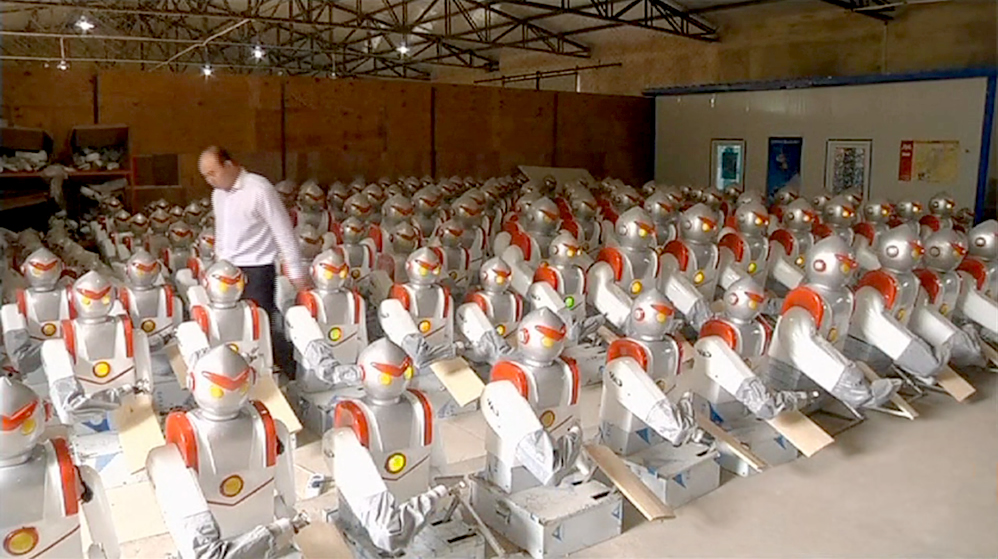
Chinese Building One Million Strong ‘robot army’

Foxconn to Speed Up ‘robot Army’ Deployment; 20,000 Robots Already in its Factories

Foxconn also looking at the U.S. and Indonesia for expansion

By Michael Kan 
Wed, June 26, 2013
 
IDG News Service (Beijing Bureau) — Manufacturing giant Foxconn Technology Group is on track with its goal to a create a “million robot army”, and already has 20,000 robotic machines in its factories, said the company’s CEO Terry Gou on Wednesday.
 
robot army 0

Workers’ wages in China are rising, and so the company’s research in robots and automation has to catch up, Gou said, while speaking at the company’s annual shareholder’s meeting in Taipei. “We have over 1 million workers. In the future we will add 1 million robotic workers,” he said. “Our [human] workers will then become technicians and engineers.”

Foxconn is the world’s largest contract electronics maker and counts Apple, Microsoft and Sony as some of its clients. Many of its largest factories are in China, where the company employs 1.2 million people, but rising Add a comment are threatening to reduce company profits.

To offset labor costs and improve its manufacturing, Foxconn has already spent three years on developing robots, Gou said. These machines are specifically developed to assemble electronics such as mobile phones, but it will take some time for Foxconn to fully develop the technology, he added.

robot army 1

“It’s a middle to long-term goal,” Gou said. But already 20,000 robot arms and robotic tools are in use at the company’s factories.

Robotics have long been used to manufacture cars and large electronics. But currently, human workers are still the best choice to put together small consumer gadgets, many of which contain complicated wiring and small sockets that are best handled with human hands, according to experts.

In addition, Foxconn’s CEO said the company is prepared to expand its manufacturing in the U.S., but the move will depend on “economic factors.” The company already has factories in Indianapolis and Houston, and employs thousands of workers in the country, according to Gou.

Last December, Foxconn customer Apple said it would manufacture one of its Mac lines in the U.S. by the end of next year. Soon after, Foxconn said it was considering growing its existing manufacturing base in the country.

robot army 2

The Taiwanese company is also exploring building factories in Indonesia, a country with significantly lower labor costs than the U.S. or China. One possible plan is for Foxconn to build electronics for the local market, which is home to 240 million people.

“Indonesia has great potential and its a great market for my company,” Gou said. “Definitely we will put a lot of investment in Indonesia.”

The company, however, is waiting for the nation’s government to improve the regulations for its tech sector. Standards over electronics safety are so low that anyone can get away with selling shoddy mobile phones, said a Foxconn official in December.

“The direction is right, but we need to take time,” Gou added. “We think in one or two years this will happen.”

1 Comment

Filed under Humor and Observations

Magnetic, levitating ‘sky trains’ may be coming to a city near you

Magnetic, levitating ‘sky trains’ may be coming to a city near you

Published August 01, 2013

FoxNews.com
  • skytran.jpg

    SkyTran’s levitating transit pods will carry passengers over street traffic to their destinations. (www.skytran.us)

Flying cars may sound like something out of “The Jetsons,” but Israel’s Tel Aviv is soon set to be the first city to welcome SkyTran’s futuristic transportation trains.

The mass transit system of magnetically levitating pods was co-developed by engineers from NASA’s Ames Research Center and the privately held SkyTran company.

Plagued by heavy traffic, the city of Tel Aviv is hoping to use SkyTran’s pods in order to offer energy and environmentally-friendly alternatives to cars and buses, The Times of Israel reported.

According to the planners, “sky trains” are a cheaper and faster transportation system and will help reduce congestion and pollution.

The city of Tel Aviv recently hired US consultant company Jenkins Gales & Martinez to help speed up the process in building the SkyTran track but no official timetable has been announced.

Read more: http://www.foxnews.com/tech/2013/08/01/magnetic-levitating-sky-trains-may-be-coming-to-city-near/#ixzz2bOsZYx67

4 Comments

Filed under Humor and Observations

What People Thought Vehicles Would Like Today

These are all pictures and illustrations of what people predicted future vehicles would be like today.  To me, beyond the coolness of the pictures, is the analysis of where they went wrong. You see, predicting the future does not usually work, because we are too fixed on how things are right now.  For instance, the clothing in the pictures is the most wrong.  Men don’t dress nice in suits all the time like they used to.  It is a way for futurists such as myself to look at the mistakes in predicting made before and try to avoid them.  Society, dress and appearance is likely to change just as much as technology.  The pictures also do not reflect a change in urban buildings or lifestyle as technology changes.  With that added thought, enjoy!

6 Comments

Filed under Humor and Observations

Raspberry Pi is Changing Our World

If you have not heard about Raspberry Pi, it is a very cheap computer circuit board that is changing the world.  It can be used to turn normal things into computerized robots and devices.  Read below and have your mind blown…

World’s cheapest computer gets millions tinkering

By Judith Evans

Published July 20, 2013

  • photo_1374378770461-1-HD.jpg

    Japanese engineer Shota Ishiwatari displays the humanoid robot “Rapiro” which works with a “Raspberry Pi” in Tokyo on July 8, 2013. Raspberry Pi, the world’s cheapest computer, costing just $25 (??17, 19.50 euros), has astonished its British creators by selling almost 1.5 million units in 18 months. (AFP)

  • photo_1374378828553-1-HD.jpg

    Japanese engineer Shota Ishiwatari displays the humanoid robot “Rapiro” which works with a “Raspberry Pi” circuit board in Tokyo on July 8, 2013. The Raspberry Pi is now powering robots in Japan and warehouse doors in Malawi, photographing astral bodies from the United States and helping to dodge censorship in China. (AFP)

LONDON (AFP) –  It’s a single circuit board the size of a credit card with no screen or keyboard, a far cry from the smooth tablets that dominate the technology market.

But the world’s cheapest computer, costing just $25 (??17, 19.50 euros), has astonished its British creators by selling almost 1.5 million units in 18 months.

The Raspberry Pi is now powering robots in Japan and warehouse doors in Malawi, photographing astral bodies from the United States and helping to dodge censorship in China.

“We’re closing in on one and and half million (sales) for something that we thought would sell a thousand,” said Eben Upton, executive director of the Raspberry Pi Foundation.

“It was just supposed to be a little thing to solve a little problem.

“We’ve sold many more to children than we expected to sell, but even more to adults. They’re using it like Lego to connect things up.”

The device, which runs the open-source Linux operating system, was designed as an educational tool for children to learn coding.

But its potential for almost infinite tinkering and customisation has fired up the imaginations of hobbyists and inventors around the world.

Tokyo inventor Shota Ishiwatari has created a small humanoid robot run by a Pi, which can tell you the weather, manage your diary and even make coffee.

“I wanted to create something by using a 3D printer and the Raspberry Pi – two cool items,” he told AFP, adding that he also wanted to demonstrate the potential of the microcomputer.

“Many Raspberry Pi users did not know how to have fun with the chip. I wanted to present practical ways to play with it.”

Upton and his colleagues first thought of creating a cheap computer suited to programming when they were teaching computer science at Cambridge University.

They noticed that children of the wired generation lacked the day-to-day experience of coding that was so formative for the computer geeks who grew up in the 1980s.

“They didn’t have the grungy familiarity with the dirty bits, the hacking,” Upton told AFP.

“The theory of computer science is maths, but the practice is a craft, like carpentry.”

Upton reminisces happily about his childhood coding on a BBC Micro, a rugged early personal computer from 1982.

Back then, you had to know a computer “language” in order to use one at all. But home computers are now so complex that parents often ban children from interfering with the underlying code.

Upton and his colleagues saw that developments in technology meant something like the Micro could now be created for a fraction of the cost, in pocket size, with the capacity to run multimedia programmes.

The team behind the Pi grew as the project developed; it now includes David Braben — the designer of a classic Micro game, Elite — and tech entrepreneur and investor Jack Lang.

By 2012, with Upton now working for a chip design firm, the Pi was ready to launch.

Demand for the device, assembled in Wales, was so high that the websites of its distributors crashed.

User groups called Raspberry Jams now meet monthly in cities from Manchester to Singapore to share ideas.

A Raspberry Jam brought together the team behind a Pi camera that will photograph rhinos and other endangered animals in east Africa, generating data on their habits and on poaching.

The Instant Wild system, backed by the Zoological Society of London, already operates in several countries, beaming images via satellite to park rangers and to an app that crowdsources identifications of animals.

But by replacing expensive purpose-built equipment with cheaper Raspberry Pis, Instant Wild hopes to vastly expand its work.

A grid of 100 Pi cameras will be set up in 2015 on a Kenyan ranch, while another Pi will make its way to Antarctica to record penguin behaviour.

“It used to be very expensive — you’d have to run a laptop, with a huge car battery to power the thing. This saves countless power and it’s easy for it to send out alerts automatically,” said Alasdair Davies, technical advisor to the project.

Upton, however, is focused closer to home.

The Raspberry Pi Foundation is nonprofit and the design freely available, so he and his team will not be retiring on the proceeds of their success.

Instead they are working on software to make the Pi more accessible for children without expert help, and Upton remains intent on improving computer education.

The foundation is in discussions with the British government on a new IT curriculum.

For the country that invented some of the earliest computers, Upton feels that teaching coding should be a matter of national pride.

“The definition of computing is being reworked to be less about PowerPoint and more about computer programming — the useful stuff. The real stuff,” he said.

Read more: http://www.foxnews.com/world/2013/07/20/world-cheapest-computer-gets-millions-tinkering/?intcmp=obnetwork#ixzz2aHjSnjI9

2 Comments

Filed under Humor and Observations

NASA Tests 3D Printed Rocket Engine Injector

NASA Successfully Tests First 3-D Printed Rocket Engine Injector

Another step toward the day when 3-D printers spit out entire spacecraft.
By Shaunacy FerroPosted 07.12.2013 at 1:00 pm3 Comments

Rocket Engine Injector NASA Glenn Research Center

We’ve seen 3-D printed aircraft and drone parts, and even plans for a printable private jet. Now NASA has demonstrated another 3-D printing first: The agency has just finished successful tests of a 3-D printed rocket engine injector at the Glenn Research Center in Cleveland, Ohio, marking one of the first steps in using additive manufacturing for space travel.

In conjunction with rocket manufacturer Aerojet Rocketdyne, NASA built the liquid-oxygen and gaseous-hydrogen rocket injector assembly using laser melting manufacturing. This sci-fi-sounding technique involves melting metallic powders down with high-powered laser beams, then fusing them into shape. Previous manufacturing methods for these type of injectors required more than a year. Being able to 3-D print the parts reduces the time frame to four months, at a 70 percent price reduction.


Installation In The Rocket Combustion Laboratory

Installation In The Rocket Combustion Laboratory:  NASA Glenn Research Center 

Eventually, 3-D printing is likely become a staple of the aerospace industry, as Davin Coburn describes in our July issue.

NASA has already expressed interest in putting 3-D printers in space, so astronauts could have easier access to spare parts and, most importantly, pizza.

Michael Gazarik, the associate administrator for space technology at NASA, even suggested entire spacecraft could one day be made with 3-D printing, calling it “game-changing for new mission opportunities.”

2 Comments

Filed under Humor and Observations