
Cute dogs to cheer the start of your week.
-

- Dog or Horse?
-

- Bro, pull yourself together…
Cute dogs to cheer the start of your week.



































Q – What is the fear of using chain saws called?
A – Common Sense.
I once used a chain saw to clear some dead trees from my yard. I rented it at a local rental store. Oh my God! Never again. These things are the most unsafe device ever created. I have nothing but respect for those who have to use them for their jobs. Wow. After seeing this story below, it only reinforces my assessment…
Chainsaw in the neck: How surgeons saved one man from a traumatic accident

Allegheny Health Network
In April, 21-year-old James Valentine was working as a tree-trimmer when he was struck in the neck by a chainsaw. In a new episode of “Untold Stories of the ER,” his doctors revisited the case.
Toevs and her team had only 10 minutes’ notice before Valentine was brought in. Her biggest concern was that he would bleed to death or that he had injured his carotid artery, which supplies the brain with blood. An injury to his esophagus would have also presented a major issue, as breathing comes first in terms of sustaining life.
Fortunately, when Valentine arrived, he was able to speak and wiggle his toes, which indicated his airway wasn’t compromised and his spinal cord wasn’t damaged. He was in some degree of shock and was appropriately scared, but he wasn’t panicking, which could have worsened the situation.
“It’d be a big issue if he panicked; we couldn’t stabilize the chainsaw, which could come out and he could bleed to death… or we could lose the airway,” Toevs said.
When the accident occurred, the chainsaw still had the motor attached, but emergency personnel were able to take it off before they reached the hospital. However, the chainsaw blade needed to remain still, so in the trauma bay, Toevs designated one person’s sole responsibility to hold the blade.
The team took a chest X-ray and found no other injuries to the chest or lungs and no blood in the chest. Valentine was taken to the operating room (OR) after a brief examination in the trauma bay.
“If there’s a problem, you want all the [surgical] resources you have,” Toevs said. “We took him to the OR and in a very controlled situation, put him to sleep, and then we pressed and got totally all set up and took out the chainsaw in a very controlled situation.”
Because there was no damage to his trachea, doctors were able to intubate him and put him on a ventilator for the surgery. Though he was losing blood, it wasn’t an alarming amount, Toevs said.
“Yes, he was losing blood because the chainsaw did injure his muscles, skin, small veins and arteries that can be tied off and don’t supply blood to the brain,” Toevs said. “It wasn’t what we call ‘firehose’ bleeding [with blood spraying uncontrollably].”
The team put Valentine to sleep, then took out the blade. Exploring the wound, they found that the blade went in about three inches in his shoulder and one inch into his neck, injuring his trapezius muscle, sternocleidomastoid muscle and other smaller muscles. But, most importantly, they found that the blade had not damaged his carotid artery.
“If it had gone a centimeter deeper, it would’ve hit. The muscle overlying the carotid was intact. Then we just explored the wound,” Toevs said. “At that point in time, it’s a huge letdown— we were preparing for the absolute worst.”
With the situation stabilized, the surgery then became routine. It took about five minutes to explore the wound to ensure nothing else was injured, then the surgeons cleaned up the blood, dirt and tree particles and closed the wound.
Valentine was admitted to the hospital overnight and began working with a physical therapist the next day. After Valentine was released from the hospital, Toevs ordered physical therapy for him to help him get his arm back to normal usage, as well as help him to move his arm above his head again.
Since Valentine is a young, healthy adult, Toevs doesn’t expect him to deal with any residual issues from the accident, and he should fully recover.
Overall, the surprisingly benign nature of the injury and the coordinated efforts of everyone involved made the procedure go smoothly, Toevs said.
“He was very blessed that he wasn’t injured more and it was also a blessing that every part went perfectly, like it was supposed to,” she said. “It was a real testimony to the EMS, the emergency department, the OR, to all the people involved… each playing a critical role to making sure he did okay.”
As for Valentine, his calmness during the perilous situation was helpful for the team— and for his recovery.
“He doesn’t know how close he came,” she said.
“Untold Stories of the ER” premieres tonight at 9/8 CST on Discovery Fit & Health.
Filed under Humor and Observations
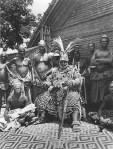
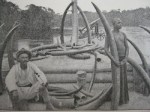
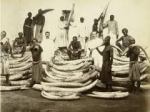
John Hobbis Harris was a Christian missionary that traveled to the Belgian Congo. His wife was an amateur photographer in this new technology of taking pictures. Her name is Alice Seeley. Their story is one of courage to document and fight against horrible atrocities along side such figures as William Sheppard, a black American Christian missionary, E.V. Sjöblom, a Swedish Baptist minister, George Washington Williams, a black American minister who had fought in the US Civil War, and even Mark Twain (Samuel Clemens). It was the photographs taken by Harris and his wife Alice Seeley that won over the public.

Alice Seeley seated. Her husband standing to her left. Not only did their photos change Belgian Congo, but the world. Their mission also provided healthcare and shelter to dismembered slaves.
King Leopold II of Belgium, like so many European monarchs in the 1800’s, had established various colonies around the world. By the late nineteenth century, most of the world had been colonized from South America to Africa, Asia and the Pacific Islands. Belgium had a substantial colony in the Congo. The Congo had two products that were in high demand – ivory and rubber. There was no modern media such as TV or radio, much less the internet. Most colonial powers could do as they pleased and no one be the wiser.
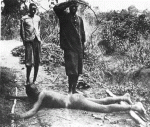
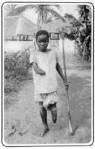
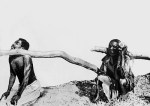
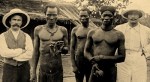
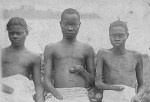
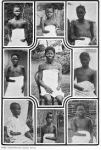
Following the American Civil War, abolitionists from America went to other areas where slavery was practiced to expose it and abolish it. American protestant missionaries were in the forefront of this movement, often suffering death as a result. In the Belgian Congo, the local populace was beaten, enslaved and mutilated to keep up the rubber plantations and bring in revenues for Belgium, while the indigenous animals were slaughtered. Several newspapers, brochures and pamphlets were used to try to stop the practice, but it was these pictures that caused King Leopold II to finally stop the worst of the atrocities.
WARNING: These images are graphic. Not only were slaves beaten or killed, but the Belgium leaders would chop off arms and legs as punishment.






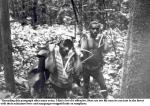
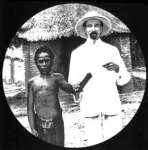
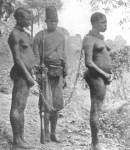

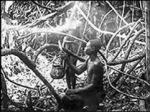


Filed under Humor and Observations
I personally think it was stupid for L’Oreal to sign her based on a viral picture during the FIFA World Cup and equally stupid to get rid of her as soon as she turns out to be politically incorrect. I understand that she was talking about hunting Americans because her country faced us in the World Cup. That was not offensive.
What she doesn’t understand is that pictures standing over the dead body of an animal you shot for fun are no longer accepted. Even standing over animals you killed for food are not good times for a photo op. Given Belgium’s horrible history in Africa (the first photo journalist international scandal in history. I will post on that next.) it is even more important for a Belgie not to post going to Africa to have fun killing them.
Belgian beauty loses modeling gig after her hunting pic hits the web

Axelle Despiegelaere appears in a video promoting L’Oréal.
The Belgium beauty that scored a L’Oreal modeling deal after her World Cup photos went viral earlier this week has been released from her contract.
The decision comes after 17-year-old Axelle Despiegelaere sparked outrage on Facebook with a picture showing her posing with a dead oryx gazelle she had hunted in Africa, The Independent reports.
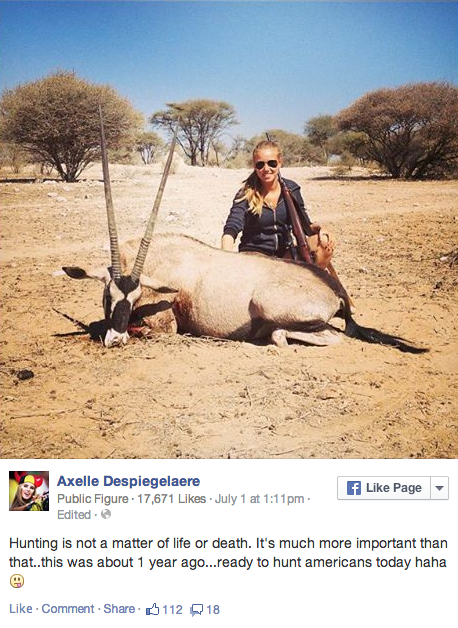
The post came on the day that Belgium eliminated the United States at the World Cup. After the furor began on Facebook, Despiegelaere responded: “Hi, I didn’t mean to offend anyone … it was a joke. Thanks for understanding.”
L’Oreal officials say that Despiegelaere will no longer be representing the company and that her contract has officially been “completed,” according to The Independent.
A spokesperson for L’Oreal said: “L’Oreal Professionnel Belgium collaborated with her on an ad hoc basis to produce a video for social media use in Belgium. The contract has now been completed.”
Filed under Animals, Humor and Observations
By Elizabeth Armstrong Moore
Published July 03, 2014

This once used to be a … “condo”?AP Photo/Gregorio Borgia
If only these walls could talk. Rome’s iconic Colosseum, built nearly 20 centuries ago in 72 AD, has long been known as the site of gory gladiator battles and animal slaughter.
Now, archaeologists who spent three weeks studying an excavated area beneath some 80 arched entrances that opened up into the arena say that after the Roman empire crumbled, the ancient structure came to house—gasp!—ordinary Romans, reports the Telegraph.
Among the findings: terracotta sewage pipes, pottery shards, the likely presence of stables and workshops, and the foundation of a wall that marked the boundaries of one of the properties.
They believe that friars from the nearby Santa Maria Nova convent, who controlled the building for a time, rented out square feet within the Colosseum as housing.
The amphitheater, no longer used as an arena, became a huge courtyard, they say, thriving with people, animals, and goods. Archaeologists even found a tiny monkey figurine carved in ivory, likely a chess pawn.
Smithsonian notes other unexpected uses followed: In the 1500s, Pope Sixtus attempted to make the Colosseum a wool factory. (On US shores, archaeologists are trying to solve the mystery of Plymouth colony.)
Filed under Humor and Observations
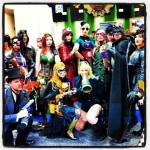
Cosplay pictures for your weekend enjoyment.











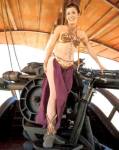




















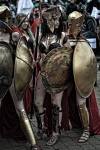

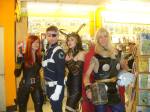









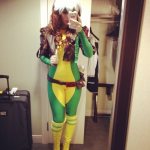


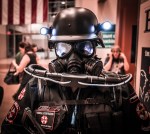




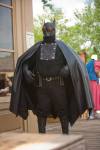


Filed under Humor and Observations
Random humor to start off your weekend…


Filed under Humor and Observations
I live in Phoenix, Arizona, USA, a place that is wonderful for eight months of the year and not so good for four months. During the summer we experience temperatures up to 123 degrees F and lows in the 90s, sometimes not dropping below 100. Last night is 105 degrees here at midnight.
We are also the recipients of Monsoons, Sciroccos and Haboobs. El Nino is a current down Mexico way that decides to reverse itself for a period of the year, causing weather disturbances in Arizona. Most of these storms do not provide moisture, as it is too dry and hot for the rain to reach the ground. Instead, we get strong winds, lightning and dust storms.
The dust storms, which have been hitting about once per week, blow other stuff, sand blast anything left outside and mess up our swimming pool filters… I have a relative in Massachusetts – Hey Uncle Dick! – that did not realize we suffer haboobs. After the photos below, I have excerpted the listing on Haboob from Wikipedia. Our haboobs feature dust clouds up to one mile high with winds up to 75 mph. Sometimes they drop the temperature, but other times they raise the humidity while temperatures remain over 100. Basically, June, July and August are not the best times to visit…


Wikipedia…
A haboob (Arabic: هَبوب habūb “blasting/drafting”) is a type of intense dust storm carried on an atmospheric gravity current. Haboobs occur regularly in arid regions throughout the world.
They have been observed in the Sahara desert (typically Sudan, where they were named and described), as well as across the Arabian Peninsula, throughout Kuwait, and in the most arid regions of Iraq.[1] African haboobs result from the northward summer shift of the inter-tropical front into North Africa, bringing moisture from the Gulf of Guinea. Haboob winds in the Arabian Peninsula, Iraq, Kuwait, and North America are frequently created by the collapse of a thunderstorm, while haboobs in Australia may be frequently associated with cold fronts. The deserts of Central Australia, especially near Alice Springs, are particularly prone to haboobs, with sand and debris reaching several kilometers into the sky and leaving up to a foot of sand in the haboob’s path.
The arid and semiarid regions of North America—in fact, any dry region—may experience haboobs. In North America the most common terms for these events is either dust storm or sandstorm. In the U.S., they frequently occur in the deserts of Arizona, including around the cities of Yuma and Phoenix[2][3]—and in New Mexico and Texas.[4] During thunderstorm formation, winds move in a direction opposite to the storm’s travel, and they move from all directions into the thunderstorm. When the storm collapses and begins to release precipitation, wind directions reverse, gusting outward from the storm and generally gusting the strongest in the direction of the storm’s travel.[5][6][7]
When this downdraft of cold air, or downburst, reaches the ground, it blows dry, loose silt and clay (collectively, dust) up from the desert, creating a wall of sediment that precedes the storm cloud. This wall of dust can be up to 100 km (62 mi) wide and several kilometers in elevation. At their strongest, haboob winds often travel at 35–100 km/h (22–62 mph), and they may approach with little or no warning. Often rain does not appear at ground level as it evaporates in the hot, dry air (a phenomenon known as virga). The evaporation cools the rushing air even further and accelerates it. Occasionally, when the rain does persist, it can contain a considerable quantity of dust. Severe cases are called mud storms. Eye and respiratory system protection are advisable for anyone who must be outside during a haboob. Moving to shelter is highly desirable during a strong event.
Filed under Humor and Observations
Most people do not realize that the Croissant is Austrian, not French. It was made in the shape of a crescent to celebrate the Austrian victory over the Turks. The Turks, being Muslims, had the crescent, or “croissant”, on their flag. The bread was made as a mockery of them.
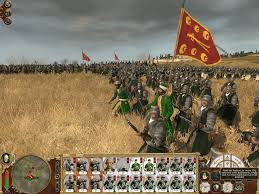
Ottoman Empire Battle Flag during Vienna siege Era
History majors might know that the Muslims came close to conquering the world. They took over part of India, moved and took over the Middle East, then North Africa, then the Iberian Peninsula (Spain and Portugal). They were stopped in Western Europe by an army of the Franks (now France). They conquered most of Eastern Europe, fought Russia, took over the Byzantine Empire, changing Constantinople to Istanbul and changing the churches back to Islamic Mosques. In the east, they were besieging the city of Vienna when they were finally stopped.
Over the years, Spain and Portugal were reclaimed in the “Reconquista” the Crusades in the west of Europe few Americans know about. The famous character “El Cid” comes from this time period. In Western Europe, the Austro-Hungarian Empire and the Russians made some inroads but it was not until after European colonization in North Africa and the end of World War 1 that the Ottoman Empire was broken up.
So the next time you eat a croissant, remember, it is celebrating the defeat of Muslim invaders. It is the same as if the Taliban started making cross-shaped Pita breads, or Iran made six-sided star pastries. Isn’t history strange?

The history of “Croissants”
The first production of a Croissant dates back to 1683. That year, Austria was under siege by the Turkish Empire. In Vienna, the Turkish assailant found that time was slipping past and decided to dig an underground tunnel to enter the city. The Vienna bakers, the majority of whom worked underground, heard noises and called in the army. The Turks were discovered and retreated.
The bakers were thanked and honored and they decided to make bread in the shape of a crescent moon (the symbol of the Turkish flag) and the croissant was born. One hundred years later, Marie Antoinette (Austrian Princess who married Louis XVI), introduced the croissant to the French Aristocrats.
It was only at the start of this century that the butter puff croissant was created, and became the French national product in 1920. Source: http://www.lagourmandise.net/history.htm
Filed under Humor and Observations
Katniss and Hermione hung out at the Dior Fashion Show and it was epic. posted on July 8, 2014, at 7:46 a.m.

Check out more articles on BuzzFeed.com!
Filed under Humor and Observations


 Michael Bradley - Time Traveler


