Category Archives: Uncategorized

IRISH!!! (information and pictures)

I am Irish.  My name was Anglicized from O’Brolochain to Bradley when my ancestors arrived in America.  I could go on and on about my ancestral home, but I will try to hit on some high points.  Your pay off is that you can read it and learn cool stuff, or you can scroll down to the Irish picture gallery, which also has some fine looking Irish ladies mixed in.  My family comes from County Derry.  None of us were famous, we were from a minor clan, and someone rose to local parrish Abbot at some point.  We were poor and fled to America for jobs and food.  Our people fought in wars, fought in bars, built the railroads, owned slaves and led the Confederates, but filled the ranks of the Union too.  We have more Irish living abroad than in Ireland thanks to the damnable British!  Yes, I explain some of “The Troubles” below as well.

My son was asked to write about his family history as a child.  I told him we were poor, drunken brawlers.  We were starving, so we came to America and stayed mostly in the North where we were despised and worked at crap jobs like building the railroads.  The luckier and immoral ones went South, learned how to buy land and became slaveholders.  When slavery ended, many slaves took their old master’s last names.  If you meet a black person named Bradley, chances are they are descended from slaves that my ancestors owned.  Not a good history.  It gets worse…  In WW2, many of the Irish sided with Hitler as a chance to rebel against the British.  My son and I both have our names on the fly watch list because Michael Bradley and Alex Bradley are common names in our homeland, and apparently, some named that have been part of “The Troubles.”  As a result, I cannot check in more than two hours early, I get searched, show documentation with picture and birth-date, and all my luggage is searched.  Yes, it does not just happen to Middle Easterners.  My wife said, you can’t have him write that stuff for class.  I said, “Why not, it is true?  Not everyone is descended from people who had it easy.”

Erin go Bragh!

Erin_Go_Bragh_flag

Erin go Bragh is an anglicisation of the Irish phrase Éirinn go Brách (pronounced [ˈeːɾʲɪn̠ʲ ɡə ˈbˠɾˠɑːx]), in which Éirinn is the dative of Éire (meaning “Ireland”). In standard modern Irish the phrase is Éire go Brách (pronounced [ˈeːɾʲə ɡə ˈbˠɾˠɑːx]). It is probable that the English version was taken from what was a “dative” context, such as Go bhfanad in Éirinn go brách (“May I stay in Ireland for ever”) or Go bhfillead go hÉirinn go brách (“May I go back to Ireland for ever”).

Alternatively, given that in a few local dialects (particularly in Waterford Irish and South Connacht Irish) Éirinn has replaced Éire as the ordinary name for Ireland, it could be that the phrase was taken from a speaker of such a dialect. This replacement of the nominative by the dative is common among Irish feminine and some masculine nouns of the second and fifth declensions, and is most widespread in the two dialect areas mentioned.[2] The word brách is an adjective/nominal which is equivalent to “for ever”, “eternal”, “always”, “still”, and conveys the global semantics of “unchanging”—such as in the phrases Fan go brách (“Just wait – don’t move – be patient and wait a bit more”) or fuair sé an litir agus as go brách leis go dtí an sagart chun í a thaispeáint dó (“he got the letter and without waiting off with him to the priest to show him it”).

A phrase confused with Erin go Bragh is Érin go Breá.[citation needed] This is actually [Tá] Éire go breá (“Ireland is (doing) fine/great/excellent”).

St. Patrick’s Day

250px-Saint_Patrick_(window)

  • St. Patrick is known for “driving the snakes out of Ireland.”  This is generally believed to mean he drove out the remnants of paganism and converted the country to Christianity.  Although most hear that and think he was like the Pied Piper who led rats out of a city.  It does not in fact mean actual snakes, but anti-Christians, such as the serpent in the Garden of Eden.
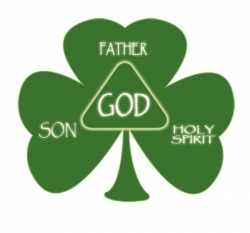
  • St. Patrick also made the Shamrock a national symbol of Ireland.  He used its three sections to explain the Holy Trinity of God the Father, Jesus the Son, and the Holy Spirit.  Each separate, but one.
draft_lens17603171module148005042photo_1297871374Holy-Trinity-Shamrock

  • Saint Patrick (LatinPatriciusProto-Irish*Qatrikias;[2] Modern IrishPádraig;[3] WelshPadrig;[4] c. 387 – 17 March c. 460[5] or c. 492[6]) was a Romano-British Christian missionary and bishop inIreland. Known as the “Apostle of Ireland”, he is the primary patron saint of the island along with Saints Brigid and Columba.
  • Two authentic letters from him survive, from which come the only generally accepted details of his life.[7] When he was about 16, he was captured from his home and taken as a slave to Ireland, where he lived for six years before escaping and returning to his family. After becoming a cleric, he returned to northern and western Ireland as an ordained bishop, but little is known about the places where he worked. By the seventh century, he had already come to be revered as the patron saint of Ireland.
  • Most available details of his life are from subsequent hagiographies, and these are now not accepted without detailed criticism. The Annals of Ulster state that he arrived in Ireland in 432, ministered inUlster around 443, and died in 457 or 461.[8] The text, however, distinguishes between “Old Patrick”[9] and “Patrick, archapostle of the Scots,”[10] who died in 492.[8] The actual dates of Patrick’s life cannot be fixed with certainty but, on a widespread interpretation, he was active as a missionary in Ireland during the second half of the 5th century.[11] He is generally credited with being the first bishop of ArmaghPrimate of All Ireland.
  • Saint Patrick’s Day is observed on March 17, the date of his death.[12] It is celebrated both inside and outside Ireland, as both a liturgical and non-liturgical holiday. In the dioceses of Ireland, it is both asolemnity and a holy day of obligation; outside Ireland, it can be a celebration of Ireland itself.

Irish in America

  • Irish immigrants of this period participated in significant numbers in the American Revolution, leading one British major general to testify at the House of Commons that “half the rebel Continental Army were from Ireland.”
  • The relatively small number of Irish Catholics concentrated in a few medium-sized cities, where they were highly visible, especially in CharlestonSavannah and New Orleans.[18][19] They became local leaders in the Democratic party, generally favored preserving the Union in 1860, but became staunch Confederates after secession in 1861.
  • During the American Civil War, Irish Americans volunteered in high numbers for the Union Army, and at least thirty-eight Union regiments had the word “Irish” in their title. 144,221 Union soldiers were born in Ireland; additionally, perhaps an equal number were of Irish descent.[43] Many immigrant soldiers formed their own regiments, such as the Irish Brigade.[44]
  • The majority of the Union Pacific track across the Nebraska and Wyoming territory till it approached Utah territory was built by veterans of both the Union and Confederate armies and many immigrant Irishmen.  (It upsets me that even history books now refer to the blacks and chinese building the railroad, when in fact it was the Irish in the East in Midwest and the Chinese in West.  A few blacks were employed but in insignificant numbers compared to the Irish.)  The blacks endured slavery and discrimination in the South, but the Irish suffered slavery and ethnic cleansing in their own country for decades, and received further abuse in America.  So our tale should not be forgotten either.

Number of Irish in America

  • After the potato famines and British land grabs and extermination of Irish, so many Irish moved to America, that by 1910 more Irish born lived in the United States than were left in Ireland.  Ever since then more Irish have lived outside Ireland.  The population in Ireland dropped from over 8 million to less than 4 million during that period of suffering.
  • Irish Americans are citizens of the United States who can trace their ancestry to Ireland. A total of 36,278,332 Americans—estimated at 11.9% of the total population—reported Irish ancestry in the 2008 American Community Survey conducted by the U.S. Census Bureau.[6] Roughly another 3.5 million (or about another 1.2% of Americans) identified more specifically with Scotch-Irishancestry. The Irish diaspora population in the United States is roughly six times the modern population of Ireland.
  • The only self-reported ancestral group larger than Irish Americans is German Americans.[6] The Irish are widely dispersed in terms of geography, and demographics. Irish American political leaders have played a major role in local and national politics since before the American Revolutionary War: eight Irish Americans signed the United States Declaration of Independence, and twenty-twoAmerican Presidents, from Andrew Jackson to Barack Obama, have been at least partly of Irish ancestry.

American Presidents with Irish ancestry

A number of the Presidents of the United States have Irish origins.[147] The extent of Irish heritage varies. For example, Chester Arthur‘s father and both of Andrew Jackson‘s parents were Irish born, whileGeorge W. Bush has a rather distant Irish ancestry. Ronald Reagan‘s father was of Irish ancestry,[148] while his mother also had some Irish ancestors. President Kennedy had Irish lineage on both sides. Within this group, only Kennedy was raised as a practicing Roman Catholic. Current President Barack Obama‘s Irish heritage originates from his Kansas-born mother, Ann Dunham, whose ancestry is Irish and English.[149] His Vice President Joe Biden is also an Irish-American.

United States President Ronald Reaganspeaking to large crowd in his ancestral home in Ballyporeen, Ireland in 1984.

Andrew Jackson
7th President 1829–37: He was born in the predominantly Scotch-Irish[150] Waxhaws area of South Carolina two years after his parents left Boneybefore, near Carrickfergus in County Antrim. A heritage centre in the village pays tribute to the legacy of ‘Old Hickory’, the People’s President. Andrew Jackson then moved to Tennessee, where he served as Governor[151]
James Knox Polk
11th President, 1845–49: His ancestors were among the first Ulster-Scots settlers, emigrating from Coleraine in 1680 to become a powerful political family in Mecklenburg CountyNorth Carolina. He moved to Tennessee and became its governor before winning the presidency.[152]
James Buchanan
15th President, 1857–61: Born in a log cabin (which has been relocated to his old school in Mercersburg, Pennsylvania). The Buchanans were originally from Deroran, near Omagh in County Tyronewhere the ancestral home still stands.[152]
Andrew Johnson
17th President, 1865–69: His grandfather left Mounthill, near Larne in County Antrim around 1750 and settled in North Carolina. Andrew worked there as a tailor and ran a successful business inGreenevilleTennessee, before being elected Vice President. He became President following Abraham Lincoln‘s assassination.[152]
Ulysses S. Grant
18th President, 1869–77: The home of his maternal great-grandfather, John Simpson, at DergenaghCounty Tyrone, is the location for an exhibition on the eventful life of the victorious Civil Warcommander who later served two terms as President. Grant visited his ancestral homeland in 1878.[153]
Chester A. Arthur
21st President, 1881–85: His election was the start of a quarter-century in which the White House was occupied by men of Ulster-Scots origins. His family left Dreen, near CullybackeyCounty Antrim, in 1815. There is now an interpretive centre, alongside the Arthur Ancestral Home, devoted to his life and times.[152][154]
Grover Cleveland
22nd and 24th President, 1885–89 and 1893–97: Born in New Jersey, he was the maternal grandson of merchant Abner Neal, who emigrated from County Antrim in the 1790s. He is the only president to have served non-consecutive terms.[152]
Benjamin Harrison
23rd President, 1889–93: His mother, Elizabeth Irwin, had Ulster-Scots roots through her two great-grandfathers, James Irwin and William McDowell. Harrison was born in Ohio and served as a brigadier general in the Union Army before embarking on a career in Indiana politics which led to the White House.[152][155]
William McKinley
25th President, 1897–1901: Born in Ohio, the descendant of a farmer from Conagher, near BallymoneyCounty Antrim, he was proud of his ancestry and addressed one of the national Scotch-Irish congresses held in the late 19th century.[156] His second term as president was cut short by an assassin’s bullet.[152][157]
Theodore Roosevelt
26th President, 1901–09: His mother, Mittie Bulloch, had Ulster Scots ancestors who emigrated from GlenoeCounty Antrim, in May 1729. Roosevelt praised “Irish Presbyterians” as “a bold and hardy race.”[158] However, he is also the man who said: “But a hyphenated American is not an American at all. This is just as true of the man who puts ‘native’ before the hyphen as of the man who puts German or Irish or English or French before the hyphen.” [1] (*Roosevelt was referring to “nativists“, not American Indians, in this context)[159]
William Howard Taft
27th President 1909–13[160][161]
Woodrow Wilson
28th President, 1913–21: Of Ulster-Scot descent on both sides of the family, his roots were very strong and dear to him. He was grandson of a printer from Dergalt, near StrabaneCounty Tyrone, whose former home is open to visitors.[152]
Warren G. Harding
29th President 1921–23[162]
Harry S. Truman
33rd President 1945–53[163][164]
John F. Kennedy
35th President 1961–63, (County Wexford)
Richard Nixon
37th President, 1969–74: The Nixon ancestors left Ulster in the mid-18th century; the Quaker Milhous family ties were with County Antrim and County Kildare.[152]
Jimmy Carter
39th President 1977–1981 (County Antrim and County Londonderry):[153] One of his maternal ancestors, Brandon McCain, emigrated from County Londonderry to America in 1810.
Ronald Reagan
40th President 1981–89: He was the great-grandson, on his father’s side, of Irish migrants from County Tipperary who came to America via Canada and England in the 1840s. His mother was of Scottish and English ancestry.[165]
George H. W. Bush
41st President 1989–93 (County Wexford): historians have found that his now apparent ancestor, Richard de Clare, Earl of Pembroke. Shunned by Henry II, he offered his services as a mercenary in the 12th-century Norman invasion of Wexford, Ireland in exchange for power and land. Strongbow married Aoife, daughter of Dermot MacMurrough, the Gaelic king of Leinster.[166][167]
Bill Clinton

Obama greets local residents on Main Street in Moneygall, Ireland, May 23, 2011.

42nd President 1993–2001: He claims Irish ancestry despite there being no documentation of any of his ancestors coming from Ireland [152][168]
George W. Bush
43rd President 2001–09: One of his five times great-grandfathers, William Holliday, was born in Rathfriland, County Down, about 1755, (a British merchant living in Ireland) and died in Kentucky about 1811–12. One of the President’s seven times great-grandfathers, William Shannon, was apparently born somewhere in County Cork about 1730, and died in Pennsylvania in 1784.[167]
Barack Obama
44th President 2009–present: Some of his maternal ancestors came to America from a small village called Moneygall, in County Offaly.[149][169] His ancestors lived in New England and the South and by the 1800s most were in the Midwest.

[edit]Vice Presidents of Irish descent

Joe Biden
47th Vice President 2009–present[170]

[edit]Other presidents of Irish descent

Sam Houston
President of Texas 1836–38 and 1841–44

[edit]Irish-American Justices of the Supreme Court

History of Ireland – High Points Only

  • The first known settlements in Ireland began around 8000 BC.
  • The 17th century was perhaps the bloodiest in Ireland’s history. Two periods of war (1641–53 and 1689–91) caused huge loss of life. The ultimate dispossession of most of the Irish Catholic landowning class was engineered, and recusants were subordinated under the Penal Laws.
  • During the 17th century Ireland was convulsed by eleven years of warfare, beginning with the Rebellion of 1641, when Irish Catholics rebelled against the domination of English and Protestant settlers. The Catholic gentry briefly ruled the country as Confederate Ireland (1642–1649) against the background of the Wars of the Three Kingdoms until Oliver Cromwell reconquered Ireland in 1649–1653 on behalf of theEnglish Commonwealth. Cromwell’s conquest was the most brutal phase of the war. By its close, up to a third of Ireland’s pre-war population was dead or in exile. As retribution for the rebellion of 1641, the better-quality remaining lands owned by Irish Catholics were confiscated and given to British settlers commenced. Several hundred remaining native landowners were transplanted to Connacht.
  • Forty years later, Irish Catholics, known as “Jacobites”, fought for James from 1688 to 1691, but failed to restore James to the throne of Ireland, England and Scotland.
  • Ireland became the main battleground after the Glorious Revolution of 1688, when the Catholic James II left London and the English Parliament replaced him withWilliam of Orange. The wealthier Irish Catholics backed James to try to reverse the Penal Laws and land confiscations, whereas Protestants supported William and Mary in this ‘Glorious Revolution’ to preserve their property in the country. James and William fought for the Kingdom of Ireland in the Williamite War, most famously at the Battle of the Boyne in 1690, where James’ outnumbered forces were defeated.

Slavery and Extermination by the British

  • From the 15th to the 18th century, Irish prisoners were sold as slaves. For centuries, the Irish were de-humanised by the English, described as savages, so making their murder and displacement appear all the more justified.[19] In 1654 the British parliament gave Oliver Cromwell a free hand to banish Irish “undesirables”. Cromwell rounded up Catholics throughout the Irish countryside and placed them on ships bound for the Caribbean, mainly Barbados. The authorities in the West Indies, fearing the Irish would resist servitude, treated the prisoners harshly. Records suggest that priests may have been routinely tortured and executed. By 1655, 12,000 political prisoners had been forcibly shipped to Barbados.[20]
  • Known as a hero in Britain, Oliver Cromwell led several armies to Ireland for the purpose of stealing their lands and thinning out the Irish population for resettlement by British.  He is probably the most hated person ever in Ireland.
  • Subsequent Irish antagonism toward England was aggravated by the economic situation of Ireland in the 18th century. Some absentee landlords managed their estates inefficiently, and food tended to be produced for export rather than for domestic consumption. Two very cold winters near the end of the Little Ice Age led directly to a famine between 1740 and 1741, which killed about 400,000 people and caused over 150,000 Irish to leave the island. In addition, Irish exports were reduced by the Navigation Acts from the 1660s, which placed tariffs on Irish products entering England, but exempted English goods from tariffs on entering Ireland. Despite this most of the 18th century was relatively peaceful in comparison with the preceding two centuries, and the population doubled to over four million.
  • The second of Ireland’s “Great Famines”, An Gorta Mór struck the country during 1845–49, with potato blight, exacerbated by the political and laissez-faire economic factors of the time[22] leading to mass starvation and emigration. (See Great Irish Famine.) The impact of emigration in Ireland was severe; the population dropped from over 8 million before the Famine to 4.4 million in 1911. Gaelic or Irish, once the island’s spoken language, declined in use sharply in the nineteenth century as a result of the Famine and the creation of the National School education system, as well as hostility to the language from leading Irish politicians of the time; it was largely replaced by English.
  • The English Parliament was well aware that they had removed the food from Ireland, left their fields fallow, and they were now suffering starvation.  When debated in Parliament, the British MPs discussed at length and decided the best thing would be to let the Irish starve or move away so it would be easier to suppress them and take their land.  They literally let over half the population of the country starve or cross oceans to get food, when they could have saved them.  The willful starvation and forced immigration of over half the Irish is why there is still so much hatred for the British, even centuries after Cromwell and slavery and land robbery.  The famines happened just 100 years ago, and Ireland has never been the same.

Here it is, picture gallery of Irishness…

2 Comments

Filed under Humor and Observations, Uncategorized

New Pope

First, no I am not Catholic.  However, when there is a new leader of 1.2 Billion people world-wide, I believe it is blog post worthy…

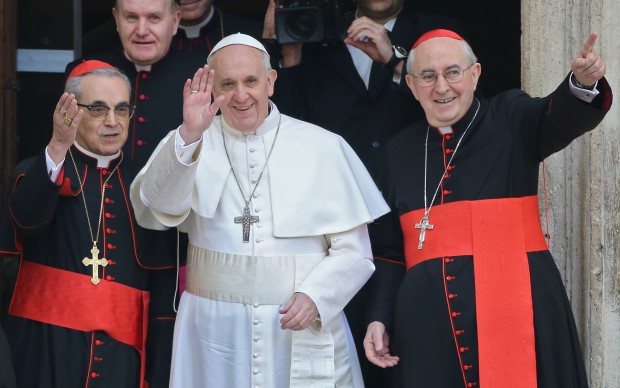
Several unusual things occurred at The Vatican.  One, a living Pope stepped down, which is very rare.  Second, the first American Pope was picked.  (Yes, all of North, Central and South America’s populations are “Americans”)  Third, he is a Jesuit, which if you remember Church history, they were at one time considered traitors and hunted down as dangerous heretics.  He selected the Pope name Francis.  I think he should have either been Francesco, since he is from Argentina, or at least Francisi, which is the latin name.  In any case, Francis is based on St. Francis of Assissi who believed he was asked by God to rebuild the Church.  At first, he thought of the physical structure, but later he realized God meant the body or members of the Church.  In this way, the new Jesuit Pope reaches out to the Franciscan Order, typically rivals, and also demonstrates that he wished to “rebuild the Church.”

Pope-Francis_March_14-e1363295111243

Here is an article on the event:

Pope Francis holds first mass with cardinals inside Sistine Chapel

Published March 14, 2013

FoxNews.com

A look at Pope Francis on first full day as pontiff

Pope Francis held his first mass as leader of the Catholic Church Thursday, urging cardinals that the church should stick to its roots and avoid modern temptations.

In his first homily at the Sistine Chapel, Jorge Mario Bergoglio, the 76-year-old Argentine cardinal who was elected pope by his peers on Wednesday, warned that the church risked becoming a “pitiful” non-governmental organization unless it goes through spiritual renewal and focuses on the message of Jesus Christ, Sky News reports.

“If we do not confess to Christ what would we be?” Francis said. “We would end up a pitiful NGO. What would happen would be like when children make sand castles and then it all falls down.”

Francis and all the cardinals in attendance wore light yellow robes over their cassocks, while the new pope spoke in Italian without notes.

Earlier Thursday, Francis stopped by his hotel to pick up his luggage and pay the bill himself and praying at Rome’s main basilica dedicated to the Virgin Mary.

He entered the St. Mary Major basilica through a side entrance just after 8 a.m. and left about 30 minutes later.

“He spoke to us cordially, like a father,” Father Ludovico Melo, a priest who prayed with Pope Francis, told Reuters. “We were given 10 minutes’ advance notice that the pope was coming.”

After becoming the first pontiff from the Americans, Francis had told a crowd of some 100,000 people packed in rain-soaked St. Peter’s Square just after his election that he intended to pray Friday to the Madonna “that she may watch over all of Rome.”

Bergoglio chose the name Francis, drawing connections to the humble 13th-century saint who saw his calling as trying to rebuild the church in a time of turmoil.

Benedict’s longtime aide, Monsignor Georg Gaenswein, accompanied Francis to the visit Thursday morning at St. Mary Major. In addition to being Benedict’s secretary, Gaenswein is also the prefect of the papal household and will be arranging the new pope’s schedule.

Like many Latin American Catholics, Francis has a particular devotion to the Virgin Mary, and his visit to the basilica was a reflection of that. He prayed before a Byzantine icon of Mary and the infant Jesus, the Protectress of the Roman People.

“He had a great devotion to this icon of Mary and every time he comes from Argentina he visits this basilica,” said one of the priests at the basilica, the Rev. Elio Montenero. “We were surprised today because he did not announce his visit.”

He then went into the main altar area of the basilica and prayed before relics of the manger in Bethlehem where Jesus is said to have been born — an important pilgrimage spot for Jesuits.

Members of his flock were charmed Thursday when Francis stopped by the Vatican-owned residence where he routinely stays during visits to Rome.

The Rev. Pawel Rytel-Andrianek, who teaches at the nearby Pontifical Holy Cross University and is staying at the residence, said he didn’t just come to get his luggage, noting that anyone could have come to get his suitcases.

“He wanted to come here because he wanted to thank the personnel, people who work in this house,” he said. Francis met with the staff in the dining room. “He greeted them one by one, no rush, the whole staff, one by one,” Rytel-Andrianek said, noting that the pope knew everyone by name.

“People say that he never in these 20 years asked for a (Vatican) car,” he said. “Even when he went for the conclave with a priest from his diocese, he just walked out to the main road, he picked up a taxi and went to the conclave. So very simple for a future pope.”

Francis has also spoken by phone with Benedict, who became the first pope to resign in 600 years and has been living at the papal retreat in Castel Gandolfo. Francis was expected to visit him this week, but a Vatican spokesman, the Rev. Thomas Rosica, said Francis wouldn’t make the trip to Castel Gandolfo on Thursday, and probably wouldn’t go Friday, either.

The visit is significant because Benedict’s resignation has raised concerns about potential power conflicts emerging from the peculiar situation of having a reigning pope and a retired one.

As the long-time archbishop of Buenos Aires, Francis has spent nearly his entire career at home in Argentina, overseeing churches and shoe-leather priests. In choosing a 76-year-old pope, the cardinals clearly decided that they didn’t need a vigorous, young pope who would reign for decades but rather a seasoned, popular and humble pastor who would draw followers to the faith and help rebuild a church stained by scandal.

Groups of supporters waved Argentine flags Wednesday night in St. Peter’s Square as Francis, wearing simple white robes, made his first public appearance as pope.

Chants of “Long live the pope!” arose from the throngs of faithful, many with tears in their eyes. Crowds went wild as the Vatican and Italian military bands marched through the square and up the steps of the basilica, followed by Swiss Guards in silver helmets and full regalia.

Francis appeared on the balcony of St. Peter’s Basilica just after a church official announced “Habemus Papum” — “We have a pope” — and gave Bergoglio’s name in Latin.

“Ladies and Gentlemen, good evening,” he said to wild cheers before making a reference to his roots in Latin America, which accounts for about 40 percent of the world’s Roman Catholics.

Francis asked for prayers for himself, and for retired Pope Emeritus Benedict XVI, whose resignation paved the way for the conclave that brought the first Jesuit to the papacy.

“You know that the work of the conclave is to give a bishop to Rome,” Francis said. “It seems as if my brother cardinals went to find him from the end of the earth. Thank you for the welcome.”

Bergoglio has shown a keen political sensibility as well as the kind of self-effacing humility that fellow cardinals value highly, according to his official biographer, Sergio Rubin. He showed that humility on Wednesday, saying that before he blessed the crowd he wanted their prayers for him and bowed his head.

“Good night, and have a good rest,” he said before going back into the palace.

In a lifetime of teaching and leading priests in Latin America, which has the largest share of the world’s Catholics, Francis has been known for modernizing an Argentine church that had been among the most conservative in Latin America.

Like other Jesuit intellectuals, Bergoglio has focused on social outreach. Catholics are still buzzing over his speech last year accusing fellow church officials of hypocrisy for forgetting that Jesus Christ bathed lepers and ate with prostitutes.

Francis, the son of middle-class Italian immigrants, is known as a humble man who denied himself the luxuries that previous Buenos Aires cardinals enjoyed. Bergoglio often rode the bus to work, cooked his own meals and regularly visited the slums that ring Argentina’s capital.

He came close to becoming pope in 2005, reportedly gaining the second-highest vote total in several rounds of voting before he bowed out of the running in the conclave that elected Pope Benedict XVI.

American Cardinal Timothy Dolan gave an inside glimpse into the drama of the conclave in his talk at the American seminary.

When the tally reached the necessary 77 votes to make Bergoglio pope, Dolan said, the cardinals erupted in applause. And when he accepted the momentous responsibility thrust upon him — ”there wasn’t a dry eye in the place,” Dolan recounted.

After the princes of the church had congratulated the new pope one by one, other Vatican officials wanted to do the same, but Francis preferred to go outside and greet the throngs of faithful. ”Maybe we should go to the balcony first,” Dolan recalled the pope as saying.

Elected on the fifth ballot, Francis was chosen in one of the fastest conclaves in years, remarkable given there was no clear front-runner going into the vote and that the church had been in turmoil following the upheaval unleashed by Benedict’s surprise resignation.

For comparison’s sake, Benedict was elected on the fourth ballot in 2005 — but he was the clear front-runner going into the vote. Pope John Paul II was elected on the eighth ballot in 1978 to become the first non-Italian pope in 455 years.

In choosing to call himself Francis, the new pope was linking himself with the much-loved Italian saint from Assisi associated with peace, poverty and simplicity. St. Francis was born to a wealthy family but later renounced his wealth and founded the Franciscan order of friars; he wandered about the countryside preaching to the people in very simple language.

He was so famed for his sanctity that he was canonized just two years after his death in 1226.

Francis will be installed officially as pope on Tuesday, on the feast of St. Joseph, patron saint of the universal church, according to Vatican spokesman Lombardi.

Lombardi, also a Jesuit, said he was particularly stunned by the election given that Jesuits typically shun positions of authority in the church, instead offering their work in service to those in power.

But Lombardi said that in accepting the election, Francis must have felt it “a strong call to service,” an antidote to all those who speculated that the papacy was about a search for power.

In an interesting twist the Jesuits were expelled from all of the Americas in the mid-18th century. Now, a Latin American Jesuit has been elected head of the 1.2-billion strong Catholic Church.

The Associated Press contributed to this report.

Read more: http://www.foxnews.com/world/2013/03/14/pope-francis-first-day-rome/#ixzz2NeBTgtCZ

Leave a comment

Filed under Humor and Observations, Uncategorized

I Will Be At Phoenix ComicCon 2013!

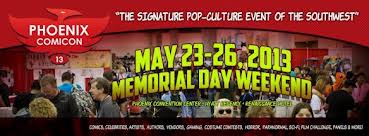
I will be at booth #1629 which will be on the end next to the Star Wars Display and the Lego Display.  I will be selling copies of my first three books, and at least my fourth, Twisted Nightmares.  Hopefully, I can finish Blood Bank by then, but I am not sure.  My wife will also be selling vintage style jewelry, steampunk items, zombie response team medallions, Cthulhu wear and other very cool items.  The link to her Etsy shop is below, her creations are SusannesPassion, all one word, no apostrophe.

I also have two tentative discussions to be on panels; one on steampunk and one on writing and publishing.  Not sure if either will pan out, but will let you know.  Also, in discussions for the Gaslamp Gathering in San Diego, but not sure on that yet.

http://www.etsy.com/shop/SusannesPassion


pcc13 two

http://www.phoenixcomicon.com/

pcc13


Leave a comment

Filed under Humor and Observations, Uncategorized, Writing

North Korea Threatens Nuclear War

First, a history lesson.  The Korean War, police action, or whatever you wish to call it, never ended.  That is right, a cease-fire was called, but the war never was ended.  My brother was stationed in Korea in the Army and they would occasionally come under fire, even in the late 1970s when he was over there.  I was in the US Air Force from 1984 to 1990 and each year participated in Operation Team Spirit.  Joint exercises to coordinate the South Korean and American military in case of renewal of hostilities with North Korea.  We have had these exercises for over 60 years now.  So, if you think what we are doing is new and provocative, it is not.  Most people living on the planet were not here in we first started joint exercises, including Kim Jong Un, the new leader.

If you think it can’t happen, just look at the Iran-Iraq War, the Russian invasion of Afghanistan and Chechnya, the break-up of Yugoslavia, the ethnic cleansing in Africa.  It can happen.  The saber rattling is to be taken seriously as Kim Jong Un has been raised in total isolation as a foolish sociopath.  While his country starves, he creates nuclear weapons and buys his wife he married when she was 16, expensive designer outfits and Dior handbags worth over $1,200 a piece.  Just some background to ponder while considering the story reposted below:


South Korea and US begin military drills as North Korea threatens war

Published March 11, 2013

Associated Press

  • SouthKoreaUSDrills.JPG

    March 9, 2013: The guided-missile destroyers USS Lassen (DDG 82), arrives to participate in the annual joint military exercises, dubbed Key Resolve, between the South Korean and United States. (AP)

SEOUL, South Korea –  North Korean state media said Monday that Pyongyang had carried through with a threat to cancel the 60-year-old armistice that ended the Korean War, as it and South Korea staged dueling war games amid threatening rhetoric that has risen to the highest level since North Korea rained artillery shells on a South Korean island in 2010.

Enraged over the South’s joint military drills with the United States and recent U.N. sanctions, Pyongyang has piled threat on top of threat, including vows to launch a nuclear strike on the U.S. Seoul has responded with tough talk of its own and has placed its troops on high alert.

The North Korean government made no formal announcement Monday on its repeated threats to scrap the armistice, but the country’s main newspaper, Rodong Sinmun, reported that the armistice was nullified Monday as Pyongyang had earlier announced it would.

The North followed through on another promise Monday, shutting down a Red Cross hotline that the North and South used for general communication and to discuss aid shipments and separated families’ reunions.

The 11-day military drills that started Monday involve 10,000 South Korean and about 3,000 American troops. Those coincide with two months of separate U.S.-South Korean field exercises that began March 1.

The drills are held annually, and this year, according to South Korean media, the “Key Resolve” drill rehearses different scenarios for a possible conflict on the Korean peninsula using computer-simulated exercises. The U.S. and South Korean troops will be used to test the scenarios.

Also continuing are large-scale North Korean drills that Seoul says involve the army, navy and air force. The South Korean defense ministry said there have been no military activities it considers suspicious.

The North has threatened to nullify the armistice several times in times of tension with the outside world, and in 1996 the country sent hundreds of armed troops into a border village. The troops later withdrew.

Despite the heightened tension, there were signs of business as usual Monday.

The two Koreas continue to have at least two working channels of communication between their militaries and aviation authorities.

One of those hotlines was used Monday to give hundreds of South Koreans approval to enter North Korea to go to work. Their jobs are at the only remaining operational symbol of joint inter-Korean cooperation, the Kaesong industrial complex. It is operated in North Korea with South Korean money and knowhow and a mostly North Korean work force.

The North Korean rhetoric escalated as the U.N. Security Council last week approved a new round of sanctions over Pyongyang’s latest nuclear weapons test Feb. 12.

Analysts said that much of the bellicosity is meant to shore up loyalty among citizens and the military for North Korea’s young leader, Kim Jong Un.

“This is part of their brinksmanship,” said Daniel Pinkston, a Seoul-based expert on North Korea with the International Crisis Group think tank. “It’s an effort to signal their resolve, to show they are willing to take greater risks, with the expectation that everyone else caves in and gives them what they want.”

Part of what North Korea wants is a formal peace treaty to end the Korean War, instead of the armistice that leaves the peninsula still technically in a state of war. It also wants security guarantees and other concessions, direct talks with Washington, recognition as a nuclear weapons state and the removal of 28,500 U.S. troops stationed in South Korea.

Pinkston said there is little chance of fighting breaking out while war games are being conducted, but he added that he expects North Korea to follow through with a somewhat mysterious promise to respond at a time and place of its own choosing.

North Korea was responsible for an artillery attack that killed four South Koreans in 2010. A South Korean-led international investigation found that North Korea torpedoed a South Korean warship that same year, killing 46 sailors. Pyongyang denies sinking the ship.

Among other threats in the past week, North Korea has warned Seoul of a nuclear war on the divided peninsula and said it was cancelling nonaggression pacts.

South Korean and U.S. officials have been closely monitoring Pyongyang’s actions and parsing its recent rhetoric, which has been more warlike than usual.

One analyst said Kaesong’s continued operations show that North Korea’s cutting of the Red Cross communication channel was symbolic. More than 840 South Koreans were set to cross the border Monday to Kaesong, which provides a badly-needed flow of hard currency to a country where many face food shortages, according to Seoul’s Unification Ministry.

“If South Koreans don’t go to work at Kaesong, North Korea will suffer” financially, said analyst Hong Hyun-ik at the private Sejong Institute in South Korea. “If North Korea really intends to start a war with South Korea, it could have taken South Koreans at Kaesong hostage.”

Under newly inaugurated President Park Geun-hye, South Korea’s Defense Ministry, which often brushes off North Korean threats, has looked to send a message of strength in response to the latest comments from Pyongyang.

The ministry has warned that the North’s government would “evaporate from the face of the Earth” if it ever used a nuclear weapon. The White House also said the U.S. is fully capable of defending itself against a North Korean ballistic attack.

On Monday, Park told a Cabinet Council meeting that South Korea should strongly respond to any provocation by North Korea. But she also said Seoul should move ahead with her campaign promise to build up trust with the North.

North Korea has said the U.S. mainland is within the range of its long-range missiles, and an army general told a Pyongyang rally last week that the military is ready to fire a long-range nuclear-armed missile to turn Washington into a “sea of fire.”

While outside scientists are still trying to determine specifics, the North’s rocket test in December and third atomic bomb test last month may have pushed the country a step closer to acquiring the ability to hit the U.S. with weapons of mass destruction. Analysts, however, say Pyongyang is still years away from acquiring the smaller, lighter nuclear warheads needed for a credible nuclear missile program.

But there are still worries about a smaller conflict, and analysts have said that more missile and nuclear tests are possible reactions from North Korea.

North Korea has a variety of missiles and other weapons capable of striking South Korea. Both the warship sinking and island shelling in 2010 occurred near a western sea boundary between the Koreas that North Korea fiercely disputes. It has been a recurring flashpoint between the rivals that has seen three other bloody naval skirmishes since 1999.

Last week, Kim Jong Un visited two islands just north of the sea boundary and ordered troops there to open fire immediately if a single enemy shell is fired on North Korean waters.

Kim was also quoted as saying his military is fully ready to fight an “all-out war” and that he will order a “just, great advance for national unification” if the enemy makes even a slight provocation, according to the North’s official Korean Central News Agency.

Read more: http://www.foxnews.com/world/2013/03/11/south-korea-and-us-begin-military-drills-as-north-korea-threatens-war/#ixzz2NNN9Jhqf

Leave a comment

Filed under Humor and Observations, Uncategorized

Comet Pan-STARRS at its brightest this weekend!

By Miriam Kramer

Published March 08, 2013

Space.com

  • comet-panstarrs-march-2013

    The progression of comet Pan-STARRS across the night sky in March 2013 is shown in this NASA graphic. (SCIENCE@NASA)

  • comet-pan-starrs-sky-map

    The path of Comet C/2011 L4 (Pan-STARRS) over the next month. (STARRY NIGHT SOFTWARE)

  • comet-pan-starrs-close-up-gingin-observatory

    Close-up of comet C/2011 L4 PANSTARRS as seen from Mount Dale, Western Australia. (ASTRONOMY EDUCATION SERVICES/GINGIN OBSERVATORY)

A comet that just made its way into the Northern Hemisphere evening sky should be at its brightest this weekend, but it may be tricky for stargazers to see.

On Sunday (March 10), the Comet Pan-STARRS is expected to make its closest approach to the sun, potentially making the comet shine even more brilliantly when it appears at twilight low in the western sky, weather permitting. But stargazers will need a bit of preparation (not to mention a clear sky) to see the comet.

“There is a catch to viewing Comet Pan-STARRS,” Amy Mainzer, the principal investigator of NASA’s near-Earth object hunting NEOWISE mission at the Jet Propulsion Laboratory in Pasadena, Calif., said in a statement Thursday (March 7). “This one is not that bright and is going to be low on the western horizon, so you’ll need a relatively unobstructed view to the southwest at twilight and, of course, some good comet-watching weather.”

On Sunday, Comet Pan-STARRS will pass about 28 million miles from the sun during its close approach. The comet made its closest pass with the Earth on Tuesday (March 5) when it flew by at about 102 million miles from the planet. [How to see the comet]

“It will appear in the west at sunset, from around the 8th to the 13th of March 2013, and will be visible to the naked eye up to the end of the month: Comet Pan-STARRS C/2011 L4 will traverse Cetus, Pisces, Pegasus and Andromeda,” Paris Observatory officials wrote in a statement Thursday, as the comet entered the Northern Hemisphere’s evening sky after months of being visible from the Southern Hemisphere.

Comet Pan-STARRS, which has the official designation C/2011 L4 (PANSTARRS), was discovered in June 2011 by astronomers using the Panoramic Survey Telescope and Rapid Response System (or PANSTARRS) telescope in Hawaii. The comet made its way into the inner solar system from the Oort cloud — a group of icy bodies orbiting the sun in a region that extends from just beyond the orbit of Neptune out to a distance of 93 trillion miles.

While Pan-STARRS may start dimming after Sunday, that doesn’t mean that comet observers should put away their binoculars yet. On March 12 and 13, the comet will appear close to the moon, possibly even silhouetting it according to SPACE.com stargazing columnist Geoff Gaherty, an astronomer with the Starry Night Education night sky software company.

There are even comet sighting opportunities in April.

On April 3, the comet should be in the same part of the sky as the Andromeda Galaxy. Although the comet won’t still be visible with the naked eye, stargazers with telescopes could still get a nice view of the comet and galaxy, Gaherty explained.

Pan-STARRS has already put on a show for stargazers in the Southern Hemisphere. It is one of several comets in the night sky expected to dazzle observers this year. Last month, amateur astronomers managed to photograph Pan-STARRS and another celestial wanderer — Comet Lemmon — at the same time to document rare photos of two comets together in the night sky.

Later this year, another comet from the Oort Cloud could be the brightest comet to pass by the Earth in a generation. Comet ISON is expected to outshine every comet in recent memory when it makes its closest swing by the sun late November.

Read more:http://www.foxnews.com/science/2013/03/08/naked-eye-comet-pan-starrs-at-its-brightest-this-weekend/?intcmp=trending#ixzz2NNIZrGk1

Leave a comment

Filed under Humor and Observations, Uncategorized

Word Trivia

Word Trivia

Fun Fridays – May 11, 2012

Word Trivia

“Stewardesses” and “reverberated” are the two longest (and commonly used) words (12 letters each) that can be typed with only the left hand.

“lollipop” is the longest word typed with your right hand.

The only 15 letter word that can be spelled without repeating a letter is uncopyrightable.

No word in the English language rhymes with month, orange, silver, or purple.

“Dreamt” is the only English word that ends in the letters “mt”.

The sentence: “The quick brown fox jumps over the lazy dog” uses every letter of the alphabet.

The words ‘racecar,’ ‘kayak’ and ‘level’ are the same whether they are read left to right or right to left (palindromes).

There are only four words in the English language which end in “dous”: tremendous, horrendous, stupendous, and hazardous.

There are two words in the English language that have all five vowels in order: “abstemious” and “facetious.” (a e i o u)

Typewriter is the longest word that can be made using the letters only on one row of the keyboard.

A “jiffy” is an actual unit of time for 1/100th of a second.

The only city whose name can be spelled completely with vowels is Aiea, Hawaii.

[Editor’s Note:  I did in fact live in Aiea for many years during a six year stint in Hawaii on the island of Oahu.  My wife and I had a terrible time getting mail.  All of our friends and family could not believe we lived in a place with only four vowels and no consonents – A I E A.  Pronounced “EYE -A- Uh”  The most common misspelling was ALEA.  They just randomly put an L in for the Aiea.  Curious folks my wonder where Aiea is located.  It is between Honolulu and Pearl Ridge.  We lived in a ten story apartment complex across the street from Aiea Chop Suey and Speedy’s Supermarket.  Aloha Stadium (home to the Aloha Bowl, the Hula Bowl, and The Pro Bowl and to the University of Hawaii Rainbow Warrior all played there.  From our lanai (balcony) we would look out over all of Pearl Harbor.  The Arizona Memorial was right in front of us.]


Leave a comment

Filed under Uncategorized, Writing

Steampunk Airship Crew #6

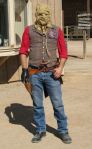
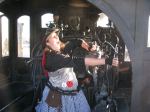
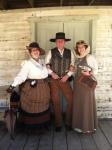
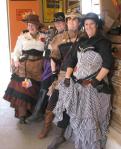
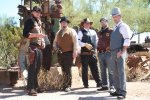
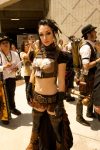
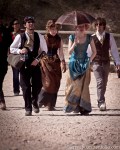
Having just returned from the amazing Wild Wild West Con 2, the Steampunk Convention at Old Tucson Studios, I have to put up more Steampunk pictures.  I had a great panel with myself, friends Patti Hulstrand and Chris Wilke.  Kudos to Diana, Jason, and Noe on throwing a great convention that was tons of fun.  Built up some wife points when I purchased Becky the whole set of original Con versions of Lady Mechanika – yes Joe Benitez was there!  They were all signed and packaged, but he was nice enough to further personalize each “to Becky.”  There was also a booth selling amazingly well made corsets for just $60.  My wife went to get one, feeling a bit guilty after I had already spoiled her, but unfortunately they did not have her size in the color she wanted.

I met so many amazing new people there is not really time to list them all.  Thanks again to those who invited me out as a guest to speak on a panel about Steampunk and writing!  Thanks also to Davina and Kathleen, who were there at the panel, and purchased The Travelers’ Club and the Ghost Ship!  I hope you enjoy it immensely!

Now, to the aircrew.  The ones in the desert are most likely from WWWC2.  I will be sprinkling them over time.  You are now ready to pick the crew and staff for your sixth airship in your burdgeoning fleet.  Do you want a merchant vessel, an explorer, a pirate ship, a military vessel, a ship for world domination, or other purposes?  Choose your crew wisely.  You cannot pick more than eight.

Leave a comment

Filed under Humor and Observations, Uncategorized

Travel the Ancient Roman Empire!

Below is a story from I09 about ORBIS.  ORBIS is an amazing site that actually allows you to explore the ancient Roman Empire by map, and see how long various modes of travel would take, what form they would take, and how many denarii would be needed.  Very cool.  First the link, then the story:

http://orbis.stanford.edu/#

This interactive travel map of the Roman Empire is like Oregon Trail meets Civilization

Ever wondered how long it would take to travel from Rome to Constantinople at the peak of the Roman Empire? Or from Luna to Larissa? Or Parma to Thessalonica? This map of the Roman World created at Stanford University is awesomely realistic — all the ancient transportation lines on it actually existed 2,000 years ago.

Tell us, would you like to travel to Rome by road, river or open sea? Would you stick to the coasts or set a course through the mainland? During which month would you journey? Would you opt for the fastest route (bearing in mind that the shortest course does not always translate to the quickest passage) or the cheapest? Speaking of expenses, how much would this journey cost you, anyway? (Please give your answer in denarii.)

Confused? Overwhelmed? Fear not — ORBIS is here to help you plan your trip. ORBIS is Stanford University’s geospatial network model of the Roman World. It’s fully interactive (as we alluded to above, you can adjust time of travel, mode of travel, starting points and destinations, and so on); highly customizable (select from fourteen different modes of transportation — and that’s just road travel); and positively bursting with information. It’s a little like Oregon Trailmeets Civilization, only without the dysentery and with infinitely more historical and comparative data. Yes, it is awesome, and — if you’re into this sort of thing — enormously time consuming.

Via Stanford:


For the first time, ORBIS allows us to express Roman communication costs in terms of both time and expense. By simulating movement along the principal routes of the Roman road network, the main navigable rivers, and hundreds of sea routes in the Mediterranean, Black Sea and coastal Atlantic [featured above is a depiction of navigable sea routes in July, with coastal routes in blue and overseas routes in green], this interactive model reconstructs the duration and financial cost of travel in antiquity.

Taking account of seasonal variation and accommodating a wide range of modes and means of transport, ORBIS reveals the true shape of the Roman world and provides a unique resource for our understanding of premodern history. [Featured below: a contour map of travel time to Rome in July.]


You can learn a little more about using ORBIS in this introductory video, but we highly recommend heading over to the ORBIS website, where you’ll learn more about this geospatial model’s applications and its historically rich digital architecture. This is really, really impressive stuff.

[ORBIS]

Top image via Shutterstock

Leave a comment

Filed under Humor and Observations, Uncategorized

Use Your Laptop With Gestures Instead of Keyboard and Mouse?

Leap Motion, Gesture-Control Gadget For Your Laptop, Will Be Released This May For $80

The Huffington Post  |  By Posted: 02/27/2013 11:59 am EST

Leap Release
Turns out that 2013 is, indeed, a Leap Year.

Leap Motion, the company that makes the hotly anticipated gesture-control device of the same nameannounced Wednesday morning that the first Leap Motion units would ship to pre-orderers around the world on May 13, and that everyone could get their hands (and fingers) on one on May 19.

If you want one, you can order on Leap Motion’s website here or, somewhat curiously, on BestBuy.com right here. The Leap Motion Controller costs $80 at either outlet.

For a refresher, the Leap Motion controller plugs into almost any newer laptop and allows you to manipulate the screen via a series of hand and finger movements in the air. It’s sort of like having a touchscreen computer, but without actually touching the screen. Watch this video below, made by Leap Motion, to get an idea of how the small device can wholly transform your computer:

Previously, Leap Motion announced that it was sending 10,000 of its controllers to developers, so that there would be apps specifically built for gesture control; earlier this year, the company announced its app store, Airspace, and we’ve already seen one of those apps, by the developers behind the to-do list Clear, shown off.

In general, though, Leap Motion works with your existing operating system (Windows 7 or 8, or OS X 10.7 and 10.8), via zoom, scroll and zoom functions baked into the hardware, which you plug into your USB port. Wired’s Roberto Baldwin wrote that the Leap probably works best as a secondary controller, after your trackpad or mouse, and for specific apps or games written for it; but, like most reviewers, he came away very impressed by the little gizmo’s accuracy and speed.

For more on the Leap Motion Controller, and to pre-order, you can visit the official website right here.

1 Comment

Filed under Humor and Observations, Uncategorized

Come By the Wild Wild West Con 2 Tomorrow and Say Hello!

Friday, March 8th, 2013, I will be appearing as a guest at Wild Wild West Con 2, the only Steampunk only Con at an actual 1880s theme park.  Old Tucson Studios, the site of over 300 movies and TV shows, will be hosting the event for the Friday, Saturday and Sunday.  It is hosted by the great folks at the Arizona Steampunk Society who have put tons of work into it.  A shout out to Diana, Jason and Noe and to the hundreds of others working to make this a fun and exciting weekend event.

Thanks to their gracious invitation, I will be there Friday, on a panel at 2 pm discussing writing steampunk, steampunk themes in literature and indie publishing.  Joining me on the panel are author/publisher/magazine editor Patti Hulstrand, and author/cover designer/computer whiz Chris Wilke.  Please stop by not only to see us, but all the great costumes, events, performances and live bands.  Here is a link:

http://www.wildwildwestcon.com/d/

logo

Unfortunately, due to still recovering from recent medical procedures, I will only be able to attend the first day.  I will not have a vendor booth, but will be available briefly before and after the panel to sign copies of my Steampunk and other books.  You will also get to see me as my alter ego, dressed in 1880s western steampunk garb.  It is sure to be a great day for you and all you bring.  Lots of fun, and a unique experience.

Leave a comment

Filed under Humor and Observations, Uncategorized, Writing