Monthly Archives: January 2013

Printing Food

3D printers are the technology that will change everything ab0ut our lives.  I was just having dinner with friends and said if you can put polymers in a 3d printer and print out three dimensional objects, why not put food paste, texture, flavor packets and coloring and print food?  In essence, you could transmit a “recipe” to a printer as easily as a structural diagram, and food is just as easy to layer as polymer.  I had no idea it would be tried so soon.  Get drunk late at night and want to head to Taco Bell?  Want a pizza delivered during the big game?  Why not print one out?  Go to pizzarecipe.com, pick out your favorite, download to the printer, voila!  Star Trek Replicators now.

A single 3D-printed burger currently costs over $300,000 to make

Jan. 22, 2013 (3:00 pm) By: 

Cheeseburgers

3D printing might be the wave of the future, or it might just end up a niche hobby that’s pretty cool but ultimately too expensive and complicated to ever take off. Whatever that fate may be, startup Modern Meadow is throwing its hat into the 3D printing ring, but rather than printing plastic trinkets or gun parts, it plans to print edible meat.

We’ve mentioned Modern Meadow – a company that is practicing a variant of 3D printing, called 3D bioprinting — before. Instead of using resin like standard 3D printing, or a material more easily sent through a printer for food-printing like melted chocolate that then hardens, Modern Meadow uses material somewhat creepily called “bioink”.

In order to print live cells, the engineers perform biopsies on animals and collect stem cells, or other special cells. Because stem cells are basically magical (this not a technical term), they can not only turn into other cells, but replicate themselves. Once they replicate enough times, the engineers load them into a bioprinter cartridge, which creates something of a bioink — a material made of many live cells. When the bioink is printed, the living cells link together and form living tissue.

Modern MeadowWhen using 3D bioprinting a hamburger as an example, Professor Gabor Forgacs — part of the father and son founders of Modern Meadow — notes that the actual shape of the food isn’t too much of a hurdle, as it’s simply a round, relatively 2D patty. Another benefit to producing edible meat is that the live tissue can die afterward, as consumable meat normally isn’t living tissue, so a method of preserving the tissue’s life isn’t really required.

Though it might be easier to print edible, dead-tissue meat, Modern Meadow is facing a couple fairly large hurdles. For one, convincing the world to eat lab-grown meat might not be so easy. Another significant hurdle is that though Modern Meadow hasn’t grown something like a burger or steak as of yet, the price of one would be astronomically high. Another team of researchers at Maastricht University in the Netherlands has been growing animal cells to produce strips of lean muscle, with the goal of creating an artificial hamburger. Though the team doesn’t use bioprinting, they do use a somewhat related process of having stem cells replicate and create live tissue in a mold. Unfortunately, creating an entire burger would currently cost over $300,000.

If this all seems a little nutty, Modern Meadow has managed to raise some backing from prominent figures, such as Peter Thiel, who was one of Facebook’s early investors. There’s no word yet on when the company will be able to print a burger (or even a slider!), but if it can, it will be interesting to see how much it’ll cost, and if people can be convinced that “synthetic” meat is truly edible.

1 Comment

Filed under Humor and Observations

Ancient Roman Graffiti

11 Colorful Phrases From Ancient Roman Graffiti

Mark Mancini
IMAGE CREDIT:
FLICKR USER ROLLER COASTER PHILOSOPHY

When the cities of Pompeii and Herculaneum were suddenly consumed by the eruption of Mount Vesuvius in 79 C.E., many of their buildings were so intimately preserved that modern archaeologists can even read the graffiti scribbled onto their ancient walls. See if any of these remind you of a twenty-first century bathroom.

1. “PHILIROS SPADO.”

“Phileros is a eunuch.”

2. “LUCIUS PINXIT.”

“Lucius wrote this.”

3. “APOLLINARIS, MEDICUS TITI IMPERATORIS HIC CACAVIT BENE.”

“Apollinaris, doctor to the emperor Titus, had a good crap here.” In Latin profanity, “cacatne” pertained to defecation.

4. “OPPI, EMBOLIARI, FUR, FURUNCLE.”

“Oppius, you’re a clown, a thief, and a cheap crook.”

5. “MIXIMUS IN LECTO. FAETOR, PECCAVIMUS, HOSPES. SI DICES: QUARE? NULLA MATELLA FUIT.”

“We have wet the bed. I admit, we were wrong, my host. If you ask ‘why?’ There was no chamber pot.” Found inside an inn.

6. “VIRGULA TERTIO SU: INDECENS ES.”

“Virgula to Teritus: You are a nasty boy.”

7. “EPAPHRA, GLABER ES.”

“Epaphra, you are bald.”

8. “TALIA TE FALLANT UTINAM MEDACIA, COPO: TU VEDES ACUAM ET BIBES IPSE MERUM.”

“If only similar swindling would dupe you, innkeeper: you sell water, and drink the undiluted wine yourself.”

9. “VATUAN AEDILES FURUNCULI ROG.”

“The petty thieves request the election of Vatia as adele.” In ancient Pompeii, an “adele” was an elected official who supervised markets and local police, among other things.

10. “SUSPIRIUM PUELLAM CELADUS THRAEX.”

“Celadus makes the girls moan.”

11. “ADMIROR, O PARIES, TE NON CECIDISSE, QUI TOT SCRIPTORIUM TAEDIA SUSTINEAS.”

“I wonder, O wall, that you have not yet collapsed, so many writers’ clichés do you bear.” This phrase seems to have been a popular one, as slightly different versions of it appear in multiple locations throughout Pompeii’s ruins.

In the interest of avoiding hardcore lewdness and profanity, I’ve omitted some of the truly vulgar defacements. For some firmly NSFW examples, do go here.

These quotes were were recorded in a comprehensive, multi-volume collection of Latin inscriptions called Corpus Inscriptionum Latinarum, which was first published in in 1857. Image credit: Flickr user Roller Coaster Philosophy.

Read the full text here: http://mentalfloss.com/article/32276/11-colorful-phrases-ancient-roman-graffiti#ixzz2JFIcy4q2
–brought to you by mental_floss!

Leave a comment

Filed under Humor and Observations

Why Are Coupons Worth 1/100th of a Cent?

Why Are Coupons Worth 1/100th of a Cent?

Ethan Trex

The next time a coupon shows up in your mail, take a look at the fine print. There’s a pretty good chance it will read something to the effect of “Cash Value 1/100th of a cent.” Why in the world is that writing on there? And are 10,000 copies of this coupon really worth a whole dollar? Let’s take a look at this coupon quirk.

PUTTING A STAMP ON CUSTOMER LOYALTY

Before we can answer the coupon-value question, we need to take a peek into a seemingly unrelated footnote in the history of commerce. Let’s talk about the mostly forgotten practice of businesses handing out trading stamps with purchases.

Trading stamps first found their way into merchants’ registers in the 1890s. When customers made a purchase, stores would given them stamps that reflected how much they had spent; a common exchange rate was one stamp for every dime spent on merchandise. Once a customer had saved up enough stamps – often over a thousand – they could swap them for something from the stamp company’s catalog, like a toaster or a clock.

The trading stamps were a runaway success. Supermarkets, gas stations, and department stores would advertise that they gave away a certain brand of stamps to help lure customers in, and the customers could then lick and paste their saved stamps to get “free” merchandise. Everyone was happy, and the system flourished. At one point in the 1960s, S&H Green Stamps printed more stamps each year than the Postal Service did. The circulation of the company’s catalog topped 30 million. The big stamp makers like S&H even built brick-and-mortar “redemption center” stores around the country.

As any economist worth his cost function can tell you, though, the toasters and vacuum cleaners that customers got weren’t free at all. Merchants had to pay for the stamps they gave away, and the cost of the stamp obviously got passed along to the customer in the form of higher prices.

Even in the early days, it didn’t take long for customers to figure out that the system wasn’t quite as rosy as merchants made it out to be. By 1904 New York had enacted laws that forced stamp makers to put a cash face value on each stamp that would enable consumers to bypass catalog redemptions and get money back for their stamps. Other states followed suit.

As one might guess, the individual stamps didn’t get princely face values. A 1904 New York Times piece noted that most stamp makers were given the value of “one mill,” or 1/10th of a cent. That valuation meant that a customer with a full book of 1,000 stamps could redeem it for a dollar. The same piece noted, though, that a customer who used the stamp makers’ catalogs could probably get an item worth three or four dollars for the same number of stamps, so the cash-redemption idea never really took off with most shoppers.

What happened to trading stamps? Their popularity peaked in the 1960s when nearly 80 percent of American households saved stamps, but within a decade the craze had died. Manufacturer coupons that shaved money off of items’ prices became more popular as inducements to get shoppers into stores, and the fuel crisis of the early 1970s sapped away the stamps’ large market at gas stations.

SO WHAT DOES ALL THIS HAVE TO DO WITH COUPONS?

At first glance, coupons and trade stamps wouldn’t seem to have all that much in common. After all, coupons lower the price of an item, while the beef with trade stamps was that they passed a hidden (and often unwanted) cost along to consumers. But some states legally lump trade stamps and coupons in together, so coupons distributed in these states have to bear some printed cash redemption value.

According to the Association of Coupon Professions, only three states require this declaration of redemption value: Indiana, Utah, and Washington. Since many coupons are designed for national distribution, though, the redemption value ends up printed on all of them. As with the old trade stamps, it doesn’t really matter how infinitesimal the stated value is as long as it’s not zero. Thus, you see coupons that are worth 1/10th, 1/20th, or 1/100th of a cent.

SO CAN I ROUND UP 20 COUPONS AND GET A PENNY?

In theory, yes. It’s hard to find reliable, concrete examples of someone schlepping in a hundred coupons to swap them out for a penny, but the web is full of anecdotes in which people “test the fine print” by trading in a giant stack of coupons for their face value at the supermarket. In all likelihood, though, you’d need to mail the coupons to the issuing company, which is a pretty lousy financial proposition given the price of stamps.

If you’re sitting on a big pile of Shake N Bake coupons, you might as well give it a try; your supermarket will probably gladly surrender a penny to ensure you don’t make a scene.

Read the full text here: http://mentalfloss.com/article/26838/why-are-coupons-worth-1100th-cent#ixzz2JFFRO2HT
–brought to you by mental_floss!

Leave a comment

Filed under Humor and Observations

Thank You to Varla Skye and My Steampunk Army

Varla Skye and My Steampunk Army contribute many of the cool steampunk aircrew shots I feature on this site.  Here is a shout out thank you to them, and if you want to see more, which I KNOW you do, here is Varla Skye’s FB page, and My Steampunk Army FB page.  Please stop by, like them, and say you saw them here…

https://www.facebook.com/MySteampunkArmy?ref=ts&fref=ts

My Steampunk Army

https://www.facebook.com/VarlaSkye?fref=ts

varla skye

Leave a comment

Filed under Humor and Observations, Uncategorized

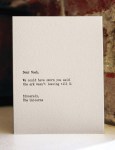
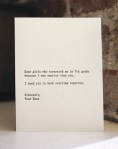
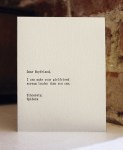
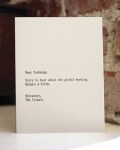
Funny, Sarcastic Cards

Funny sarcastic cards.  Hard to describe them beyond that.  Enjoy:

Leave a comment

Filed under Humor and Observations

Steampunk Airship Crew Post 3

In my third edition of Steampunk Airship Crew, you once again get to figure out who you will hire as your crew for the third Airship in your growing fleet of dirigibles.  Are you an air pirate?  A conqueror?  A defender?  A traveler and explorer?  A sky trader?  Smuggler?  It is up to you what to do with your ship, but crew members are hard to come by and may or may not fit your expectations.  You can’t hire them all, so who would you pick out of the following applicants?

Leave a comment

Filed under Humor and Observations

More Random Humor

More random humor for your enjoyment:

Leave a comment

Filed under Humor and Observations

Rejection Letters to Famous Authors

Try, Try Again: Rejection Letters Received by Bestselling Authors

IMAGE CREDIT:


For writers, getting rejected can seem like a pastime. But don’t take my word for it, even though I’ve gotten my share of no-thank-yous. These best-selling authors were rejected, too, and some not very kindly. Editors, publishers and agents have made big errors in judgment, as evidenced by the list of unkind (and sometimes needlessly rude) rejections received by these famous writers.

1. GEORGE ORWELL

It seems Alfred Knopf didn’t always understand satire. Animal Farm, the famed dystopian allegory that later became an AP Reader standard and Retrospective Hugo Award winner, was turned down because it was “impossible to sell animal stories in the U.S.A.” A British publishing firm initially accepted and later rejected the work as well, arguing that “…the choice of pigs as the ruling caste will no doubt give offense to many people, and particularly to anyone who is a bit touchy, as undoubtedly the Russians are.”

2. GERTRUDE STEIN

Not much burns worse than mockery, and I would imagine Gertrude Stein was probably fuming when she received this letter from Arthur C. Fifield with her manuscript for Three Lives: “Being only one, having only one pair of eyes, having only one time, having only one life, I cannot read your MS three or four times. Not even one time. Only one look, only one look is enough. Hardly one copy would sell here. Hardly one. Hardly one.” Twenty years later, Stein’sThe Autobiography of Alice B. Toklas became her one and only best-seller.

3. STEPHEN KING

Most fans know that King’s big break came with Carrie, the story of a friendless, abused girl with secret telekinetic powers. Though one publishing house told him they were “not interested in science fiction which deals with negative utopias.  They do not sell,” Doubleday picked up the paperback rights to the novel and sold more than a million copies in its first year.

4. WILLIAM GOLDING

Though Lord of the Flies was one of my favorite books from high school, it seems some publishers disagreed. One unimpressed agent called the classic “an absurd and uninteresting fantasy which was rubbish and dull.” To date, the book has been required reading in high schools for nearly fifty years, 14.5 million copies have been sold, and Golding’s work has been adapted for film twice.

5. JACK KEROUAC


It’s not incredibly surprising that Kerouac’s work was considered unpublishable in his time. After all, the guy wrote about drugs, sex, and the kind of general lawlessness that many people in the 1950s considered obscene. When shopping out his ubiquitous On the Road, Kerouac’s agent’s mail contained gems like, “His frenetic and scrambling prose perfectly express the feverish travels of the Beat Generation. But is that enough? I don’t think so” and even worse, “I don’t dig this one at all.”

6. MARY HIGGINS CLARK

Back in 1966, the young romance author was trying to sell a story she called “Journey Back to Love.” It didn’t go well, however; her submission to Redbook came back with a rejection from the editors, stating “We found the heroine as boring as her husband had.” Ouch! The piece was eventually run as a two-part serial in an English magazine, and Mary Higgins Clark currently boasts forty-two bestselling novels.

7. AYN RAND

When Rand sent her manuscript out for The Fountainhead, a request from Bobbs-Merrill for her next work-in-progress came back with a curt “Unsaleable and unpublishable.” Not to be deterred, the author called upon Hiram Haydn, newly appointed editor-in-chief of Random House. After an “infinite number” of questions and an assurance that Ms. Rand would not be censored, she signed on with Random House and, to date, has sold over 7 million copies in the U.S.

8. ERNEST HEMINGWAY

In a bid to remove himself from a contract with publishers Boni & Liveright, Hemingway penned The Torrents of Spring with the sole intention of being rejected. Horace Liveright turned it down, Hemingway’s contract was broken, and he moved on to find a new publisher. Of course, it didn’t go smoothly; one queried editor told the author that “It would be extremely rotten taste, to say nothing of being horribly cruel, should we want to publish this.” It all ended well, however. Papa Hemingway moved on to Scribner, who published all of his books from then on—each of which became a bestseller.

Read the full text here: http://mentalfloss.com/article/26662/try-try-again-rejection-letters-received-bestselling-authors#ixzz2IsCcnvOj
–brought to you by mental_floss!

1 Comment

Filed under Writing

Lying about Length

Does length really matter?  Some people lie about their length in inches a lot and all they get is “disappointed people” but now overestimating your size can be unlawful.  That is right, I am talking about Subway’s famous foot-long sandwiches.  Apparently, many of them are only eleven inches long, and now, people are suing for false advertisement.  Think about that the next time you advertise something as longer or bigger around than it usually is…

2 NJ men sue Subway over short footlong sandwiches

Published January 23, 2013

Associated Press

  • subway_footlong.jpg

Two New Jersey men sued Subway this week, claiming the world’s biggest fast-food chain has been shorting them by selling so-called footlong sandwiches that measure a bit less than 12 inches.

The suit, filed Tuesday in Superior Court in Mount Holly, may be the first legal filing aimed at the sandwich shops after an embarrassment went viral last week when someone posted a photo of a footlong and a ruler on the company’s Facebook page to show that the sandwich was not as long as advertised.

At the time, the company issued a statement saying that the sandwich length can vary a bit when franchises do not bake to the exact corporate standards.

Stephen DeNittis, the lawyer for the plaintiffs in the New Jersey suit, said he’s seeking class-action status and is also preparing to file a similar suit in Pennsylvania state court in Philadelphia.

He said he’s had sandwiches from 17 shops measured — and every one came up short.

“The case is about holding companies to deliver what they’ve promised,” he said.

Even though the alleged short of a half-inch or so of bread is relatively small, it adds up, he said. Subway has 38,000 stores around the world, nearly all owned by franchisees and its $5 footlong specials have been a mainstay of the company’s ads for five years.

DeNittis said both plaintiffs — John Farley, of Evesham and Charles Noah Pendrack, of Ocean City — came to him after reading last week about the short sandwiches.

DeNittis is asking for compensatory damages for his client and a change in Subway’s practices.

The Milford, Conn.-based firm should either make sure its sandwiches measure a full foot or stop advertising them as such.

He points to how McDonald’s quarter-pounders are advertised as being that weight before they are cooked.

Subway did not immediately return a call to The Associated Press on Wednesday.

Read more: http://www.foxnews.com/leisure/2013/01/23/2-nj-men-sue-subway-say-company-misled-them-by-selling-footlongs-that-came-up/?intcmp=features#ixzz2IraGDOKs

Leave a comment

Filed under Humor and Observations

2,000-year-old treasure found in Black Sea fortress

2,000-year-old treasure found in Black Sea fortress

By Owen Jarus

Published January 10, 2013

LiveScience

  • Black Sea treasure 1.jpg

    Researchers working at the site of Artezian in the Crimea (Ukraine) have discovered two hoards of buried treasure (one hoard shown here) dating to A.D. 45, a time when the people of the citadel were under siege by the Roman army. Here, two silver anklets, beads, numerous coins and a white, glass flask with a two-headed face, one side serious and the other happy. (Russian-Ukrainian Archaeological Artezian Expedition)

  • Black Sea treasure.jpg

    The citadel was torched by the Roman army in A.D. 45, with many of its inhabitants likely killed. Some time afterward Artezian was rebuilt with stronger fortifications although it, along with the rest of the Bosporan Kingdom, was under the sway of Rome. (Russian-Ukrainian Archaeological Artezian Expedition)

Residents of a town under siege by the Roman army about 2,000 years ago buried two hoards of treasure in the town’s citadel — treasure recently excavated by archaeologists.

More than 200 coins, mainly bronze, were found along with “various items of gold, silver and bronze jewelry and glass vessels” inside an ancient fortress within the Artezian settlement in the Crimea (in Ukraine), the researchers wrote in the most recent edition of the journal Ancient Civilizations from Scythia to Siberia.

“The fortress had been besieged. Wealthy people from the settlement and the neighborhood had tried to hide there from the Romans. They had buried their hoards inside the citadel,” Nikolaï Vinokurov, a professor at Moscow State Pedagogical University, explained. [See Photos of the Buried Treasure]

‘They had buried their hoards inside the citadel.’

– Nikolaï Vinokurov, a professor at Moscow State Pedagogical University 

Artezian, which covered an area of at least 3.2 acres and also had a necropolis (a cemetery), was part of the Bosporus Kingdom. At the time, the kingdom’s fate was torn between two brothers —Mithridates VIII, who sought independence from Rome, and his younger brother, Cotys I, who was in favor of keeping the kingdom a client state of the growing empire. Rome sent an army to support Cotys, establishing him in the Bosporan capital and torching settlements controlled by Mithridates, including Artezian.

People huddled in the fortress for protection as the Romans attacked, but Vinokurov said they knew they were doomed. “We can say that these hoards were funeral sacrifices. It was obvious for the people that they were going to die shortly,” he wrote in an email to LiveScience. The siege and fall of the fortress occurred in AD 45.

Curiously, each hoard included exactly 55 coins minted by Mithridates VIII. “This is possibly just a simple coincidence, or perhaps these were equal sums received by the owners of these caskets from the supporters of Mithridates,” the team wrote in its paper.

A Greek lifestyle

Vinokurov’s team, including a number of volunteers, has been exploring Artezian since 1989 and has found that the people of the settlement followed a culture that was distinctly Greek. The population’s ethnicity was mixed, Vinokurov wrote, “but their culture was pure Greek. They spoke Greek language, had Greek school; the architecture and fortification were Greek as well. They were Hellenes by culture but not that pure by blood.”

Greeks are known to have created colonies on the Black Sea centuries earlier, intermarrying with the Crimeans. The customs and art forms they introduced appear to have persisted through the ages despite being practiced nearly 600 miles (1,000 kilometers) from Greece itself.

This Greek influence can be seen in the treasures the people of Artezian buried. Among them is a silver brooch engraved with an image of Aphrodite, the Greek goddess of love, and gold rings with gems engraved with images of Nemesis and Tyche, both Greek deities.

When archaeologists excavated other portions of the torched site they found more evidence of a Greek lifestyle.

“In the burnt level of the early citadel, many fragmentary small terra cotta figures were found depicting Demeter, Cora, Cybele, Aphrodite with a dolphin, Psyche and Eros, a maiden with gifts, Hermes, Attis, foot soldiers and warriors on horseback, semi-naked youths,” the researchers wrote in their paper, adding fragments of a miniature oinochoai (a form of Greek pottery) and small jugs for libations also were found.

All this was torched by the Romans and later rebuilt by Cotys I, who had been successfully enthroned by Rome. However the treasures of the earlier inhabitants remained undiscovered beneath the surface, a testament to a desperate stand against the growing power of Rome.

Read more: http://www.foxnews.com/science/2013/01/10/2000-year-old-treasure-discovered-in-black-sea-fortress/?intcmp=features#ixzz2Iq68lRoH

Leave a comment

Filed under Humor and Observations