Category Archives: Humor and Observations

No Wire, No Power Source – New Devices Work in Thin Air

Devices Connect with Borrowed TV Signals and Need No Power Source

Devices that can make wireless connections even without an on-board battery could spread computing power into everything you own.

 WHY IT MATTERS

A novel type of wireless device sends and receives data without a battery or other conventional power source. Instead, the devices harvest the energy they need from the radio waves that are all around us from TV, radio, and Wi-Fi broadcasts.

These seemingly impossible devices could lead to a slew of new uses of computing, from better contactless payments to the spread of small, cheap sensors just about everywhere.

“Traditionally wireless communication has been about devices that generate radio frequency signals,” says Shyam Gollakota, one of the University of Washington researchers who led the project. “But you have so many radio signals around you from TV, Wi-Fi, and cellular networks. Why not use them?”

Gollakota and colleagues have created several prototypes to test the idea of using ambient radio waves to communicate. In one test, two credit-card-sized devices—albeit with relatively bulky antennas attached—were used to show how the technique could enable new forms of payment technology. Pressing a button on one card caused it to connect with and transfer virtual money to a similar card, all without any battery or external power source.

Here is a video of the prototypes:
“In that demonstration, the LEDs, touch sensors, microcontrollers, and the wireless communication are all powered by those ambient TV signals,” says Gollakota.

The devices communicate by varying how much they reflect—a quality known as backscatter—and absorb TV signals. Each device has a simple dipole antenna with two identical halves, similar to a classic “rabbit ears” TV aerial antenna. The two halves are linked by a transistor, which can switch between two states. It either connects the halves so they can work together and efficiently absorb ambient signals, or it leaves the halves separate so they scatter rather than absorb the signals. Devices close to one another can detect whether the other is absorbing or scattering ambient TV signals. “If a device nearby is absorbing more efficiently, another will feel [the signals] a bit less; if not, then it will feel more,” says Gollakota. A device encodes data by switching between absorbing and not absorbing to create a binary pattern.

The device gets the power to run its electronics and embedded software from the trickle of energy scavenged whenever its antenna is set to absorb radio waves.

In the tests, the devices were able to transfer data at a rate of one kilobit per second, sufficient to share sensor readings, information required to verify a device’s identity, or other simple tidbits. So far the longest links made between devices are around 2.5 feet, but the University of Washington team could extend that to as much as 20 feet with some relatively straightforward upgrades to the prototypes. The researchers also say the antennas of backscatter devices could be made smaller than those in the prototypes.

Gollakota says the devices could be programmed to work together in networks in which data travels by hopping from device to device to cover long distances and eventually connect to nodes on the Internet. He imagines many of a person’s possessions and household items being part of that battery-free network, making it possible to easily find a lost item like your keys. “These devices can talk to each other and know where it is,” he says.

The researchers tested that scenario by placing tags on cereal boxes lined up on a shelf to mimic a grocery store or warehouse. Each tag communicated with its nearest neighbor to check if it was in the correct place, and blinked its LED if it was not.

That demonstration impresses Kristofer Pister, a professor at the University of California, Berkeley, whose work on tiny devices dubbed “smart dust,” which gather data from just about anywhere, helped spawn many research projects on networked sensors. Using TV signals to enable such applications without batteries is “a really clever idea,” he says.

While Pister and others around the world—including the Washington group—have spent years creating the technology needed to make cheap, compact sensors practical (see “Smart Specks”), such networks are relatively scarce. Josh Smith, a University of Washington professor who led the backscatter project with Gollakota, says that being able to do without onboard power could help.

Bhaskar Krishnamachari, who works on sensor networks at the University of Southern California, notes that in some rural areas and indoor environments, there may not be enough ambient radio waves to support the battery-free approach. “For many practical implementations, an onboard battery may be unavoidable,” he says. “However, the proposed approach may go some way in extending the time between battery-charging events.”

The backscatter communication technology was developed by Gollakota with Smith and David Wetherall, also a University of Washington professor, along with grad students Vincent LiuAaron Parks, and Vamsi Talla. A paper on the technology won best paper award at the ACM Sigcomm conference in Hong Kong this week.

3 Comments

Filed under Humor and Observations

6,100-YEAR-OLD POTS REVEAL EARLIEST EVIDENCE OF COOKING WITH SPICES

6,100-YEAR-OLD POTS REVEAL EARLIEST EVIDENCE OF COOKING WITH SPICES

KITCHEN DAILY 8/22/13

Prehistoric palates may be more refined than we think.

NBC News reports that the earliest conclusive evidence of humans cooking with spicehas been discovered from 6,100-year old clay cooking pots found in Neolithic sites in Denmark and Germany. Burnt food remains on the pots revealed traces of garlic mustard seeds along with meat and fish fats.

old pot

While spices have been found in older sites, it is unclear whether they were used in food or for medicinal or decorative purposes. This new discovery shows well-preserved food scraps without any whole seeds, suggesting that the seeds were crushed to release flavor.

According to a Smithsonian magazine blog post, experts previously thought that cooking with plants during this time period was largely motivated by a need for calories, but garlic mustard seeds have little nutritional value.

The findings suggest culinary spices were in use more than 1,000 years earlier than previously thought, predating the discovery of tumeric and ginger in 4,500-year old cooking pots from northern India.

spices

Lead researcher Dr. Hayley Saul tested the primitive recipe and likened it to today’s popular mustard seeds. “It went down very well,” she tells NBC News.

Check out the slideshow above to find out more about this surprising discovery and what other ancient spices have been found.

Leave a comment

Filed under Humor and Observations

Wormhole best time-travel option

Wormhole best time-travel option, astrophysicist says

By Jillian Scharr

Published August 27, 2013

LiveScience
  • Back to the Future

    In the movie “Back to the Future,” Doc Brown builds a time machine into a Delorean. (Universal)

The concept of a time machine typically conjures up images of an implausible plot device used in a few too many science-fiction storylines. But according to Albert Einstein’s general theory of relativity, which explains how gravity operates in the universe, real-life time travel isn’t just a vague fantasy.

Traveling forward in time is an uncontroversial possibility, according to Einstein’s theory. In fact, physicists have been able to send tiny particles called muons, which are similar to electrons, forward in time by manipulating the gravity around them. That’s not to say the technology for sending humans 100 years into the future will be available anytime soon, though.

Time travel to the past, however, is even less understood. Still, astrophysicist Eric W. Davis, of the EarthTech International Institute for Advanced Studies at Austin, argues that it’s possible. All you need, he says, is a wormhole, which is a theoretical passageway through space-time that is predicted by relativity. [Wacky Physics: The Coolest Little Particles in Nature]

“You can go into the future or into the past using traversable wormholes,” Davis told LiveScience.

Where’s my wormhole?
Wormholes have never been proven to exist, and if they are ever found, they are likely to be so tiny that a person couldn’t fit inside, never mind a spaceship.

‘There are numerous space-time geometry solutions that exhibit time travel.’

– Astrophysicist Eric W. Davis 

Even so, Davis’ paper, published in July in the American Institute of Aeronautics and Astronautics’ journal, addresses time machines and the possibility that a wormhole could become, or be used as, a means for traveling backward in time.

Both general-relativity theory and quantum theory appear to offer several possibilities for traveling along what physicists call a “closed, timelike curve,” or a path that cuts through time and space essentially, a time machine.

In fact, Davis said, scientists’ current understanding of the laws of physics “are infested with time machines whereby there are numerous space-time geometry solutions that exhibit time travel and/or have the properties of time machines.”

A wormhole would allow a ship, for instance, to travel from one point to another faster than the speed of light sort of. That’s because the ship would arrive at its destination sooner than a beam of light would, by taking a shortcut through space-time via the wormhole. That way, the vehicle doesn’t actually break the rule of the so-called universal speed limit the speed of light because the ship never actually travels at a speed faster than light. [Warped Physics: 10 Effects of Traveling Faster Than Light]

Theoretically, a wormhole could be used to cut not just through space, but through time as well.

“Time machines are unavoidable in our physical dimensional space-time,” David wrote in his paper. “Traversable wormholes imply time machines, and [the prediction of wormholes] spawned a number of follow-on research efforts on time machines.”

However, Davis added, turning a wormhole into a time machine won’t be easy. “It would take a Herculean effort to turn a wormhole into a time machine. It’s going to be tough enough to pull off a wormhole,” he told LiveScience.

That’s because once a wormhole is created, one or both ends of it would need to be accelerated through time to the desired position, according to general relativity theory.

Challenges ahead
There are several theories for how the laws of physics might work to prevent time travel through wormholes.

“Not only do we assume [time travel into the past] will not be possible in our lifetime, but we assume that the laws of physics, when fully understood, will rule it out entirely,” said Robert Owen, an astrophysicist at Oberlin College in Ohio who specializes in black holes and gravitation theory.

According to scientists’ current understanding, keeping a wormhole stable enough to traverse requires large amounts of exotic matter, a substance that is still very poorly understood.

General relativity can’t account for exotic matter according to general relativity, exotic matter can’t exist. But exotic matter does exist. That’s where quantum theory comes in. Like general relativity, quantum theory is a system for explaining the universe, kind of like a lens through which scientists observe the universe. [Video How to Time Travel]

However, exotic matter has only been observed in very small amounts not nearly enough to hold open a wormhole. Physicists would have to find a way to generate and harness large amounts of exotic matter if they hope to achieve this quasi-faster-than-light travel and, by extension, time travel.

Furthermore, other physicists have used quantum mechanics to posit that trying to travel through a wormhole would create something called a quantum back reaction.

In a quantum back reaction, the act of turning a wormhole into a time machine would cause a massive buildup of energy, ultimately destroying the wormhole just before it could be used as a time machine.

However, the mathematical model used to calculate quantum back reaction only takes into account one dimension of space-time.

“I am confident that, since [general relativity] theory has not failed yet, that its predictions for time machines, warp drives and wormholes remain valid and testable, regardless of what quantum theory has to say about those subjects,” Davis added.

This illustrates one of the key problems in theories of time travel: physicists have to ground their arguments in either general relativity or quantum theory, both of which are incomplete and unable to encompass the entirety of our complex, mysterious universe.

Before they can figure out time travel, physicists need to find a way to reconcile general relativity and quantum theory into a quantum theory of gravity. That theory will then serve as the basis for further study of time travel.

Therefore, Owen argues that it’s impossible to be certain of whether time travel is possible yet. “The wormhole-based time-machine idea takes into account general relativity, but it leaves out quantum mechanics,” Owen added. “But including quantum mechanics in the calculations seems to show us that the time machine couldn’t actually work the way we hope.”

Davis, however, believes scientists have discovered all they can about time machines from theory alone, and calls on physicists to focus first on faster-than-light travel.

“Until someone makes a wormhole or a warp drive, there’s no use getting hyped up about a time machine,” Davis told LiveScience.

Accomplishing this will require a universally accepted quantum gravity theory an immense challenge so don’t go booking those time-travel plans just yet.

Read more: http://www.foxnews.com/science/2013/08/27/wormhole-best-bet-for-time-machine/?intcmp=obinsite#ixzz2dIFw73ID

2 Comments

Filed under Humor and Observations

Photos, models, crafters, etc.

I am a huge fan of cosplay, steampunk and other genres.  I receive photos and materials from over 2,500 different people, many of them from my FB news feed.  If you know the model, photographer, or maker of the outfits, please let me know so I can give them credit on my site.  This is an unpaid site and I do not profit from using the photos but I also do not want to use copyrighted materials without permission or without giving credit.  Help me, you, and others by sending me the information when you have it.  You can do so by commenting on the picture or post, or by emailing me at eiverness@cox.net.  If you ever wish for me to take down a photo, just let me know.  I can usually provide same day changes.

If you would like to have your photos, artwork, crafting, or cosplay highlighted with its own post, just let me know.  I will usually do so if your quality is up to snuff and I like your work.  I do not solicit or take advertising money, so if you get a post it is just because I like your work.  I also run a PG-13 site here, so if you can’t get by with posting it on FB, I can’t post it here either.  Thanks!


Leave a comment

Filed under Humor and Observations

Thanks!

On Monday morning mbtimetraveler.com reached over 200,000 hits for this year alone and we’re not even through August.  Thanks to all of you who make it so much fun for me to bring you pieces of my strange, eclectic personality.  I post what I find strange, interesting or cool.  Archaeology, cosplay, comedy, steampunk, dogs, technology, vehicles, real life monsters, original writing, whatever strikes my fancy.  I am so glad that many of you enjoy and like to see some of the same things.  🙂

200000

5 Comments

Filed under Humor and Observations

More Steampunk Aircrew

Steampunk cosplay is near and dear to my heart since I both write Steampunk books, and I cosplay Steampunk.  For those who do not know, Steampunk is science fiction from the Age of Steam, or roughly 1830 to 1900, during the reign of Queen Victoria and the American civil war and wild west days.  For more steampunk, type “steampunk” or “steampunk aircrew” into my search box on my home page.  Now… if you could only hire some for your next airship crew, who would you pick?

8 Comments

Filed under Humor and Observations

Smartwatches to Compete With Smartphones?

A look at every smartwatch currently in development

By Simon Hill

Published August 26, 2013

Digital Trends

There is a cold war going on in tech. Almost every major tech player, and some new companies we’ve never heard of, is plotting and planning to win the war ahead: for your wrist. It’s unanimous: the oldest piece of tech: the watch, is now the device of the future. Smartphones and tablets are the fastest-growing technologies of all time, but smartwatches could take off in a huge way in the years ahead.

If you’re curious about what kind of technological wonderment may adorn a wrist near you, pull up a chair and get comfy as we run through all the facts and rumors about every smartwatch in development.

For the full list of smartwatches in development, visitDigitalTrends.com.

  • 1Neptune Pine

    Neptune Pine

    Billing itself as the first fully independent smartwatch (not sure everyone else will agree), the Neptune Pine allows you to make calls, take pictures, and go online to browse or catch up on email. It has a Micro SIM slot, front and rear-facing cameras (5MP for the rear-facing), and it runs Android. There’s also support for Bluetooth 4.0, Wi-Fi, and GPS. There are 16GB or 32GB versions for $335 and $395 respectively. It comes in black or white and is set to ship in December.

  • 2Apple iWatch

    CiccareseDesign/Federico Ciccarese

    The perception that Apple needs a new innovation has fueled the chatter about an iWatch. The rumor mill went into overdrive after CEO Tim Cook expressed a lack of excitement about Google Glass in a discussion about wearable tech.

    “I think the wrist is somewhat natural,” said Cook. “I think there are other things in this space that could be interesting. Sensors are exploding. It will become clearer over time.”

    In February, a Bloomberg report suggested that Apple had “100 product designers working on a wristwatch-like device.”

    The Wall Street Journal was quick to concur that Apple was indeed experimenting with a wristwatch device and had already discussed it with manufacturing partner, Foxconn.

    Engadget picked up on the curved glass rumor and dredged up a patent application for a slap bracelet that would include AMOLED technology, a virtual keyboard, and an energy gathering component whereby your body movement would help recharge the battery.

    In March, Bloomberg suggested the smartwatch could be more profitable than Apple TV (surely not a big ask so far?) and that Apple’s head of design, Jony Ive, has a special interest in watches.

    In June, Apple filed an application for the iWatch trademark in Japan, Russia, Taiwan, Mexico, and Turkey. We’re not sure how Apple will deal with the fact that the iWatch name has already been trademarked in the U.S. and Europe by other companies.

    In July, we heard that Apple was hiring new talent to work on wearable tech.

    KGI Securities analyst Ming-Chi Kuo suggested a late 2014 release for the iWatch and speculated that it might incorporate tech from Apple’s iPod Nano, specifically the touch technology, that it will sport a 1.5- to 2-inch display, and that it will make use of biometric technology.

    A 9to5Mac report in July revealed that the iWatch team was cherry-picked from various corners of Apple. It’s no surprise to find miniaturization experts and power efficiency engineers among their numbers. More interesting is the inclusion of team members from AuthenTec, the mobile security company acquired by Apple last year, and responsible for all the fingerprint sensor rumors. The biometric angle was given yet more mileage with the suggestion that fitness, medical, and sleep analysis experts are also involved in the iWatch project.

    The difficulties of operating a small touchscreen display have led to widespread rumors that the iWatch will support Siri for voice controls. This idea could date back to a 2011 New York Times blog.

  • 3Sonostar Smartwatch

    Sonostar.com

    At the Computex 2013 trade show in June we saw the Sonostar smartwatch which has a 1.73-inch touchscreen E Ink display with a resolution of 320 x 240 pixels. It connects to your Android or iPhone via Bluetooth and offers information on calls, messages, social networking updates, and emails. It will also have a few dedicated apps. It’s going to cost $180 and it comes in black or white.

  • 4Geak Watch

    igeak.com

    The Geak Watch runs Android 4.1 and it has support for Wi-Fi, Bluetooth, GPS, NFC, and FM radio. It’s also packed with sensors to monitor your health and fitness. It has a 1.55-inch 240 x 240 pixel resolution multi-touch display, a 1GHz processor, backed by 512MB of RAM, and 4GB of storage. It apparently costs around $330 and you can pre-order now.

  • 5Google/Motorola Smartwatch

    There’s no doubt that Google’s Glass has been the focus of wearable tech excitement, but that’s because we know so much about it already. Google has a lot of fingers in a lot of other pies and a smartwatch design is certainly one of them. We’ve already seen Android-compatible smartwatches hit the market, though they are fairly basic in terms of features.

    With more powerful hardware designed by Google, we could see a device that actually runs Android and services like Google Now could offer easy interactivity. The context sensitive nature of the Moto X, with sensors that determine your desires by measuring your movements, could also work superbly well in a smartwatch. It could turn on automatically when you glance at it, and be ever-ready for voice commands. It’s even possible that Motorola will manufacture the smartwatch; it did release the MotoActv MP3 player and fitness tracker a while back.

    For more on this smartwatch and all others in development, visitDigitalTrends.com.

1 Comment

Filed under Humor and Observations

Frog Swallows Christmas Light – Caught on Photo

Ribbit! Frog All Lit Up by Swallowed Christmas Light


Photo: James Snyder

The Daily Dozen feature on National Geographic, edited by photo editor Susan Welchman, is a treasure trove of neat “Your Shots” photos submitted by the magazine’s readers (a selection of which will actually appear on the magazine itself – talk about awesome!).

I particularly like this one, submitted by James Snyder who wrote:

This is a Cuban tree frog on a tree in my backyard in southern Florida. How and why he ate this light is a mystery. It should be noted that at the time I was taking this photo, I thought this frog was dead having cooked himself from the inside. I’m happy to say I was wrong. After a few shots he adjusted his position. So after I was finished shooting him, I pulled the light out of his mouth and he was fine. Actually, I might be crazy but I don’t think he was very happy when I took his light away.

Link to the Daily Dozen (this particular shot by James appeared on the April – Week 1 section)

Leave a comment

Filed under Animals, Humor and Observations

World’s Roundest Object

‘World’s Roundest Object’ May Provide New Definition Of Standard Kilogram

The Huffington Post  |  By Posted: 08/23/2013 4:12 pm EDT

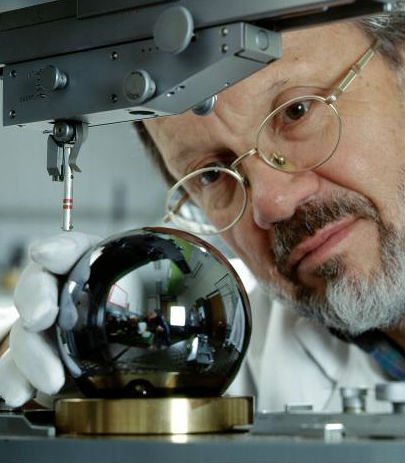
In a world where everything strives to be the best and the biggest, scientists behind The Avogadro Project in Australia have sought a surprising superlative: the world’s roundest object.

And they aren’t just doing it for bragging rights. Instead, the remarkable sphere may provide a solution to what’s known as the “kilogram problem.”

Unlike other scientific units, which can theoretically be measured anywhere in the world based on natural properties, the kilogram is still based on a physical object: a cylinder of platinum and iridium that dates back to 1889.

roundest

So while the “meter” is defined as the distance light travels in a tiny fraction of a second, and the “second” can be counted by the precise decay of an atom, the kilogram is no more (and no less) than a physical mass that sits in a secured vault at the Bureau International des Poids et Mesures in Paris.

For reasons no one understands — and despite precautionary measures — the cylinder’s mass keeps changing. In other words, the kilogram, as defined by the cylinder (and compared to 40 exact replicas of the cylinder kept in other countries), doesn’t weigh the same as it used to.

To solve that problem, researchers at the Australian Centre for Precision Optics, which is home to The Avogadro Project, are crafting nearly perfect spheres made of a highly pure and very stable form of silicon. By calculating the sphere’s volume and weight, scientists should be able to determine the exact number of silicon atoms in the object itself, thereby providing an unchanging definition for the mass of a kilogram.

Per Australia’s Commonwealth Scientific and Industrial Research Organisation (CSIRO), scientists settled on a sphere as the standard shape because it “has no edges that might get damaged,” and “only one dimension [its diameter] has to be measured in order to calculate its volume.”

As for how the world’s roundest objects were made, New Scientist reports two spinning rotors ground them for several months. Afterward, computer-guided lasers measured each for slight derivations that were corrected individually.

If you were to blow up our spheres to the size of the Earth, you would see a small ripple in the smoothness of about 12 to 15 mm, and a variation of only 3 to 5 metres in the roundness,” CSIRO master optician Achim Leistner said of the end result.

round 2

A second, competing method to determine a standard measurement for the kilogram is the “watt balance” — a system tied to Earth’s gravitational pull on a kilogram and the force needed to counteract it. This strategy has also earned quite a following.

Despite these advances, the standard kilogram remains a cylinder that’s more than 120 years old — at least for now. And until the world’s roundest object proves its mettle, well, we’ll just have to roll with it.

Leave a comment

Filed under Humor and Observations

More Funny Signs, Newspapers and Stories

Funny signs, newspapers and stories for your amusement.  Some of them may not be G rated.

1 Comment

Filed under Humor and Observations