Category Archives: Writing

10 Painful Rejection Letters To Famous People Proving You Should NEVER Give Up Your Dreams


People Sharing

The sting of rejection is bitter, but it’s a necessary step to triumph. Even the best have been told that they aren’t good enough.

1. Madonna

undefined

perezhilton.comWhen the Queen of Pop finally signed with Sire Records in 1982, her debut album sold more than 10 million copies worldwide. She used this early rejection as motivation, as this respected producer didn’t believe she was “ready yet.” She’s now the best selling female artist of all time.

2. Tim Burton

undefined

lettersofnote.comThis Disney editor didn’t consider Burton’s first children’s book, “The Giant Zlig”, marketable enough. He took the feedback to heart, feverishly honed his skills and was hired as an animator’s apprentice at the company just a few years later. He went on to become involved in films like “Edward Scissorhands”, and “The Nightmare Before Christmas”.

3. Andy Warhol

undefined

papermag.comIn 1956, Warhol gave one of his pieces to the Museum of Modern Art – for free – but was quickly rejected. Obviously, his luck turned around pretty fast. On top of having his own museum in Pittsburgh, the very museum that rejected him now features 168 of his original works.

4. U2

undefined

mentalfloss.comWhen U2 debuted in 1979, RSO Records was thoroughly unimpressed. Within months, the band signed with Island Records and released their first international single, “11 O’Clock Tick Tock.” They went on to sell 150 million records, win 22 Grammy Awards (most of any band ever), and performed in the highest grossing concert tour in history .

5. Kurt Vonnegut

undefined

lettersofnote.comThree writing samples sent to The Atlantic Monthly in 1949 were deemed commendable, but “not compelling enough for final acceptance.” Rather than giving up, Kurt framed the letter, which now hangs in his Memorial Library in Indianapolis.

His most famous work, Slaughterhouse-Five , is rumored to have developed out of one of the samples.

6. Sylvia Plath

undefined

openculture.comAlthough this wasn’t a complete rejection, the New Yorker requested the entire first half of “Amnesiac” to be cut. It’s hard to believe that the Pulitzer Prize-winning poet would have her work torn apart, but it shows how even the greatest writers start from humble beginnings.

Share On Facebook

7. Gertrude Stein

undefined

mentalfloss.comIn possibly the snarkiest letter of all time, Arthur C. Fifield turned down Gertrude Stein’s manuscript for “The Making of Americans” without reading all of it, then mocked her. The celebrated novelist and poet later mentored the likes of Ernest Hemingway.

8. Jim Lee

undefined

instagram.comToday, Jim is the co-publisher of DC comics and one of the most famous figures in the comic book industry. But in this letter from Marvel (one of many rejection letters he’d received throughout his life), he was told to reapply “when he had learned to draw hands.”

9. Stieg Larsson

undefined

theguardian.comThis Swedish letter the man behind the award-winning “Millennium” trilogy told him he wasn’t good enough to be a journalist. Although he didn’t live long enough to experience his own success, those in charge at the JCCJ in Stockholm must be kicking themselves.

10. Edgar Rice Burroughs

undefined

erbzine.comEdgar’s claim to fame, “Tarzan of the Apes”, has spawned 25 sequels and countless reproductions. But before everyone knew about the famous ape man, his story was unceremoniously rejected from a magazine in 1912. Luckily, a wiser publication accepted his piece later that year, launching a legacy that is now over a hundred year old.

11. Others didn’t save their letters, but they’ll never forget the words that fueled their success…

Walt Disney – Fired from the Kansas City Star in 1919 because he “lacked imagination and had no good ideas.”

JK Rowling – Rejected by dozens, including HarperCollins, when a small publisher in London took a chance on Harry Potter.

Oprah Winfrey – Fired as an evening news reporter of Baltimore’s WJZ-TV because she couldn’t separate her emotions from her stories.

George Orwell – A publisher turned down his legendary novel, Animal Farm, with the words “It is impossible to sell animal stories in the USA”.

Jerry Seinfeld – Didn’t find out he was cut from a minor role on a sitcom until he read the script and discovered his part missing.

Elvis Presley – After a performance in Nashville early in his career, he was told by a manager that he was better off driving trucks in Memphis (his previous job).

Steve Jobs – Fired from the company he started, Apple, but was desperately brought back in 1997 to save it. Apple is now the most valuable company in the world.

Stephen King – His first book, Carrie, was rejected thirty times. He nearly threw the book out when his wife saved it from the trash and encouraged him to keep trying.

Marilyn Monroe – At the start of her storied modeling and acting career, she was told she should consider becoming a secretary.

Abraham Lincoln – Demoted from Captain to Private during war, failed as a businessman, and lost several times as a political candidate before becoming President.

I could show you more, but the list would never end because no one has ever won without first experiencing many failures and rejections.  We can choose to learn from these lessons, or let them destroy our spirit. The ones who ultimately succeed are those who never, ever stop trying. Share this list and inspire others to keep chasing their dreams!

Satisfy your curiosity by checking out more lists on Distractify! See below.

Leave a comment

Filed under Humor and Observations, Writing

Book Review – Mac & June – Love in the Time of Oil

This is a book review I completed for a magazine, but with their ongoing permission I also post some reviews here on my own blog site.  This book is so awesome that I recommend all of you go out and buy it.  You will not be disappointed. (following the review is the Amazon Link to buy it online).

Mac & June – Love in the Time of Oil

By James David Nicol

 Book Review by Michael Bradley

mac and june

Mac & June – Love in the Time of Oil is one of the best slice of life books I’ve read in my lifetime.  Written by James David Nicol, it details the love story between Mac, an America sent over to Scotland in 1974 during the North Sea Oil boom, and June, a local Aberdeen woman with a uniquely Scottish fisherman family.  Nicol is himself a native of Scotland, though he has since lived in such exotic places as Hong Kong, Australia, and now Phoenix, Arizona.

There is so much to love about this story it is hard to know where to start.  The overall story line is similar to My Big Fat Greek Wedding, in which an American deals with the culture clash and interesting characters of his love interest’s Greek family.  It is also reminiscent of Polish Wedding, starring Claire Danes and Gabriel Byrne and Lena Olin which gives similar insight into the Polish traditions.  In Mac and June, you will definitely learn about family and life in seventies’ Scotland.

The language, the humor, the pathos and the challenges are all laid out smoothly and as a reader you grow to love each and every character.  The Grandpa of June really steals the show though and his parts of the story alone are worth the price of the book and the time to read it.  As a first novel, James David Nicol shows a mastery of prose and fiction rarely seen even in much more experienced authors.

Nostalgia fans will also appreciate the 1970s references including language, music and other trends.  Mac and June is similar to American Graffiti in its use of time and locale to tell the story of ordinary people facing situations men and women have faced throughout time.

I give my highest recommendation to read this novel.  The two notes I must make is that the book is so good you might read through it all at once and be left wanting more.  My understanding is that Nicol is working on a sequel, so let’s hope that is not to far out to wait.  Second, the salty language and adult situations of real people living in Scotland in a blue collar town may be too much for a younger audience.  As a result, this is probably a book for those eighteen and above.  Neither the situations nor the language are inappropriate to the story, but a realistic part of it.

http://www.amazon.com/Mac-June-Love-The-Time-ebook/dp/B00GS8J50E

James David Nicol

James David Nicol

Leave a comment

Filed under Humor and Observations, Writing

Interview with Cosplayer Sara Moni

My Interview with awesome Sara Moni, coming up in an upcoming issue of The WOD Magazine.  If you need a cosplayer at your upcoming con, or a great model, you can’t beat having Sara Moni.  Please, no creeps, or I will find and will Liam Neeson your butt!  She is a professional and sweetheart.

Sara Moni Interview

MB: Today our interview is with Sara Moni, an outstanding young cosplayer. How long have you been into cosplay now, and what got you started?

SM:  I started really cosplaying in 2010, but I was making costumes and T-shirts before that. I’ve always liked superheroes and sci-fi and I love dressing up in costumes. It was inevitable.

MB: What are some of your favorite characters to cosplay?

SM:  I play so many that I love, but if I had to name two favorites, it would be Wasp and Sailor Pluto.

MB:  Do your cosplay choices match those you read and watch, or are there some differences?

SM:  Every character I cosplay I am a fan of, or the series that they came from. I never pick costumes just based on how they look.  Every time I dress up it’s as a fan.

MB:  I know you started as a Marvel girl. Are you all Marvel, or you like them all now?

SM:  I love Batman like everybody else LOL, but I just find that Marvel has more intriguing characters that I like and identify with. I’m starting to read more DC now though. I also like some Image and Dark Horse comics.

MB:  How many cons and events/photo shoots are you doing per year?

SM:  About ten or so cons and even more shoots!

MB:  What are some of your favorite events or locations?

SM:  Phoenix will always be number one!

MB: Do you make all your outfits and make-up or do you have some preferred helpers?

SM:  Yes I make it all, unless otherwise specified as a collaboration, and I do all my own make-up as well.

MB: You have a very exotic look. Does it help that you can pull off so many different looks?

SM:  Absolutely.  It helps being able to pull off whatever I need. It’s nice being a ringer for a character, but it’s in even more fun challenge to tackle something that is totally different, like my female frost giant.

MB: What are some of your best cosplay moments?

SM:  There are so many. My most recent was in Salt Lake City where a girl with autism said that I inspired her to cosplay. It almost made me cry!

MB: Do you cosplay just for fun, or do you have a store and blog site we can plug for you?

SM:  I definitely think you can do both as long as the fun dominates. My prints are at saramoni.storenvy.com and all of the proceeds from that go right back into my costumes. You can also find me on Facebook at Sara Moni Cosplay.

MB: I see you have worked with charities. Do you have a particular memorable experience from helping others?

SM:  I am an active member of the Arizona Avengers and when we have events for foster children or sick children there is nothing that can top seeing them smile.

MB: How safe do you feel at cons now? Is it safe to walk from parking lots in costume? Are the bigger crowds bringing out “touchy” people who break barriers they shouldn’t?

SM:  I feel very safe. I don’t put myself in sketchy situations in or out of costume. I always walk in a group and I do carry physical deterrents with me! Ha that’s the nice way of putting it.

MB: What advice do you have for people starting out?

SM:  Always remember why you started and don’t forget. When it stops being fun, it’s time to stop.

MB: Who would you like to give a shout out for being someone who helped you get started and friends you look forward to seeing at cons?

SM:  So many! The Arizona Avengers of course – my friends from high school that were cosplayers and any new people I meet that share the same fandoms that I do!

MB: Any upcoming projects or events we can see you at?

SM:  On Free Comic Book Day I will be at Drawn to Comics – and I am scheduled for several upcoming conventions.

MB: I saw a tweet from Nathon Fillion (Captain Malcom “Mal” Reynolds from Firefly) commending you on your cosplay of Inara Serra, his love interest on the show , was that an awesome moment? Are you planning to get a photo with him at Phoenix Comic Con?

SM:  It’s still surreal and I’ll still get twitter alerts from it now! I saw him at FanX but wasn’t able to talk to him. Hopefully at Phoenix I will!

NOTE:  Blog link to Inara Serra cosplay article on Sara Moni – http://www.bloglovin.com/viewer?post=2559828447&group=0&frame_type=a&blog=3888164&link=aHR0cDovL2Zhc2hpb25hYmx5Z2Vlay5jb20vY29zdHVtZXMvYS1nb3JnZW91cy1pbmFyYS1zZXJyYS1jb3NwbGF5Lw&frame=1&click=0&user=0


Leave a comment

Filed under Humor and Observations, Writing

10 Things New Science Fiction Writers Should Know

Being a science fiction creator is the most amazing adventure — you get to invent whole new worlds, brand new futures, and fantastic technologies, and you get to tell the most incredible stories about them. But it’s also a tough and heartbreaking career path, whether you’re in books, comics, movies or television. Here are 10 things that every brand new science fiction creator ought to know at the start.

Top image: guitfiddle on Deviant Art.

1) You’re still just telling personal stories

This is kind of a big one — no matter who you are or what kind of work you’re doing, you’re still telling a story that’s personally meaningful to you. Because science fiction is so idea-focused and so often driven by technologies or world-changing discoveries, it’s easy to lose sight of that. But not finding the personal story inside your huge alien-invasion narrative is the easiest way to fail. The only way to stand out, and the only way to tell stories that are going to move others, is to figure out what you’re personally connecting to in your work, no matter how clever or widescreen your premise.

2) The things everybody remembers about their favorite stories are never why those stories work

We see this all the time nowadays — once a movie or book becomes a classic, people fixate on that one cool moment or that one clever line of dialogue. (Or sometimes, they fixate on something totally random, that just became a meme for some reason.) But no matter what, that one cool moment is not why people love that story — they love it for everything that sets up the cool moment, and everything else that makes it a great story. And this is why nostalgia is so deadly — because nostalgia tends to focus on the tip of the iceberg rather than the huge frozen juggernaut beneath. So if you spend a lot of time trying to recreate the coolest moment from your favorite TV episode, you’ll miss the stuff that mostly goes unnoticed, which made people care in the first place. Nostalgia always cheats, and the only answer is to try and create your own thing.

10 Things That Every Brand New Creator of Science Fiction Should Know

Image via JadrienC/Deviant Art.

3) Science fiction is always about the time when it was created

4) Ideas aren’t stories

Basically, you need to understand the difference between a premise and a plot. (This took me years to master, and I’m still not always great at telling the difference.) A premise is “in the future, everybody has a brain chip that regulates emotion.” A plot is “one person’s brain chip malfunctions,” or “someone invents a second brain chip that allows technology, but people who have both chips go insane.” A story that just lays out a basic premise isn’t really a story at all — it’s a pitch, at best. The hard part is often turning the idea into an actual story, and see point #1 above — you need to find what’s speaking to you personally about this premise.

5) Even if you perfectly imitated your heroes, you’d still fail.

Let’s say you manage to write a book that Ursula K. Le Guin could have written, or you figure out how to direct a movie exactly like James Cameron. Leaving aside the impossibility of fully capturing the style of one of the genre’s great originals, you’ll still be kind of screwed. For one thing, even if people may say they’re looking for the next James Cameron, they don’t mean they’re looking for a carbon copy of James Cameron. It’ll just fall flat. For another, the field is constantly changing, and if you copy your heroes too much, you risk coming up with a perfect rendition of what everybody was looking for 20 years ago. Pay homage to Le Guin all you want — but you also have to work to develop your own style, that’s something new and fresh.

6) Cool story ideas are dime a dozen.

People get paranoid about having their ideas stolen, or being accused of stealing someone else’s idea, or “wasting” an idea, or whatever. But ideas really are as common as dirt, and it’s easy to come up with more. Even cool ideas. Just spend half an hour reading New Scientist, or scanning the front page of the newspaper, or watching people in a public place — story ideas come from everywhere. And they’re mostly worthless. Even if you come up with a clever story idea that would make a Hollywood producer’s ears prick up, it’s still worthless unless you can turn it into something. And that, in turn, requires coming up with a protagonist who’s fascinating and belongs in the middle of that cool idea. Ideas are easy, but stories are freakishly hard.

7) Resist the urge to give up on your characters

If your characters aren’t clicking, or if you can’t figure out how to make them go in the direction your plot needs them to go in, that usually means you need to take a step back and think about what they’re really going through and what they would really feel in that situation. It’s tempting to push them into a pat resolution that satisfies your plot needs but doesn’t actually make that much sense for the characters. It’s also tempting to fall into a bleak, “existential” ending where your characters fail, just because you’re annoyed with them and can’t figure out what else to do with them. (And there’s nothing worse than a bleak ending that hasn’t been earned.) The end of your story is not a finish line, and this isn’t a race. Sometimes you need to go back and figure out where you went wrong.

8) Trends are at least half over by the time you know about them

Seriously. Everybody who’s been around for a while has a sob story in which they (or a friend) tried to jump on that hot vampire romance trend, or that super-popular “dystopian teen fiction” trend, and then realized that the trend was already on its last legs. You shouldn’t chase trends anyway, because that’s probably not going to result in work that you’re going to feel as good about in the end. But even if trend-chasing was a good idea, bear in mind there’s a long pipeline for books and an even longer one for movies or TV — the things you see coming out right now represent the trends that are already ending.

10 Things That Every Brand New Creator of Science Fiction Should KnowSExpand

Image: Ben Wootten via Concept Ships

9) Doing your homework is half the battle

Research is a huge part of writing really good science fiction, especially if you’re speculating about future developments. Learn how to talk to scientists about their work — if you seem smart and interested in telling good stories about science, they’ll often be willing to talk toyou. Also, learn how to read scientific papers and do research. And learn how to do research about other cultures and other times, too — even if you’re not writing about them, it’ll make your worldbuilding way stronger.

10) You’re the worst judge of your own work

This never really stops being true, for a lot of us. Especially when you’ve just finished something, you often can’t see what’s working. There’s no substitute at all for getting feedback from others, and running your work past professionals as much as you possibly can. Join a critique group or take classes, just to get more feedback on your work. When you wonder why your favorite writer or director has gone downhill since they became a megastar, it’s usually because they stopped getting feedback on their work. But especially when you’re starting out, you need constant abuse to get better at your craft.

2 Comments

Filed under Writing

Character Writing Tips from Writers Write

Character Writing Tips from Writers Write

The 12 Common Character Archetypes


Writers can use these 12 Archetypes to create characters

The 12 Common Archetypes by Carl Golden

The twelve archetypes are divided into ego types, self types, and soul types.

1) The Four Ego Types

1. The Innocent
Motto: Free to be you and me
Core desire: to get to paradise
Goal: to be happy
Greatest fear: to be punished for doing something bad or wrong
Strategy: to do things right
Weakness: boring for all their naive innocence
Talent: faith and optimism
The Innocent is also known as the: utopian, traditionalist, naive, mystic, saint, romantic, dreamer.

2. The Orphan/Regular Guy or Gal
Motto: All men and women are created equal
Core Desire: connecting with others
Goal: to belong
Greatest fear: to be left out or to stand out from the crowd
Strategy: develop ordinary solid virtues, be down to earth, the common touch
Weakness: losing one’s own self in an effort to blend in or for the sake of superficial relationships
Talent: realism, empathy, lack of pretence
The Regular Person is also known as the: good old boy, everyman, the person next door, the realist, the working stiff, the solid citizen, the good neighbour, the silent majority.

3. The Hero
Motto: Where there’s a will, there’s a way
Core desire: to prove one’s worth through courageous acts
Goal: expert mastery in a way that improves the world
Greatest fear: weakness, vulnerability, being a “chicken”
Strategy: to be as strong and competent as possible
Weakness: arrogance, always needing another battle to fight
Talent: competence and courage
The Hero is also known as the: warrior, crusader, rescuer, superhero, the soldier, dragon slayer, the winner and the team player.

4. The Caregiver
Motto: Love your neighbour as yourself
Core desire: to protect and care for others
Goal: to help others
Greatest fear: selfishness and ingratitude
Strategy: doing things for others
Weakness: martyrdom and being exploited
Talent: compassion, generosity
The Caregiver is also known as the: saint, altruist, parent, helper, supporter.

2) The Four Soul Types

5. The Explorer
Motto: Don’t fence me in
Core desire: the freedom to find out who you are through exploring the world
Goal: to experience a better, more authentic, more fulfilling life
Biggest fear: getting trapped, conformity, and inner emptiness
Strategy: journey, seeking out and experiencing new things, escape from boredom
Weakness: aimless wandering, becoming a misfit
Talent: autonomy, ambition, being true to one’s soul
The explorer is also known as the: seeker, iconoclast, wanderer, individualist, pilgrim.

6. The Rebel
Motto: Rules are made to be broken
Core desire: revenge or revolution
Goal: to overturn what isn’t working
Greatest fear: to be powerless or ineffectual
Strategy: disrupt, destroy, or shock
Weakness: crossing over to the dark side, crime
Talent: outrageousness, radical freedom
The Outlaw is also known as the: rebel, revolutionary, wild man, the misfit, or iconoclast.

7. The Lover
Motto: You’re the only one
Core desire: intimacy and experience
Goal: being in a relationship with the people, work and surroundings they love
Greatest fear: being alone, a wallflower, unwanted, unloved
Strategy: to become more and more physically and emotionally attractive
Weakness: outward-directed desire to please others at risk of losing own identity
Talent: passion, gratitude, appreciation, and commitment
The Lover is also known as the: partner, friend, intimate, enthusiast, sensualist, spouse, team-builder.

8. The Creator
Motto: If you can imagine it, it can be done
Core desire: to create things of enduring value
Goal: to realize a vision
Greatest fear: mediocre vision or execution
Strategy: develop artistic control and skill
Task: to create culture, express own vision
Weakness: perfectionism, bad solutions
Talent: creativity and imagination
The Creator is also known as the: artist, inventor, innovator, musician, writer or dreamer.

3) The Four Self Types

9. The Jester
Motto: You only live once
Core desire: to live in the moment with full enjoyment
Goal: to have a great time and lighten up the world
Greatest fear: being bored or boring others
Strategy: play, make jokes, be funny
Weakness: frivolity, wasting time
Talent: joy
The Jester is also known as the: fool, trickster, joker, practical joker or comedian.

10. The Sage
Motto: The truth will set you free
Core desire: to find the truth.
Goal: to use intelligence and analysis to understand the world.
Biggest fear: being duped, misled—or ignorance.
Strategy: seeking out information and knowledge; self-reflection and understanding thought processes.
Weakness: can study details forever and never act.
Talent: wisdom, intelligence.
The Sage is also known as the: expert, scholar, detective, advisor, thinker, philosopher, academic, researcher, thinker, planner, professional, mentor, teacher, contemplative.

11. The Magician
Motto: I make things happen.
Core desire: understanding the fundamental laws of the universe
Goal: to make dreams come true
Greatest fear: unintended negative consequences
Strategy: develop a vision and live by it
Weakness: becoming manipulative
Talent: finding win-win solutions
The Magician is also known as the: visionary, catalyst, inventor, charismatic leader, shaman, healer, medicine man.

12. The Ruler
Motto: Power isn’t everything, it’s the only thing.
Core desire: control
Goal: create a prosperous, successful family or community
Strategy: exercise power
Greatest fear: chaos, being overthrown
Weakness: being authoritarian, unable to delegate
Talent: responsibility, leadership
The Ruler is also known as the: boss, leader, aristocrat, king, queen, politician, role model, manager or administrator.

Note: There are four cardinal orientations: freedom, social, ego, order. The types have a place on these orientations.

Article via soulcraft.co

Writers Write offers the best writing courses in South Africa. To find out about Writers Write – How to write a book, or The Plain Language Programme – Writing courses for business, email news@writerswrite.co.za

Join us on Facebook and Twitter for daily writing tips

Follow @Writers_Write

Writers Write – Write to communicate

Leave a comment

Filed under Writing

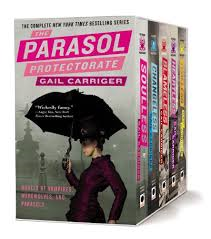
The Parasol Protectorate Series – Review of the Series

I wrote this review of The Parasol Protectorate Series by Gail Carriger for publication in the upcoming issue of the magazine The WOD.  If you are familiar with my book and movie reviews, I am usually accused of being more of a critic than a reviewer.  This time, you can experience my lighter side as I love this series.

The Parasol Protectorate Series

By Gail Carriger

 Book Reviews by Michael Bradley

untitled (2)

The problem you face when writing about a five book series is that you will obviously have some degree of spoilers as you explain the plot twists.  If you mention a character in book three, readers of book one obviously knows they survived books one and two.  As a result, I will discuss the author, series and quality first, then will have a big bolded all caps spoiler alert before we get into those types of details.

As a steampunk author myself, I have always been a fan of the genre, even before I knew it was a genre.  I grew up with Jules Verne and HG Wells stories, which at the time were simply science fiction written in the late 1800s.  Today, if you write similar adventures that occur during the Age of Steam – roughly 1830 to 1900 – that have a science fiction component, they are referred to as Steampunk.  The time period was thrilling because for the first time the labor of a man or a beast of burden such as an ox or horse were replaced by steam power.  Factories, trains, urban pollution, cotton looms, steam ships and other devices were like landing on the Moon for the first time.

Gail Carriger

Gail Carriger

The map of Africa was still blank in the middle and we were looking for the source of the Nile.  The sun never set on the British Empire, the major powers jockeyed for empires, magic and science were hard to distinguish, and the United States had the Wild West, the Civil War and Indian wars.  It is in this time period in which Gail Carriger writes her fiction series, the Parasol Protectorate.  Gail Carriger is the pen name of Tofa Borregaard who holds three degrees including a Masters in Archaeology and a Masters in Anthropology.  She has lived in both the United States and England and traveled enough to have a cosmopolitan view of things.  Her training and experiences definitely inspire her style of writing.

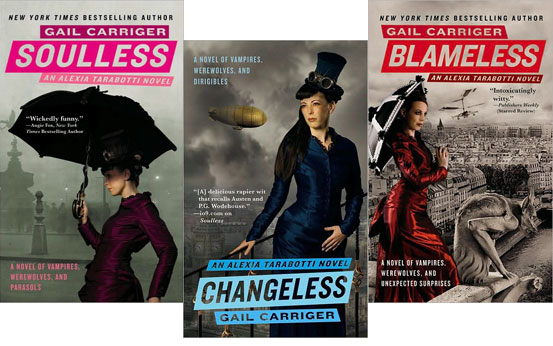
Gail Carriger has a very unique and clever idea in her first book Soulless, which introduces the main character, Alexia Tarabotti.  Alexia is born with no soul, hence the name of the book.  People with too much soul in her world might end up as vampires or as werewolves or even linger about for a time as ghosts.  To be soulless is very rare and basically makes her immune to those with the abundance of soul and even able to remove their power temporarily with her touch.  This concept alone is rife with conflict, but don’t expect the series to take you down the familiar path of vampires and werewolves seen in contemporary urban fantasy.

GailBW1Fix

Instead, Gail Carriger is a master at weaving fashion, social morays, customs and humor into her novels.  Her character development and whimsical narrative style are superlative, telling the story in such a charming and entertaining fashion that you have difficulty putting the books down.  There is action, international intrigue, gadgetry and supernatural elements, but it is a world of fun, clothing choices and friendship, not a gory monster fest all too common in lesser literature.

I am a huge fan of Gail Carriger, and in limited correspondence through emails and her Facebook and blog site, I am a fan not only of her writing, but of her as a person as well.  You can stop here with no spoilers and rush out to buy all five books and read them.  You will have a great time and be sorry when they are done.

Gail will also be appearing at LepreCon 2014, May 8-11 in Mesa, Arizona.  Be sure to come by if you are in the area and meet this outstanding author.  Show your support if you are already a fan like me and queue up for the signatures for your books.

parasol-protectorate

SPOILER ALERT – Released in just 2009, Soulless is the first in the five book series.  Alexia Tarabotti faces the challenge of being too tan and curvy due to her half-Italian heritage and suffers the further problem of being a well-read intellectual and opinionated woman in an era that does not always appreciate those qualities.  She suffers her step family, focuses on fashion and spends time with Ivy Tunstell, the delightful but fashionably challenged best friend.  Her soulless nature, though not well known, soon draws her into a world of intrigue with the werewolves, her friend the dapper vampire and the local hive, and even with Queen Victoria herself.  As if that is not enough to deal with, she encounters a particularly annoying werewolf named Lord Maccon.

In the second book, Changeless, we find Alexia married and now a noblewoman, the Lady Woolsey.  Her husband is off on business while a pack of werewolf soldiers camps on her front lawn.  Exorcised ghosts, an angry Queen Victoria and other dangers bring her all the way to Scotland to investigate matters and learn the truth about her own husband.  There is a particular incident at the end of this book that is definitely a cliff hanger for the third in the series.

In the third book, Blameless, Alexia separates from her husband in a scandalous way, even though she herself is – blameless.  Lacking her husband, she is back with her scornful family, the Queen fires her from her position, and someone begins to send deadly clockwork devices after her to kill her.

This is the one book I did not enjoy at first; neither did my wife who read along with me.  The reason is that the first part of the book loses the whimsical style of the first two and creates a more real and tense situation.  It almost had me put down the series, but having enjoyed the first two, I powered through this beginning.

About a third through the volume, it regained the usual more light-hearted style as Alexia travels, faces challenges, and her personal problems start to be repaired.  In the end, the third book is definitely worth reading and leads you on to the next two, but if I had to find a fault, it would be the early tone of the middle book.

untitled (3)

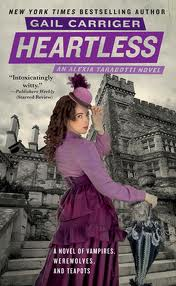
The fourth installment of the series is Heartless.  Alexia must once again solve a sinister plot to kill Queen Victoria and delve even farther into the mysterious past of her husband.  One of her sisters becomes heavily involved in the suffragette movement, while her cross-dressing friend Madame Lafoux is once again creating strange clockwork devices.  This is one of the more intriguing books in the series because the characters are already strongly established, allowing the author to focus more on subtleties and interesting twists along the way.

11324166

The final book, Timeless serves as a capstone and rite of passage for all the characters in the series.  Alexia is now relatively settled in to her new lifestyle, when a summons is received from an ancient vampire leader in Egypt.  This takes the reader off to the distant sands of the Nile Delta for more adventures with their beloved characters.

In Egypt, when all is done, it brings a satisfying end to the series, having told Alexia’s main story of life challenges and passing the torch to several other characters known to the reader.  As a fan, you sometimes want story series to go on forever, however, experience shows that telling a story too long causes some series to become ridiculous or forced.  As it is, the Parasol Protectorate thoroughly tells the start to end story of Alexia while leaving the reader with a sense of satisfied completion.

Congratulations to Gail Carriger for such excellent work in writing five such wonderful novels in this Steampunk series.  When I first started reading Soulless, I was told it was a “woman’s Steampunk novel” because it is from Alexia’s view and deals with fashion.  I would totally disagree.  I think everyone can enjoy the series equally.  I also appreciate how it is written with wit, an eye to history, great characters and action, but never descends to being tawdry or bloody in place of good storytelling.  I wholeheartedly recommend this series.

1 Comment

Filed under Humor and Observations, Writing

Psychology in Writing

In my past life, one of my positions was CFO for the Department of Health Services.  I had a number of awesome discussions with our Chief of Psychiatry, Amy Schwartz.  As with most knowledge, it can filter down in strange ways.  In this post, I want to share how it has helped me as an author.

1.  Everyone is the hero of their own novel.  Amy taught me that it is nearly impossible to find someone who does not view themselves as the focal point and hero of their life novel.  No matter the evidence they may be evil, petty or a failure, they never view themselves as a villain or as a background character.  For that reason, I try to write villains that believe they are heroes.  Why do they do what they do?  How do they rationalize their goals and their behavior?

2.  No one views themselves as a side-kick.  At the salon the other day, two ladies were working side by side and called themselves a team.  I asked them, which is the hero and which is the side-kick?  What followed was a pause of silence for a full two minutes.  They both think they are the hero and the other the side-kick, but would never say it.  Whether you have a dominant hero or villain, there are no henchmen, side-kicks or blindly loyal people.  They can be robots, zombies, mind-controlled, crazed cult followers, etc.  However, no one even partly normal will view themselves as your side kick.

They might be the unappreciated reason the hero wins, because of all their work.  They may be waiting to learn from the mentor before coming the master.  They may follow the crime lord out of fear, profit, or wait their chance to betray or move-up the ranks.

Henchmen - What do they think of themselves?

Henchmen – What do they think of themselves?

3.  Even given uniforms and strict appearance rules, people will stand out.  You cannot contain individuality.  Everyone has it.  Whether it be a more confident walk, a gleam to their eye, a sigh before they do something, even in the most homogenous situations, everyone can tell characteristics about the others.  Your story cannot have redshirts or mindless thugs that all look and act the same and be reasonable.  Even a casual observer’s brain will pick up some non-uniformity to classify people.  Tall, short, build, eyes, hair, gait, speech, lack of speech, eye contact, hand positions, skin, clothing condition, something.  I was in the military where they try to make you all the same.  The more they do outwardly, the more you learned everything about the person inside.

imagesCASKR8AH

4.  People who are positive or negative tend to stay that way.  Even if your hero or villain wins, they will be negative about it if they are negative people.  If they lose, they won’t give up if positive.  Outlook is mostly interior and psychological and not tied to someone’s outward fortunes.

5.  People question authority, gossip and bitch.  Wherever you have a group of people, they will talk about each other, form cliques and complain.  If everyone gets along in your story and supports each other, there should be some supernatural intervention or it won’t ring true.

6.  People do not change with history.  People in Rome wrote graffiti, cheated each other, committed adultery, thievery and made fun of each other just like now.  The more we find about any ancient people, the more we see humans have changed very little in their quests for love, sex, power, conflict, wealth, travel, gossip, etc.  Writing about people 10,000 years in the past or future might not be that different.
7. Group identity causes conflict and confidence.  Our group is awesome.  Your group sucks and might be dangerous.  It’s the basis for nationalism, families, tribes, prejudice, racism, etc.  In any group, one group will cling together against another.  Common friends and common foes.  It might be something nice like which sports team you prefer, or something bad like we want the fresh water from the river and need to kill you to get it.

8.  Maslow’s hierarchy of needs.  You can look this one up.  Basically, we are hard wired to get what we need.  A person dying of thirst, hunger or being tortured to death will do things beyond the pale.  Yes, starving people will be cannibals, murderers and eat trash.  Even if they were normal people two months ago.  Never underestimate the drive of instinct in dire circumstances.  People do not retain ‘civilized’ rules when civilization breaks down.

9.  In a crisis, the most dangerous threat is other humans beings.  If people need things to survive and there are not enough to go around, the math is done very quickly.  Things may go ok for awhile, but the stronger the instinctual need to survive, the longer without needs met, the more dangerous it gets.  Even good people will rationalize their actions.  Remember number 1.

10.  There is no random speech.  All you know is that person told you something at that moment for some reason.  They may have lied, told the truth or been mistaken.  But why did they open their mouth and tell you that?  To make you love them, respect them, fear them?  To fill in a silence?  To test you, because they were nervous, to throw you off the trail?  You can do so much with this in your writing and your life.  Why did that person say this to me, in this place and time, in that tone of voice?  What trail of events or conversation evoked that statement and why?

I hope these help you as well.

Michael Bradley

Leave a comment

Filed under Writing

Eye Project

I want to do a project with pictures of eyes.  “The Eyes of Cosplay” or “The Eyes Have It” or something similar.  A share of the profits, if any, would be distributed to each of the participants.  Each participant will also be able to buy copies at costs for their own resale at events.  Let me know if you think this is a good idea and if you would be interested in participating.  I am not sure if it works better as a calendar or perhaps a print.  The following are some samples of eyes photos like I had in mind.  We can either take the shots with a photographer in Arizona, or you could send your own for consideration.  Your feedback is very much appreciated.

5 Comments

Filed under Humor and Observations, Uncategorized, Writing

Emotion Wheel for Writers

funny-chart-synonyms-words-fear-anger


Leave a comment

Filed under Writing

Origins of Words and Phrases

Ever wonder about a particular   saying and where it came from? Have you come up empty handed? Are you stumped?   Well look no further! Some of the answers will have you saying “son of   a gun!”

I’ve compiled a list of   the phrases and words that I find most interesting. Some of the sayings are   hundreds of years old and their exact origins remain a mystery. Opinions vary  about the exact derivations of some, but I’ve decided to include only the most   interesting theories.

Check back soon for a bibliography.

raining       cats and dogs       – If you’ve corrected your child after he or she took this phrase literally,       you may owe them a slight apology! The origin of this saying dates back       to the 1600s. Poor drainage systems on buildings in the 17th century caused       gutters to overflow, spewing out along with water, garbage and a few unexpected       critters. It is possible that animals such as rodents lived in the thatched       roofs and when it rained heavily, the dead carcasses would fall––undoubtedly       unpleasant! As far as large dogs falling from the sky…well…that one       will have to remain a mystery.
to       be stumped       – Be stumped no more! Being “stumped” comes from the pioneering       days when the land was cleared to lay down train tracks. When the workers       came across a tree stump, it would cause a dilemma or “to be stumped.”
wrong       side of the tracks       -Before there were cars, trains were an important means of transportation.       Of course, pollution wasn’t a big concern so when a train rolled by, heavy       black smoke and soot went with it. Usually the wind blew the black smoke       to one side of the tracks and only the poorest of people would endure living       in that hard to breathe environment. No one wanted to be on “the wrong       side of the tracks.”
rule       of thumb -No, this phrase is definitely NOT “P.C”! Who knew? Some people think”Rule         of thumb” is derived from the days when woman were sometimes beaten with         a switch. To be “kind” the switch could not be thicker than a thumb’s width.         This was made law in 1782 when an English judge stated that men were allowed       to beat their wives but that the stick could not be thicker than one’s thumb.

There are other theories about the origin of this phrase. Perhaps using ones thumb to measure a switch is folk lore after all….

to       propose a toast       – This often used phrase comes from an 18th century punch bowl drink made       with cider, cinnamon, cloves, and other spices and garnished with pieces       of toast that would float on top. I’m unsure of the purpose of the toast       and can’t imagine a burnt piece of bread being “decorative,” but       next New Years Eve, don’t forget to include the toast!
Good       Samaritan       – comes from from the Bible (Luke 10:30-33), in which Jesus tells the parable       of a priest who passes by a man in need of help, laying on the ground. A       Samaritan, who was part of the enemy tribe, helps the man up and back to       health when the priest does not…the message being that you should treat       your enemy with the same good respect as your friend. Other meanings can       also be extracted, such as the golden rule: treat others the way you would       like to be treated, and so on.
upper       and lower case letters       – I’ve heard that the term started when letters were hand carved out of       wood and were then laid out to be type set. The letters were kept on a two       shelves in the work space…the big letters, or the upper case ones were       kept on the top or “upper” shelf and the small or lower case letters were       kept on the “lower” shelf to make it easy for the printer to keep things       organized.
wrong       end of the stick       -If you imaged the most disgusting origin then you were right! I’ve heard       two explanations that vary slightly. One comes from the outhouse days when       there were no flushing toilets and the other dates back much earlier, to       the days of the Roman baths. Regardless, the outcome was the same! The person       in the next stall may have asked for their neighbor to “pass the stick,”       instead of toilet paper since that was yet to exist. The stick had a sponge       on one end and if the recipient grabbed the wrong end, they’d be getting       the wrong end of the stick. Most definitely unpleasant!
mad       as a hatter       – This phrase comes from the days when felt hats were made using a mercury       on some cheaper furs, that caused the hatter to go mad, thus the “mad hatter”       in Alice In Wonderland. Mercury poisoning caused tremors, brain damage,       tooth loss, slurred speech, and more. A “mad hatter” was one to       be avoided. I think the lesson to be learned is 1) don’t make your own hats       and 2) don’t use mercury!
Everything       but the kitchen sink       – comes from World War Two when everything possible was used to contribute       to the war effort…all metal was used for the U.S arsenal. The only objects       left out were porcelain kitchen sinks. Does anyone still have a porcelain       sink?
big       wig– Picture       a big puffy white haired gentleman and then you’ll be picturing a “big       wig.” This term is derived from powdered wigs worn by men in the 18th       century. The bigger the wig, the more wealthy the individual. Who knows,       perhaps someday wigs for men will go back in style!
son       of a gun       – One version of this saying is that sailors traveling to the west Indies       sometimes raped native woman on ships, which sometimes occurred between       the cannons. When a woman gave birth to a son, he was called “son between       the guns.” This term was used later, using the word”gun” to mean soldier.       His son would thus be called a “son of a gun.” Other etymologists speculate       that son of a gun meant an illegitimate son of a soldier, who would be nicknamed       “gun.” How “son of a gun” transformed into it’s current       usage is unknown…well I”ll be damned or “son of a gun!”
 

don’t throw the         baby out with the bath water         – What’s one to do when they only have one basin of bath water and a litter         of children to be bathed? Easy! Use the same bath water and dump it out         when your last child gets lost in it! Back in the pre-running water days,         the order of the household determined which family member got to take         the bath first. The man (or head of the household) naturally went first,         followed by the children and the baby last. The water would become so         dirty that when a baby was bathed in it, he could possibly be lost or         even tossed out! Of course, one would hope that the parents would have         enough common sense to check first!

cut       to the chase       -Remember going to watch those old black and white silent films? Sure you       do! Well, you’ve probably heard of them, anyway. In the black and white       silent film movie era, in the 1920s, a chase scene was often the exciting       part of the film. Who really wanted to sit through that other stuff, anyway?       Cut to the chase meant to cut the film, or edit it down to the good part,       the chase scene––no speaking necessary!
spick       and span –       Perhaps you’ve polished your car and it looked “spick and span”       or maybe one day you were convinced       to buy that new cleaning product on TV because you were assured that your       kitchen would be “spick and span” after usage. The phrase is derived       from two archaic words: spick, which was a spike or nail and span, which       meant “wood chip.” When a ship was polished and new, it was called       “spick and span,” meaning every nail and piece of wood was untarnished.       The phrase originally meant “brand new” but is now used to indicate       cleanliness.

1 Comment

Filed under Humor and Observations, Writing