Monthly Archives: February 2014

Putin on The Ritz – Sochi Showcases Wonders of Command Economies…

Photographic Proof That Sochi Is A Godforsaken Hellscape Right Now

In Russia, Olympics compete against you! Follow @SochiFails for more of this.                 posted on  February  6, 2014 at  2:18pm EST

                           BuzzFeed Staff                                               posted  February  6, 2014  2:18pm EST
I know, right? Now tell your friends!
Photographic Proof That Sochi Is A Godfors…
1. The final preparations for the highly anticipated and perpetually controversial Sochi Olympics are furiously underway.

2. But unfortunately for the tightly controlled Russian PR machine, international reporters have arrived.

In 24 hours alone, 26,000 tweets have been sent using the hashtag #SochiProblems http://t.co/KIlAnDWCaw

3. And here are the things they are finding:

 Hallways very dangerous, keep calm and carry on…or trip and fall and hit head. #SochiProblems #Sochi2014

A lot of complaints about the accommodations. This is the foyer of my apartment. #SochiProblems

Ok, so my hotel doesn’t have a lobby yet.

For those of you asking, when there’s no lobby in your hotel, you go to the owner’s bedroom to check in. #Sochi2014

7. Live wires in showers.

New plumbing work or extra shower hose? @espnWD. #SochiProblems #Sochi2014

Light fixtures falling from celling are normal, go back to bed. #SochiProblems #Sochi2014

My hotel has no water. If restored, the front desk says, “do not use on your face because it contains something very dangerous.” #Sochi2014

Water restored, sorta. On the bright side, I now know what very dangerous face water looks like. #Sochi #unfiltered

How does water take urine away after I use it? #SochiProblems #Sochi2014

We torture your bowels with complex toilets. #SochiProblems #Sochi2014

No flush, must play basketball with used toilet paper. #SochiProblems #Sochi2014

Only shell of toilet, you have no way to flush! #SochiProblems #Sochi2014

Made a lot of new friends this morning #sochi #Sochi2014 #SochiProblems

No toboggan in restaurants, this is law. #SochiProblems #Sochi2014

I think @blakeshelton‘s song took too much meaning in Russia. #HoneyBee #SochiProblems #Sochi2014

You can have internet, but it must be impossible to use. #SochiProblems #Sochi2014

Ignore construction, if you fall in man-hole you see whole new side of city. #Sochi2014 #SochiProblems

The grass isn’t greener on the other side, it’s green where you….paint it. #SochiProblems @PHSCE

Got back to hotel. Lift broken after half day in use. Trekked up stairs. Door to my floor (that’d be the fire door) locked. Utter farce.

Firehose there for artistic impression, give it a try. #SochiProblems #Sochi2014

5am update: The stray dogs are all awake and barking at each other, like birds on a tree just before sunrise.

THIS IS AN EMERGENCY SITUATION, LEAVE THE BUILDING IMMEDIATELY. 6am Sochi wake up. Brief moment of terror as locked fire door.

Sochi cribs. Check out my couch! #sochi #SochiProblems #Sochi2014

30. Some of the situations are so bad they inspired their own memes.

Uh, Miley? What did you do to my hotel room? #SochiProblems #Sochi2014

31. And people have even made a survival guide.

32. Journalists making fun of the Sochi conditions will most likely continue through the Olympics.

Just arrived at Sochi, I could have sworn my hotel room looked different online

33. Especially in light of extravagant spending elsewhere…

34. But have no fear! If you are having problems, you can tweet at game organizer Dmitry Chernyshenko.

@DChernyshenko Our media hotel is not ready Dmitry….11 rooms booked five months ago, only one ready. Please help.

35. And he will tell you to look at mountains.

@HarryCNN to believe you need just to turn back and to look at the mountains 😉

1 Comment

Filed under Humor and Observations

1887: Octopus chatelaine

1887: Octopus chatelaine

January 30, 2014
A chatelaine is a decorative belt hook or clasp worn at the waist with a series of chains suspended from it. Each chain is mounted with a useful household appendage such as scissors, thimble, watch, key, vinaigrette, household seal, etc.

Leave a comment

Filed under Humor and Observations

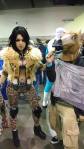
Cosplay Pictures for your Saturday Enjoyment

Cosplay Pictures for your Saturday Enjoyment

Leave a comment

Filed under Humor and Observations

Paintings made with Buttons

Mind Blowing Paintings made by miscellaneous objects.

An outstanding artist Jane Elizabeth Perkins in her Plastic Classics art series, used many miscellaneous objects she found, like buttons, pins, clips, pen cap, plastic toys, LEGO pieces, key chain, keys, etc. She have re-created paintings like DaVinci’s Mona Lisa, and made portraits of famous Albert Einstein, Queen of Britain, and Nelson Mandela.

When you inspect closely, it will be revealed that many minor forgotten objects she have used to make these beautiful and impressionist painting. She have used many objects in its original form, not even the colour have been used for most of the objects. Her skills are unmatched and her work is so impressive and astonishing that we couldn’t stop ourselves from sharing it with you guys. Please check the very innovative work done by an artist from UK. Observe and watch closely and you will be amazed to find the objects she have used for her impressive paintings. I loved it.

plastic-classics-found-objects-famous-portraits-jane-perkins-9 plastic-classics-found-objects-famous-portraits-jane-perkins-8  plastic-classics-found-objects-famous-portraits-jane-perkins-4 plastic-classics-found-objects-famous-portraits-jane-perkins-1 janeperkins4 janeperkins5 janeperkins6 janeperkins7 janeperkins8 janeperkins3 janeperkins2 janeperkins1

Images via: Jane Perkins website

Leave a comment

Filed under Humor and Observations, Uncategorized

Robotic cops to monitor traffic in space

Robotic cops to monitor traffic in space

By

War Games

Published February 06, 2014

FoxNews.com

In the absence of red and green lights to control traffic in space, a team of scientists at the Lawrence Livermore National Laboratory is developing mini-satellites that will work as “traffic cops” to help prevent collisions.

The threat of collisions in space is serious: If a military satellite is hit and damaged, it could mean loss of communications, visual information on the ground and GPS for deployed troops. There is also a serious threat to spacecraft with humans aboard, like shuttles and the International Space Station.

It’s the stuff of movies. Anyone see “Gravity”?

But it’s a real threat too, one that escalates as the quantity of space debris grows. According to NASA, more than 500,000 pieces of space junk are orbiting the Earth, and some of them are traveling at crazy speeds – as in 17,500 mph, more than fast enough for a tiny fragment of orbital debris to cause damage to a satellite or a spacecraft.

But what if we had a force that could act as a sort of satellite traffic control, one that could stop collisions, help control space traffic and, very importantly, prevent satellites from colliding?

The answer is the STARE (Space-Based Telescopes for Actionable Refinement of Ephemeris) mission, which was launched to help avoid space collisions. Ultimately, the plan is to create a constellation of “space cop” nano-satellites that will operate in low earth orbit.

It is incredibly hard to accurately predict a satellite’s location in low earth orbit at any moment, largely because of uncertainties like atmospheric drag, which creates errors in tracking satellite position and velocity.

To cope with these errors, the Space Surveillance Network has to repeatedly observe the nearly 20,000 objects it tracks.

But even with all this effort, the accuracy of a satellite’s position in low earth orbit is only within about one kilometer – about 3/5ths of a mile.

Not knowing exactly where the space objects are located means that for every anticipated collision, there are about 10,000 false alarms. And the false alarms create a “Chicken Little” effect: when there is a collision warning, satellite operators think it is just another false alarm, and they seldom move their assets.

The STARE mission aims to reduce this kilometer of uncertainty down to 100 meters or less, which would dramatically reduce the number of false alarms.

Now the Lawrence Livermore team, led by Wim de Vries and lead engineer Vincent Riot, has proven it can be done.

To demonstrate the new technology, the team chose as its target the NORAD 27006 satellite.

The scientists used six images taken by a ground-based satellite over a 60-hour period to prepare. Then they took four observations during the first 24 hours of the test mission for calculations, and they were able to predict NORAD’s trajectory to within less than 164 feet over the next 36 hours, a very promising number since the team had hoped to reduce uncertainty only to about 328 feet.

Then, from the ground, the Livermore team changed the orbit of the satellite. Their findings were published in the recent Journal of Small Satellites.

Ultimately, when their “traffic cop” is deployed to space, it will perform the same sorts of observations and analysis in orbit that the scientists made on the ground. When development is completed, it will prevent all sorts of collisions: satellite with satellite, satellite with debris and more.

And all of that without a whistle.

Ballet dancer turned defense specialist Allison Barrie has traveled around the world covering the military, terrorism, weapons advancements and life on the front line. You can reach her at wargames@foxnews.com or follow her on Twitter @Allison_Barrie.

Leave a comment

Filed under Humor and Observations

Woolly mammoths (and rhinos) ate flowers

Woolly mammoths (and rhinos) ate flowers

By Tia Ghose

Published February 06, 2014

  • pleistocene-arctic

    The Arctic had much more diverse flora than previously thought during the Pleistocene Era (Mauricio Anton)

Woolly mammoths, rhinos and other ice age beasts may have munched on high-protein wildflowers called forbs, new research suggests.

And far from living in a monotonous grassland, the mega-beasts inhabited a colorful Arctic landscape filled with flowering plants and diverse vegetation, the study researchers found.

The new research “paints a different picture of the Arctic,” thousands of years ago, said study co-author Joseph Craine, an ecosystem ecologist at Kansas State University. “It makes us rethink how the vegetation looked and how those animals thrived on the landscape.”

The ancient ecosystem was detailed Wednesday in the journal Nature.

Pretty landscape In the past, scientists imagined that the now-vast Arctic tundra was once a brown grassland steppe that teemed with wooly mammoths, rhinos and bison. But recreations of the ancient Arctic vegetation relied on fossilized pollen found in permafrost, or frozen soil. Because grasses and sedges tend to produce more pollen than other plants, those analyses produced a biased picture of the landscape. [Image Gallery: Ancient Beasts Roam an Arctic Landscape]

To understand the ancient landscape better, researchers analyzed the plant genetic material found in 242 samples of permafrost from across Siberia, Northern Europe and Alaska that dated as far back as 50,000 years ago.

They also analyzed the DNA found in the gut contents and fossilized poop, or coprolites, of eight Pleistocene beasts woolly mammoths, rhinos, bison and horses found in museums throughout the world.

The DNA analysis showed that the Arctic at the time had a varied landscape filled with wildflowers, grasses and other vegetation.

And the shaggy ice age beasts that roamed the landscape took advantage of that cornucopia. The grazers supplemented their grassy diet with a hefty helping of wildflowerlike plants known as forbs, the stomach content analysis found.

These forbs are high in protein and other nutrients, which may have helped the grazers put on weight and reproduce in the otherwise sparse Arctic environment, Craine told Live Science.

Vanishing wildflowers Between 10,000 and 15,000 years ago, forbs declined in the Arctic,study co-author Mary E. Edwards, a physical geographer at the University of Southampton in England, wrote in an email.

Though it’s not exactly clear why, “we do know from much other evidence that the climate changed at this time,” Edwards said.

The ice age was ending and warmer, wetter weather was prevailing. That climate “allowed trees and shrubs to flourish and these would have outgrown forbs by shading them for example,” Edwards said.
It’s also possible that the vanishing of these high-protein plants hastened the extinction of ice age beasts such as the woolly mammoth. For example, grasslands may have been delicately balanced, with poop from the grazers nourishing the plants, which in turn kept the animals alive. If a big jolt in climate disrupted one part of the chain for instance by depleting the forbs that may have led the whole system to collapse, Edwards speculated.

The findings also raise questions about modern grazers such as bison, Craine said. If the ancient beasts dined on forbs, it’s possible these wildflower-like plants play a bigger role in the diet of modern bison as well, he said.

Leave a comment

Filed under Humor and Observations

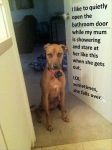
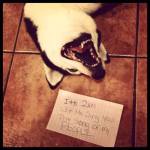
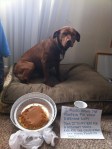
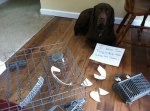
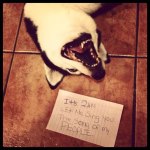
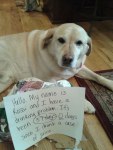
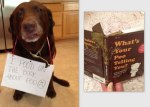
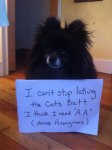
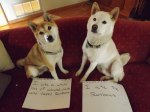
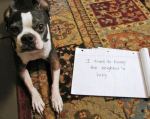
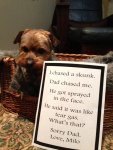
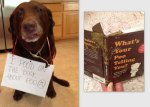
Dog Shaming For Your Tuesday Blues

I apologize for the late post on cute dog pictures.  Unfortunately, I was back at the orthopedic surgeon yesterday.  Good news is they know what is wrong, bad news, probably looking at one or two surgeries again…sigh…  Anyway, to make up for it being late, I am posting the ever popular dog shaming photos.  This is the last of my current stock so send me more.  Also, if you want more now, type “dog shaming” into the search box on my home page for a bunch of them.  I think I have posted about ten sets.

Leave a comment

Filed under Animals, Humor and Observations

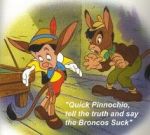
Denver Bronco Super Bowl Loss Humor

If you are a Bronco fan, you should probably skip this post…

  1. The Denver Broncos could not fly home after the game.  Apparently, someone had painted an end zone in front of the airports.

  2. At least Bruno Mars was able to make it to midfield by halftime.
  3. They said Peyton Manning could be anyone – so he became Tony Romo.
  4. The Broncos logo is a horse’s head but they played like a horse’s ass.
  5. This was not the worst loss in Super Bowl history.  Unfortunately for Denver, they hold that record already.

  6. The game started off with a safety because Peyton Manning inadvertently audibled “Papa Johns” instead of “Omaha”.
  7. The Broncos now can claim the second largest disaster to hit New York.
  8. New York got the high taxes and New Jersey got the toxic waste dumps.  Colorado got the Broncos because they had third pick.
  9. The two states with legal marijuana made the Super Bowl.  The one with all legal slaughtered the medical marijuana.  Based on this statistical data, the Arizona Cardinal will win the Super Bowl next year if we not only legalize marijuana, but hand out free samples to all citizens.
  10. It was all a test to see if depressed Denver fans eat more Papa Johns than happy Denver fans.
  11. The Denver Broncos sacrificed a virgin to win the Super Bowl.  Unfortunately, they sent Tim Tebow to the Jets instead of the bottom of an active volcano, so it didn’t work.
  12. I guess for Denver it will always be Elway or the highway…
  13. At least Papa Johns delivers.
  14. Even ObamaCare does not cover this much choking.
  15. Fans wanted to help, but Google and Wikipedia have no listings for applying the Heimlich Maneouver to an entire football team.
  16. International fans were wondering if American Football had a limit for scoring or a way to stop the game out of mercy.

Leave a comment

Filed under Humor and Observations

4,600-year-old step pyramid uncovered in Egypt

4,600-year-old step pyramid uncovered in Egypt

By Owen Jarus

Published February 03, 2014

  • step-pyramid-1 new.JPG

    Archaeologists working near the ancient settlement of Edfu in southern Egypt have uncovered a step pyramid that dates back about 4,600 years. (Tell Edfu Project at the University of Chicagoâs Oriental Institute)

Archaeologists working near the ancient settlement of Edfu, in southern Egypt, have uncovered a step pyramid that dates back about 4,600 years, predating the Great Pyramid of Giza by at least a few decades.

The step pyramid, which once stood as high as 43 feet, is one of seven so-called “provincial” pyramids built by either the pharaoh Huni (reign ca. 2635-2610 B.C.) or Snefru (reign ca. 2610-2590 B.C.). Over time, the step pyramid’s stone blocks were pillaged, and the monument was exposed to weathering, so today, it’s only about 16 feet tall.

Scattered throughout central and southern Egypt, the provincial pyramids are located near major settlements, have no internal chambers and were not intended for burial. Six of the seven pyramids have almost identical dimensions, including the newly uncovered one at Edfu, which is about 60 × 61 feet. [See Photos of the Newly Uncovered Step Pyramid]

The purpose of these seven pyramids is a mystery. They may have been used as symbolic monuments dedicated to the royal cult that affirmed the power of the king in the southern provinces.

“The similarities from one pyramid to the other are really amazing, and there is definitely a common plan,” said Gregory Marouard, a research associate at the University of Chicago’s Oriental Institute who led the work at the Edfu pyramid. On the east side of the newly uncovered pyramid, his team found the remains of an installation where food offerings appear to have been made — a discovery that is important for understanding this kind of pyramid since it provides clues as to what they were used for.

The team also found hieroglyphic graffiti incised on the outer faces of the pyramid. The inscriptions are located beside the remains of babies and children who were buried at the foot of the pyramid. The researchers think the inscriptions and burials date to long after the pyramid was built and that the structure was not originally intended as a burial place.

Initial results of the excavation were presented at a symposium held in Toronto recently by the Society for the Study of Egyptian Antiquities.

Uncovering the pyramid Though scholars knew of the existence of the pyramid at Edfu, the structure had never been excavated before Marouard’s team started work in 2010, he said in the study. His team found that the pyramid was covered by a thick layer of sand, modern waste and remains from the pillaging of its blocks.

It didn’t look like a pyramid he said, and people in a nearby village even thought the structure was the tomb of a sheikh, a local Muslim saint. As the team went to work cleaning the monument, the ancient pyramid was revealed. [In Photos: The Seven Ancient Wonders of the World]

Built of sandstone blocks and clay mortar, it had been constructed in the form of a three-step pyramid. A core of blocks rises up vertically, with two layers of blocks beside it, on top of each other. This made the pyramid look like it had three steps. The style is similar to that of a step pyramid built by Djoser (reign ca. 2670-2640 B.C.), the pharaoh who constructed Egypt’s first pyramid at the beginning of the third ancient Egyptian dynasty. The technique is close to that used at the Meidum pyramid, which was built by either Snefru or Huni and started out as a step pyramid before being turned into a true pyramid.

“The construction itself reflects a certain care and a real expertise in the mastery of stone construction, especially for the adjustment of the most important blocks,” said Marouard in his paper. Marouard also noted that the pyramid was built directly on the bedrock and was constructed entirely with local raw materials. The quarry where the sandstone was extracted was discovered in 2011, and is located only about a half mile north of the pyramid.

The growth of a modern-day cemetery and village poses a danger to the newly uncovered pyramid. In order to help prevent further looting, a fence was built around the structure, thanks to financial assistance from the American Research Center in Egypt and the National Endowment for the Humanities.

Graffiti and child burials As the team uncovered the pyramid, they found that inscriptions had been incised on its outer faces. They include hieroglyphic depictions of a book roll, a seated man, a four-legged animal, a reed leaf and a bird.

“These are mostly private and rough inscriptions, and certainly dedicated to the child/babies’ burials located right under these inscriptions at the foot of the pyramid,” Marouard told Live Science in an email. One of the inscriptions appears to mean “head of the house” and may be a reference to the mother of a buried child.

Marouard said his team would be publishing these burials and images in more detail in the future.

A pyramid abandoned The archaeologists found that by the time of the reign of Khufu (the pharaoh who built the Great Pyramid), ca. 2590-2563 B.C., the pyramid at Edfu had been abandoned, and offerings were no longer being made. This occurred less than 50 years after its construction, Marouard said.

This suggests the seven small pyramids stopped being used when work on the Great Pyramid began. It seems Khufu no longer thought there was a need to maintain a small pyramid at Edfu, or elsewhere in southern Egypt, Marouard said. Rather, Khufu focused all the resources on building the Great Pyramid at Giza, which is close to the Egyptian capital at Memphis, he added.

Khufu may have felt politically secure in southern Egypt and saw no need to maintain or build pyramids there, Marouard said in the email. The “center of gravity of Egypt was then at Memphis for many centuries — this region draining resources and manpower from the provinces, all regions being put to use for the large construction sites of funerary complexes.”

At Wadi al-Jarf, a port found on the shore of the Red Sea that dates to Khufu’s time, papyri (written documents) dating to the end of Khufu’s reign were recently discovered that supports the idea that the pharaoh tried to converge all the resources he could toward Giza and the ancient wonder being constructed there.

Leave a comment

Filed under Humor and Observations

Heroin Addiction Claims Philip Seymour Hoffman – Dead at 46

I honestly don’t know how to solve our problem that we lose so many people, both famous and unknown, to addiction.  I grew up in drug central in California and almost everyone used drugs.  But even amongst the kids growing up in the drug plentiful late 1970s like me, we knew that if it involved a needle or a flame and spoon it was best to say no.  Even ‘druggies’ realized that meth, crack, and heroine were asking for an overdose.  The needles themselves spread disease, but the drugs were often of indeterminate strength and mixed with random ingredients to ‘cut them’ for more sales.  Mixed with partying, poor diet, lack of sleep, alcohol and cocaine, shooting up is a like playing Russian Roulette.

Philip Seymour Hoffman was one of my favorite actors and extremely talented.  He gets added to the list of my favorites like Mitch Hedburg, John Belushi, Chris Farley, Elvis, and Morrison that all died too soon due to drug addiction.  Were there family members or friends who could have forced an intervention?  Did their former rehab facilities not do proper follow-up?  What about all those we don’t hear about found every day, dead in their own vomit with a needle stuck in their arm?

Not sure what to do.  But we need to do something.

BREAKING: Philip Seymour Hoffman Found Dead at 46

By                             
.

Philip Seymour Hoffman found dead at 46. (Getty Images)

Academy Award winner Philip Seymour Hoffman was found dead in his New York City apartment on Sunday. He was 46.

The New York City Police Department  confirmed to “The Insider With Yahoo” that the actor was found dead at 12 p.m. ET in his fourth floor apartment in the West Village of New York City.

While the official cause of death is still unknown at this point, police confirm that he may have died of a drug overdose. The actor was found with a needle in his arm and apparent heroin was found at the scene. Playwright David Katz is believed to have made the initial discovery.

The New York Medical Examiner confirms that an autopsy of the remains will be conducted on Monday.

Hoffman’s family released a statement regarding his death:

“We are devastated by the loss of our beloved Phil and appreciate the outpouring of love and support we have received from everyone. This is a tragic and sudden loss and we ask that you respect our privacy during this time of grieving.  Please keep Phil in your thoughts and prayers.” The family will not be making any further statements at this time.

[Related: Celebrities React to Philip Seymour Hoffman’s Death]

Hoffman struggled with a heroin addiction and had checked into rehab in May 2013.

In a 2006 interview with CBS’ “60 Minutes,” Hoffman discussed his earlier drug use dating back to the time after his graduation from New York University’s drama school.

“It was all that [drugs and alcohol], yeah, it was anything I could get my hands on… I liked it all,” Hoffman said. Eventually, he chose to seek treatment. “I went [to rehab], I got sober when I was 22 years old. You get panicked… and I got panicked for my life. It really was just that.”

He also revealed that his drug habit was life-threatening. “I have so much empathy for these young actors that are 19 and all of a sudden they’re beautiful and famous and rich. I’m like, ‘Oh my God. I’d be dead.’ You know what I mean? I’d be 19, beautiful, famous and rich. That would be it. I think back at that time. I think if I had the money, that kind of money and stuff. So, yeah [I would have died].”

Bizarrely, Hoffman was the victim of a death hoax earlier this week. However, at the time, his rep confirmed that he was alive and well.

Hoffman won an Academy Award for Best Actor for his work in the 2005 film, “Capote.” He’s has been nominated for Oscars for his performances in “The Master,” “Doubt,” and “Charlie Wilson’s War.” The longtime thespian will also be remembered for a number of smaller films, including “Magnolia,” “Synecdoche, New York, and “The Talented Mr. Ripley,” as well as his breakout in “Twister” and his most recent turn as Plutarch Heavensbee in “The Hunger Games: Catching Fire.”

Hoffman was also active in the New York theater scene, and had been nominated for Tony Awards three times.

He has three children, Tallulah Hoffman, Cooper Alexander Hoffman and Willa Hoffman, all under the age of 11, with costume designer Mimi O’Donnell. While Hoffman and O’Donnell never married, they’ve been together since 1999, when they met on the set of the play “In Arabia We’d All Be Kings.”

3 Comments

Filed under Humor and Observations