Category Archives: Humor and Observations

KWOD Radio Interview at Phoenix ComicCon 2013

Patti Hulstrand, the host of KWOD radio is broadcasting live from Phoenix ComicCon 2013.  She will be interviewing many bright stars among movie actors, TV actors, and great authors.  Then…after she interviews those people, she has been gracious enough to add me to the list as well.  I have appeared on her radio show once before and she was a gracious and captivating host.  I will likely be discussing the new anthology, Twisted Nightmares, just out last week in print form.

My new picture

Michael Bradley, Author

Remember, you can stop by booth #1629 at Phoenix ComicCon 2013 to say hello and get your autographed copy, right off the presses.  Thanks to Patti Hulstrand and all of you who give me your time and support.  It is much appreciated.

T-Nightmares-Cover

Leave a comment

Filed under Humor and Observations, Writing

Could humans be cloned?

Could humans be cloned?

By Rachael Rettner

Published May 19, 2013

LiveScience

  • Battlestar Galactica cylons.jpg

    Actresses Tricia Helfer (left) and Grace Park (right), who played humanoid Cylons with countless clones on the TV show “Battlestar Galactica.” (Syfy)

  • Egg nucleus transfer final.jpg

    The first step during SCNT is enucleation or removal of nuclear genetic material (chromosomal) from a human egg. An egg is positioned with holding pipette (on the left) and egg’s chromosomes are visualized under polarized microscope. A hole is made in the egg’s shell (zone pellucida) using a laser and a smaller pipette (on the right) is inserted through the opening. The chromosomes then sucked in inside the pipette and slowly removed from the egg. (Cell, Tachibana et al.)

The news that researchers have used cloning to make human embryos for the purpose of producing stem cells may have some people wondering if it would ever be possible to clone a person.
Although it would be unethical, experts say it is likely biologically possible to clone a human being. But even putting ethics aside, the sheer amount of resources needed to do it is a significant barrier.

Since the 1950s when researchers cloned a frog, scientists have cloned dozens of animal species, including mice, cats, sheep, pigs and cows.

‘It’s grossly unethical.’

– Dr. Robert Lanza, chief scientific officer at the biotech company Advanced Cell Technology 

In each case, researchers encountered problems that needed to be overcome with trial and error, said Dr. Robert Lanza, chief scientific officer at the biotech company Advanced Cell Technology, which works on cell therapies for human diseases, and has cloned animals.

With mice, researchers were able to use thousands of eggs, and conduct many experiments, to work out these problems, Lanza said. “Its a numbers game,” he said.

But with primates, eggs are a very precious resource, and it is not easy to acquire them to conduct experiments, Lanza said.

In addition, researchers can’t simply apply what they’ve learned from cloning mice or cows to cloning people.

For instance, cloning an animal requires that researchers first remove the nucleus of an egg cell. When researchers do this, they also remove proteins that are essential to help cells divide, Lanza said. In mice, this isn’t a problem, because the embryo that is ultimately created is able to make these proteins again. But primates aren’t able to do this, and researchers think it may be one reason that attempts to clone monkeys have failed, Lanza said. [See How Stem Cell Cloning Works (Infographic)]

What’s more, cloned animals often have different kinds of genetic abnormalities that can prevent embryo implantation in a uterus, or cause the fetus to spontaneously abort, or the animal to die shortly after birth, Lanza said.

These abnormities are common because cloned embryos have just one parent rather than two, which means that a molecular process known as “imprinting” does not occur properly in cloned embryos, Lanza said. Imprinting takes place during embryo development, and selectively silences certain genes from one parent or the other.

Problems with imprinting can result in extremely large placentas, which ultimately leads to problems with blood flow for the fetus, Lanza said. In one experiment, Lanza and colleagues cloned a species of cattle called banteng, and it was born at twice the size of a normal banteng. It had to be euthanized, Lanza said.

The extremely high rate of death, and the risk of developmental abnormities from cloning makes cloning people unethical, Lanza said.

“It’s like sending your baby up in a rocket knowing there’s a 50-50 chance it’s going to blow up. It’s grossly unethical,” Lanza said.

Read more: http://www.foxnews.com/science/2013/05/19/could-humans-be-cloned/#ixzz2TnzBJH7Y

Leave a comment

Filed under Humor and Observations

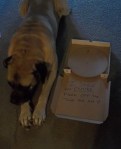
Dog Shaming for Your Monday Blues

I have posted these before and they seem to be very popular, so here we go again.  Pictures of a dog shaming, where people have the culprit with a sign describing their crime.  Enjoy!

1 Comment

Filed under Animals, Humor and Observations

Flags Made from Country’s Food

You will need to click the flags to see the complete picture.


1

AUSTRALIA - Meat pie, sauce
3
CHINA - Pittaya/dragon fruit and star fruit
4
FRANCE - Blue cheese, brie, grapes
5
GREECE - Kalamata olives and feta cheese
6
INDIA - Curries, rice, pappadum wafer
7
INDONESIA - Spicy curries and rice (Sambal)
8
ITALY - Basil, pasta, tomoatoes
9
JAPAN - Tuna and rice

10

LEBANON - Lavash, fattoush, herb spring
11
SOUTH KOREA - Kimbap and sauces
12
SPAIN - Chorizo and rice
13
VIETNAM - Rambutan, lychee, starfuit
14
SWITZERLAND - Charcuteries and emmental
15
THAILAND - Sweet chilli sauce, shredded coconut, blue swimmer crab
16
TURKEY - Turkish Delight (Lokum)
17
UNITED KINGDOM - Scone, cream, jams
18
UNITED STATES - Hot dogs, ketchup and mustard

3 Comments

Filed under Humor and Observations, Uncategorized

Teenager Finds Viking Coins

Danish teenager makes rare Viking-era find with metal detector

Published May 16, 2013

Associated Press

  • Denmark Viking Find 2013.jpg

    Coins from Bohemia, Germany, Denmark and England discovered during an archaeological dig last year, some of 365 items from the Viking era. Danish National Museum spokesman Jens Christian Moesgaard says the coins have a distinctive cross motif attributed to Norse King Harald Bluetooth, who is believed to have brought Christianity to Norway and Denmark. (AP Photo/Polfoto/Stokke Brothers)

  • Denmark Viking Find 2013 1.jpg

    A pendant necklace in silver of Thor’s Hammer discovered during an archaeological dig last year, one of 365 items from the Viking era, including 60 rare coins. (AP Photo/Polfoto/Stokke Brothers)

COPENHAGEN, Denmark –  Danish museum officials say that an archaeological dig last year has revealed 365 items from the Viking era, including 60 rare coins.
Danish National Museum spokesman Jens Christian Moesgaard says the coins have a distinctive cross motif attributed to Norse King Harald Bluetooth, who is believed to have brought Christianity to Norway and Denmark.

Sixteen-year-old Michael Stokbro Larsen found the coins and other items with a metal detector in a field in northern Denmark.

Stokbro Larsen, who often explores with his detector, said he is often laughed at because friends find him “a bit nerdy.”

Moesgaard said Thursday that it was the first time since 1939 that so many Viking-era coins have been found, calling them “another important piece in the puzzle” of history.

Read more: http://www.foxnews.com/science/2013/05/16/teenager-rare-viking-era-find-metal-detector/#ixzz2Tlao6A2i

1 Comment

Filed under Humor and Observations

1868 Steam Robot

Steampunk was just steam technology in the late 1800’s.   Many inventions are somewhat lost to us today.  The authors HG Wells and Jules Verne were writing science fiction, which is now steampunk science fiction.  The first rebirth of steampunk writing was a serial based on a boy who builds a steam powered man to pull a wagon to the west where they fight Indians and make their fortune, returning home in triumph.  These stories were very popular in the 1920’s and 1930’s in America.  This shows that as early as 1868, such an invention actually existed.  If petroleum was not discovered as an energy source, who knows what cool technology we would have developed with steam and hydraulics?

1868:

Steam Robot

“Zadoc P. Dederick, along with Isaac Grass, was the creator of a steam-powered human-like robot designed to pull a cart.”

7 Comments

Filed under Humor and Observations

Stormtrooper Helmet Art

Star Wars fans are familiar with the standard TK series of plasti-steel white blaster armor with com helmet and HUD vision slits used by the Emperor’s Imperial Stormtroopers.  However, you may not have seen the alternative art for these helmets…  Enjoy!

1 Comment

Filed under Humor and Observations

Legendary Lost City Possibly Found

Ciudad Blanca, Legendary Lost City, Possibly Found In Honduran Rain Forest

Posted: 05/15/2013 1:51 pm EDT  |  Updated: 05/16/2013 1:24 pm EDT

By: Stephanie Pappas, LiveScience Senior Writer 

Published: 05/15/2013 09:00 AM EDT on LiveScience

New images of a possible lost city hidden by Honduran rain forests show what might be the building foundations and mounds of Ciudad Blanca, a never-confirmed legendary metropolis.

Archaeologists and filmmakers Steven Elkins and Bill Benenson announced last year that they had discovered possible ruins in Honduras’ Mosquitia region using lidar, or light detection and ranging. Essentially, slow-flying planes send constant laser pulses groundward as they pass over the rain forest, imaging the topography below the thick forest canopy.

What the archaeologists found — and what the new images reveal — are features that could be ancient ruins, including canals, roads, building foundations and terraced agricultural land. The University of Houston archaeologists who led the expedition will reveal their new images and discuss them today (May 15) at the American Geophysical Union Meeting of the Americas in Cancun.

ciudad blanca

Square structures may mark the foundations of ancient buildings in the Honduran rainforest. 

Ciudad Blanca, or “The White City,” has been a legend since the days of the conquistadors, who believed the Mosquitia rain forests hid a metropolis full of gold and searched for it in the 1500s. Throughout the 1900s, archaeologists documented mounds and other signs of ancient civilization in the Mosquitias region, but the shining golden city of legend has yet to make an appearance.

Whether or not the lidar-weilding archaeologists have discovered the same city the conquistadors were looking for is up for debate, but the images suggest some signs of an ancient lost civilization.

“We use lidar to pinpoint where human structures are by looking for linear shapes and rectangles,” Colorado State University research Stephen Leisz, who uses lidar in Mexico, said in a statement. “Nature doesn’t work in straight lines.”

The archaeologists plan to get their feet on the ground this year to investigate the mysterious features seen in the new images.

Follow Stephanie Pappas on Twitterand Google+. Follow us @livescienceFacebook Google+. Original article onLiveScience.com.

3 Comments

Filed under Humor and Observations

Teenager Designs Better Nuclear Plant

Meet the teenager who designed a safer nuclear power plant

By Elizabeth Palermo

Published May 15, 2013

TechNewsDaily

  • tayler-wilson-ted

    Taylor Wilson (TED)

Do nuclear power plants need a redesign? Critics of nuclear energy seem to think so, and so does nuclear energy advocate, Taylor Wilson. A physics wunderkind, Wilson became the youngest person to ever create fusion at age 14. And since graduating from high school last year, he’s devoted himself to finding innovative solutions to the world’s biggest problems.

The now nineteen-year-old Wilson recently spoke to a TED audience about his design for a small, modular fission reactor that is both less expensive and much safer to operate than today’s nuclear reactors.

Its assembly-line construction, 30-year fuel life and low usage cost make Wilson’s reactor an ideal source of electricity for both developing nations and space explorers, according to the young scientist.

To get an idea of how today’s nuclear reactors work, Wilson first explained to his listeners at TED how electricity is produced using a steam turbine. In a steam turbine system, water boils and turns to steam, which turns the turbine and creates electricity.

Nuclear fission, Wilson said, is really just a fancy tool for getting the water in a steam turbine system to boil quickly and steadily.

Today’s nuclear power plants produce steam for their turbines using pressurized-water reactors — or big pots of water under high pressure — which are heated up with help from uranium dioxide fuel rods encased in zirconium. These rods control and maintain the nuclear fission reaction.

When nuclear power was first used to heat water in a turbine system, it was a big advancement in existing technology. But Wilson said his idea for a redesign stemmed from the suspicion that it wasn’t really the best way to do it.

“Is fission kind of played out, or is there something left to innovate here?” Wilson said he asked himself. “And I realized that I had hit upon something that I think has this huge potential to change the world.”

Instead of finding a new way to boil water, Wilson’s compact, molten salt reactor found a way to heat up gas. That is, really heat it up.

Wilson’s fission reactor operates at 600 to 700 degrees Celsius. And because the laws of thermodynamics say that high temperatures lead to high efficiencies, this reactor is 45 to 50 percent efficient.

Traditional steam turbine systems are only 30 to 35 percent efficient because their reactors run at low temperatures of about 200 to 300 degrees Celsius.

And Wilson’s reactor isn’t just hot, it’s also powerful. Despite its small size, the reactor generates between 50 and 100 megawatts of electricity, which is enough to power anywhere from 25,000 to 100,000 homes, according to Wilson.

Another innovative component of Wilson’s take on nuclear fission is its source of fuel. The molten salt reactor runs off of “down-blended weapons pits.” In other words, all the highly enriched uranium and weapons-grade plutonium collecting dust since the Cold War could be put to use for peaceful purposes.

And unlike traditional nuclear power plants, Wilson’s miniature power plants would be buried below ground, making them a boon for security advocates.

According to Wilson, his reactor only needs to be refueled every 30 years, compared to the 18-month fuel cycle of most power plants. This means they can be sealed up underground for a long time, decreasing the risk of proliferation.

Wilson’s reactor is also less prone to proliferation because it doesn’t operate at high pressure like today’s pressurized-water reactors or use ceramic control rods, which release hydrogen when heated and lead to explosions during nuclear power plant accidents, like the one at Fukushima in 2011.

In the event of an accident in one of Wilson’s reactors, the fuel from the core would drain into a “sub-critical” setting- or tank- underneath the reactor, which neutralizes the reaction. The worst that could happen, according to Wilson, is that the reactor is destroyed.

“But we’re not going to contaminate large quantities of land,” said Wilson. “So I really think that in the, say, 20 years it’s going to take us to get fusion and make fusion a reality, this could be the source of energy that provides carbon-free electricity.”

Wilson said his idea could help combat climate change, bring affordable power to the developing world and power rockets to explore space.

“There’s something really poetic about using nuclear power to propel us to the stars,” Wilson said, “Because the stars are giant fusion reactors. They’re giant nuclear cauldrons in the sky … there’s something poetic about perfecting nuclear fission and using it as a future source of innovative energy.”


Read more: http://www.foxnews.com/tech/2013/05/15/teenager-designs-safer-nuclear-power-plants/?intcmp=features#ixzz2TTvuJwJc

3 Comments

Filed under Humor and Observations

Epic Meltdown

Local Arizona restaurant – Amy’s Baking Company Bakery Boutique & Bistro – Is slated to be on Kitchen Nightmares on TV with Gordon Ramsey.  First, if I own a restaurant, why would I want to be on Kitchen Nightmares?  Second, the owners are so wacko that even Gordon Ramsey and his crew walked out.  The show aired last Friday, basically with them packing up and saying you guys are too psycho to work with.  So, what then?

crazy cooks

In an epic meltdown, as if the horrible publicity were not already enough, the owners start flaming their own customers in social media.  On Facebook, on Yelp, on Reddit…  They get more bizarre as they go.  It is a great example of what NOT to do EVER when you are in business.  If they had offered to have a Yelp night, or FB or Reddit night, they could have invited their haters for a free meal and settled things down.  But noooooo….   For a good laugh, read the link below:  (warning: their language gets worse as they go.)

http://www.buzzfeed.com/ryanhatesthis/this-is-the-most-epic-brand-meltdown-on-facebook-ever


Leave a comment

Filed under Humor and Observations