600 Year Old Chinese Coin Found In Kenya

Illinois scientists find rare coin in Kenya

Digging History

Published March 13, 2013

Associated Press

  • 600-year-old Chinese coin found in Kenya

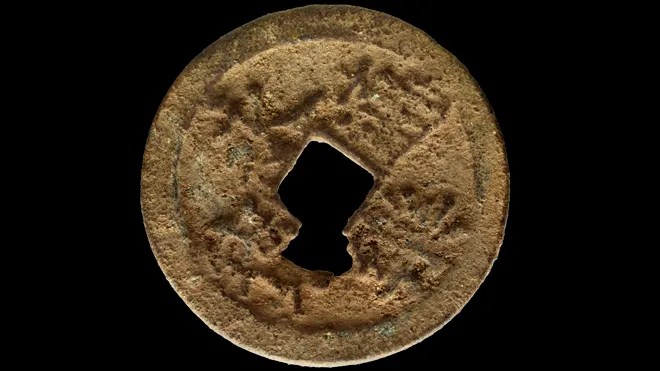
    Feb. 8, 2013: A rare, 600-year-old Chinese coin that scientists from Illinois discovered on the Kenyan island of Manda. The museum announced the discovery Wednesday, March 13. (AP Photo/Courtesy The Field Museum, John Weinstein)

CHICAGO –  Scientists from Illinois have found a rare, 600-year-old Chinese coin on the Kenyan island of Manda.

The Field Museum in Chicago announced the find Wednesday. The joint expedition was led by Chapurukha Kusimba of the museum and Sloan Williams of the University of Illinois-Chicago. Researchers say the coin proves trade existed between China and eastern Africa decades before European explorers set sail.

The coin is made of copper and silver. It has a square hole in the center so it could be worn on a belt. Scientists say it was issued by Emperor Yongle of China and his name is written on the coin.

Scientists from Kenya, Pennsylvania and Ohio also participated in the expedition. They also found human remains and other artifacts predating the coin.

Read more: http://www.foxnews.com/science/2013/03/13/illinois-scientists-find-rare-coin-in-kenya/?intcmp=obinsite#ixzz2OQNpWSIh

1 Comment

Filed under Humor and Observations

One Big Shotgun

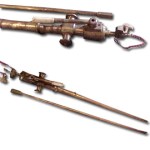
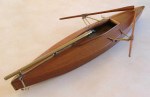
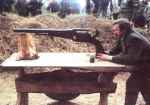
Most of you have probably never heard of the “punt gun.”  It was the world’s largest shotgun, and I do mean LARGE, placed in a “punt” or small flat-bottom boat.  The purpose?  It was used for “fowling” or basically shooting wild birds like ducks for resale as food.  If your last name is Fowler, perhaps one of your ancestors did this for a living.  A punt gun could kill up to 50 ducks in one shot.  The crew of one or two would push their punt silently along to a group of fowl.  They had to point the gun by lining up the punt to be pointed at their target.  Then BOOM!

Enjoy these pictures of a gun used primarily in the 19th and 20th centuries before such use was consider unsporting.


punt is a flat-bottomed boat with a square-cut bow, designed for use in small rivers or other shallow water. Punting refers to boating in a punt. The punter generally propels the punt by pushing against the river bed with a pole. A punt should not be confused with a gondola, which is propelled by an oar rather than a pole.

Punts were originally built as cargo boats or platforms for fowling and angling, but in modern times their use is almost exclusively confined to pleasure trips.


http://en.wikipedia.org/wiki/Punt_gun

Leave a comment

Filed under Humor and Observations, Uncategorized

Before Lady Gaga, Before Madonna – Peggy Moffitt

Even today, many of these styles would be avant garde and Peggy Moffitt wore them in the 1960’s, yep, fifty years ago when men dressed like the movie Men-in-black, the Civil Rights Movement was in full swing, and America was trying to catch up with the Soviets in the space race.  Most important was the Summer of ’63, at least personally, because I was born…

An homage to Peggy Moffitt

1960s:Peggy Moffitt

“Peggy Moffitt (born 1940) was during the 1960s a premier model. She developed a signature style that featured heavy, Kabuki-like makeup and an asymmetrical hair cut.”

– Wikipedia

As a warning for young folks, the following Wikipedia post has a topless shot of Peggy. Not sure why they did that out of all her pictures, but it has good information on her.

http://en.wikipedia.org/wiki/Peggy_Moffitt


Leave a comment

Filed under Humor and Observations, Uncategorized

More Steampunk Aircrew

A regular feature of the blog is to post great pictures of steampunk enthusiasts.  Steampunk being a science fiction, or a “historical future” in the Age of Steam, roughly 1830 to 1900 or so, usually British or American Wild Western themed.  So, ready to hire crew for your airship?  You decide if you want heroes, military, pirates, merchants, explorers or whatever.  You can’t hire them all, so who would you pick?  (For earlier posts, type “steampunk aircrew” into the search box on the home page.  I think this is the seventh post.) (photographers, if any of these are your work, please send me your information so I can credit you, or if you wish, so I can remove it from my site.  This is an unpaid site and I get my pictures from Facebook, emails and so forth, so often I do not know the original source.  Thanks)

3 Comments

Filed under Humor and Observations

Seven Masted Schooner – 1902

1902:

The Thomas W. Lawson

“The Thomas W. Lawson was a seven-masted schooner originally planned for the Pacific trade but used primarily to haul coal and oil along the East Coast of the United States. The ship was the largest pure sailing vessel ever built.

“Her design and purpose was an ultimately unsuccessful bid to keep sailing ships competitive with steam ships” 

– Wikipedia

Sources: Boston Public Library

Leave a comment

Filed under Uncategorized

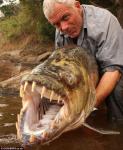
More Real Monsters

This is an ongoing post that has proven popular.  You can type in “real monsters” in the Search box on the home page to find earlier posts.  I know monster is a relative term…

2 Comments

Filed under Animals, Humor and Observations

Celebrating the “Nutty” Artistry of Steve Casino

Celebrating the amazing and “nutty” artwork of Steve Casino, “painter of nuts.”  Here is a link to his site showing his hand crafted peanut shell artistry.  Following are some samples from this site.  Pretty cool.  My ongoing effort to highlight artists with unique styles or materials.  Earlier posts include jelly bean art, fractal images, book art, etc.  Typing “art” into the search box on the Home page should bring most of them up.

http://stevecasino.com/

1 Comment

Filed under Humor and Observations, Uncategorized

Man Swallowed by Golf Course

Illinois Sinkhole: Mark Mihal Survives Getting Swallowed On Golf Course

AP  |  Posted: 03/12/2013 10:46 am EDT  |  Updated: 03/13/2013 9:19 am EDT

 
Illinois Sinkhole

Golf courses are great, but there’s a hole in one.

WATERLOO, Ill. (AP) — When it comes to dealing with this divot, score one for golfer Mark Mihal.

The St. Louis Post-Dispatch (http://bit.ly/13QvcoX) reports that the mortgage broker from Creve Coeur, Mo., is recovering after a sinkhole opened up beneath him Friday on the fairway at the 14th hole of a southwestern Illinois golf course.

The pit that swallowed him was 18 feet deep and 10 feet wide.

illinois sinkhole

The 43-year-old Mihal was hoisted to safety with a rope. The encounter at Annbriar Golf Course near Waterloo just southeast of St. Louis left him with a dislocated shoulder.

Although Mihal says he still considers the course one of his favorites, he’s having second thoughts about returning there, saying “it’d be kind of strange playing that hole again, for sure.”

Information from: St. Louis Post-Dispatch, http://www.stltoday.com

Leave a comment

Filed under Humor and Observations

The Great Paris Exposition Telescope

1900:

The Great Paris Exposition Telescope

“The Great Paris Exhibition Telescope with a 1.25 m diameter lens was the largest refracting telescope ever constructed.  When the year-long exposition was over, The company which had organized in build the telescope declared bankruptcy and were unable to sell it. It was ultimately broken up for scrap; the lenses are still stored away at the Paris Observatory.”– Wikipedia

Leave a comment

Filed under Humor and Observations

What Antarctica looked like before the ice

What Antarctica looked like before the ice

By Becky Oskin

Published March 08, 2013

LiveScience

  • antarctica_3d

    This 3-D reconstruction of the topography hidden under Antarctica’s two-mile-thick coating of ice was made using data from radar surveys. The continent was relatively flat before glaciers started carving deep valleys 34 million years ago, a new (Stuart N. Thomson/UA department of geosciences)

Like Alaska’s mighty Yukon, a broad river once flowed across Antarctica, following a gentle valley shaped by tectonic forces at a time before the continent became encased in ice. Understanding what happened when rivers of ice later filled the valley could solve certain climate and geologic puzzles about the southernmost continent.

The valley is Lambert Graben in East Antarctica, now home to the world’s largest glacier. Trapped beneath the ice, the graben (which is German for ditch or trench) is a stunning, deep gorge. But before Antarctica’s deep freeze 34 million years ago, the valley was relatively flat and filled by a lazy river, leaving a riddle for geologists to decode: How did Lambert Graben get so steep, and when was it carved?

The key to Lambert Graben’s history was found in layers of sediments just offshore, in Prydz Bay. In a new study, Stuart Thomson, a geologist at the University of Arizona (UA) in Tucson, looked into the past by decoding sands deposited by the river, and the messy piles left behind by the glacier. The river sands are topped with a thick layer of coarser sediment that signals the onset of glacial erosion in the valley, the researchers found. The erosion rate more than doubled when the glaciers moved in, Thomson said.

‘Glaciers can carve deep valleys quickly — and did so on Antarctica before it got … covered by 1 or 2 miles of thick, stationary ice.’

– Peter Reiners, a UA geologist 

“The only way that could happen is from glaciers,” he said. “They started grinding and forming deep valleys.”

Understanding when glaciers first wove their way across Antarctica will help scientists better model the ice sheet’s response to Earth’s climate shifts, the researchers said.

“There’s a big effort to model how glaciers flow in Antarctica, and these models need a landscape over which glaciers can flow,” Thomson told OurAmazingPlanet. “Once these models can predict past changes, they can more accurately predict what will happen with future climate changes.”

The sediments also hold clues to the tectonic evolution of East Antarctica, and a mountain range buried beneath the vast, thick ice sheet. [Album: Stunning Photos of Antarctic Ice]

The findings are detailed in the March 2013 issue of the journal Nature Geoscience.

History of the ice
Lambert Graben formed during the breakup of Gondwana, an ancient supercontinent, a process that happened in stages. Antarctica, India and Africa tore apart in the Late Cretaceous (about 80 million years ago). The split created long, linear valleys oriented perpendicular to the continental coastlines. At the time, Earth’s climate was warmer than it is today, and as Antarctica moved southward, settling into its home over the South Pole, the continent teemed with plants and animals.

Scientists can partially reconstruct this past environment with fossils and through radar that peers beneath the ice to map the shapes of the rock below. A 3D map of Antarctica today shows chasms carved by glaciers, rugged mountains and other remnants of its warmer existence.

But the surveys tell nothing about how the landscape looked before the ice carved out all those features. “People have speculated when the big fjords formed under the ice,” Thomson said. “But no one knows for sure until you sample the rocks or the sediments.”

Thomson and his colleagues analyzed sediments drilled from the ocean floor just offshore of Lambert Glacier, as well as from onshore moraines, the rock piles pushed up by glaciers. Tests on minerals in the sands and muds helped them figure out when and how fast the surface eroded.

Here’s what the sediments say: From about 250 million to 34 million years ago, the region around Lambert Glacier was relatively flat, and drained by slow-moving rivers, Thomson said. About 34 million years ago, which coincides with a cooling of Earth’s climate, big glaciers appeared, shaping the spectacular valley now hidden under thick ice.

“It seemed like it occurred very early on, 34 [million] to 24 million years ago,” Thomson said. Erosion slowed dramatically as the ice sheet stabilized about 15 million years ago, he said.

Some 5,250 to 8,200 feet of rock have since disappeared, ground down by glaciers and carried away by the ice, according to the study.

“Glaciers can carve deep valleys quickly — and did so on Antarctica before it got so cold that the most of it got covered by 1 or 2 miles of thick, stationary ice,” Peter Reiners, a UA geologist and study co-author, said in a statement.

Clues to buried mountain range

Lambert Graben extends about 375 miles inland, ending at one of Antarctica’s most enigmatic features — an entombed mountain range called the Gamburtsev Mountains. Buried under the ice, the mountains rose during Gondwana’s rifting. Geologic evidence suggests two pulses of upliftfrom rifting events about 250 million years ago and 100 million years ago pushed up the jagged peaks.

But Thomson and his colleagues did not find evidence in the sediments for a second uplift phase 100 million years ago. The river sands contain minerals from the Gamburtsev Mountains, and the tiny grains suggest the mountains got their height with one tectonic push.

“This underscores both the mountain range’s remarkable age and the extraordinary degree of subglacial landscape preservation,” writes Darrel Swift in an accompanying article in Nature Geoscience. Swift, a geologist at the University of Sheffield in the United Kingdom, was not involved in the study.

Read more: http://www.foxnews.com/science/2013/03/08/what-antarctica-looked-like-before-ice/?intcmp=obinsite#ixzz2O9j2guAz

Leave a comment

Filed under Humor and Observations